
Table of Contents
- What Is the Difference Between Traditional Consulting Firms and AI Matching Platforms?
- How Do Traditional Consulting Firms Like McKinsey and Bain Actually Work?
- How Do AI Matching Platforms Work?
- Consulting Firms vs AI Platforms: Speed, Cost, and Fit Compared
- Who Should Consider a McKinsey Alternative?
- How Much Does Each Option Cost?
- Making the Right Choice for Your Business
- Frequently Asked Questions
What Is the Difference Between Traditional Consulting Firms and AI Matching Platforms?
Traditional consulting firms are professional services companies that staff teams of consultants, usually organized by industry practice, to diagnose and fix business problems over weeks or months for a fixed or retainer fee. AI matching platforms are a different animal entirely. They're software-driven services that use algorithms to connect you directly with one advisor, coach, mentor, or specialist whose actual experience lines up with the problem you described, usually way faster and often cheaper per engagement.
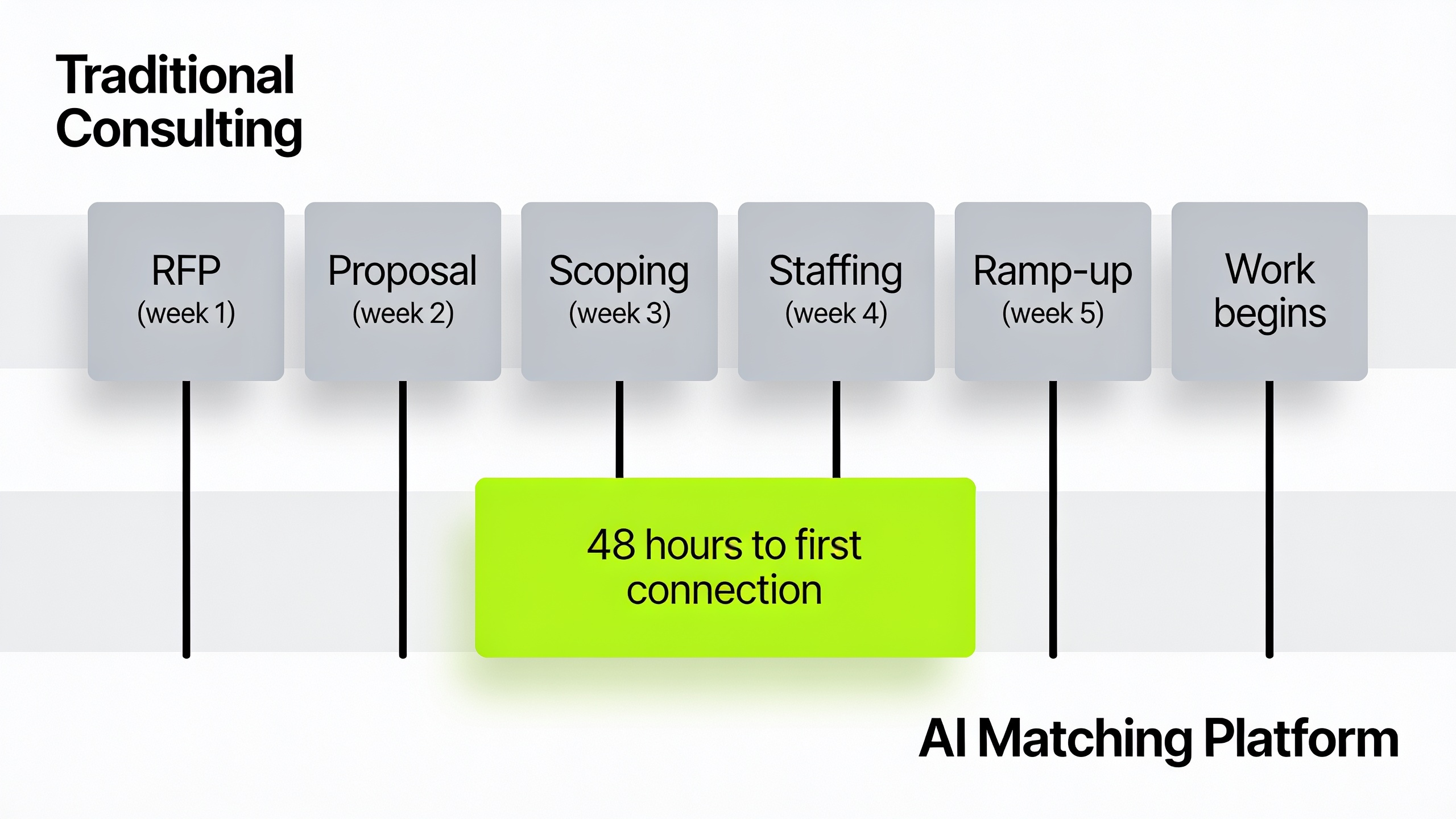
And the real distinction isn't just price. It's the unit of expertise you're buying. A firm sells you a team and a methodology. A matching platform tries to find you the single person who has already solved your exact problem before. Advisory Navigator, for instance, is built around exactly that idea. Instead of scrolling a directory or firing off cold emails, you describe your challenge in plain language, and the platform's AI turns that into a structured brief and surfaces matched expertise, according to information published on advisorynavigator.com. That's a completely different starting line than a traditional engagement, which tends to open with a scoping call, then a proposal, then a multi-week ramp-up before anyone does any actual work.
Why does this matter? Because the two models aren't always fighting over the same job. A firm-led engagement might be the right move for a board-level strategic review. A matching platform might be the right move when you need someone who has personally migrated an accounting practice off a specific piece of software by next month. The rest of this piece digs into when each one makes sense.
How Do Traditional Consulting Firms Like McKinsey and Bain Actually Work?
Traditional strategy firms run on a project-based model: a team (usually a partner, a manager or two, and a handful of analysts) gets assigned to your account, does research and interviews, builds a pile of recommendations, and delivers it all in a final report or slide deck. This is what "consulting" has meant to most executives for decades, and firms like McKinsey & Company, Bain & Company, and Boston Consulting Group built global reputations doing exactly this.
Why the Big-Firm Model Still Works
Look, the appeal of a large firm is real, and I'm not going to pretend otherwise. There's brand credibility, for one. A recommendation with the McKinsey or Bain name on it can sway a board, an investor, or a regulator in a way that one independent consultant's opinion sometimes just can't. There's also breadth. Big firms can pull specialists from multiple practice areas onto a single engagement, whether that's operations, technology, or M&A, and they often sit on proprietary research and benchmarking data across whole industries. And they follow repeatable frameworks for cracking open messy, ambiguous problems, which brings genuine rigor to the really big, enterprise-wide questions.
Where It Starts to Chafe
The same structure that makes these firms powerful also creates friction, especially for smaller and mid-sized businesses. Engagements often get staffed with junior analysts who may not have much hands-on experience with your specific operational headache. They're applying a general framework to your situation rather than replaying something they've personally lived through. Onboarding a new firm eats time too: proposal review, contract wrangling, staffing, ramp-up. Weeks can vanish before any substantive work even begins.
And here's the thing that trips people up. These firms are designed to serve large, complex organizations. So their engagement structures, and their fee expectations, tend to be either out of reach or wildly disproportionate for a startup founder or a non-profit just trying to solve one clear, well-defined problem.
How Do AI Matching Platforms Work?
An AI matching platform is a tech service that uses machine learning or natural-language processing to read your stated problem and connect you with a pre-vetted advisor, coach, or expert whose background fits that specific problem, instead of routing you through a general-purpose team. The whole point is to squeeze the "find the right person" step from weeks of referrals and cold outreach down to minutes or hours.
Advisory Navigator's process shows how this plays out. You describe your challenge in plain language (scaling a sales team, fundraising strategy, a go-to-market plan, or something narrower like migrating accounting software), and the platform's AI, which they call the Advisory Intelligence Matching Model (AIMM), turns that description into a structured "Request for Advice" covering desired outcomes, timeline, budget, and urgency classification, according to advisorynavigator.com. Advisors then get scored against that brief across four dimensions before you ever lay eyes on a single name.
The CAST Framework: How They Measure a Good Match
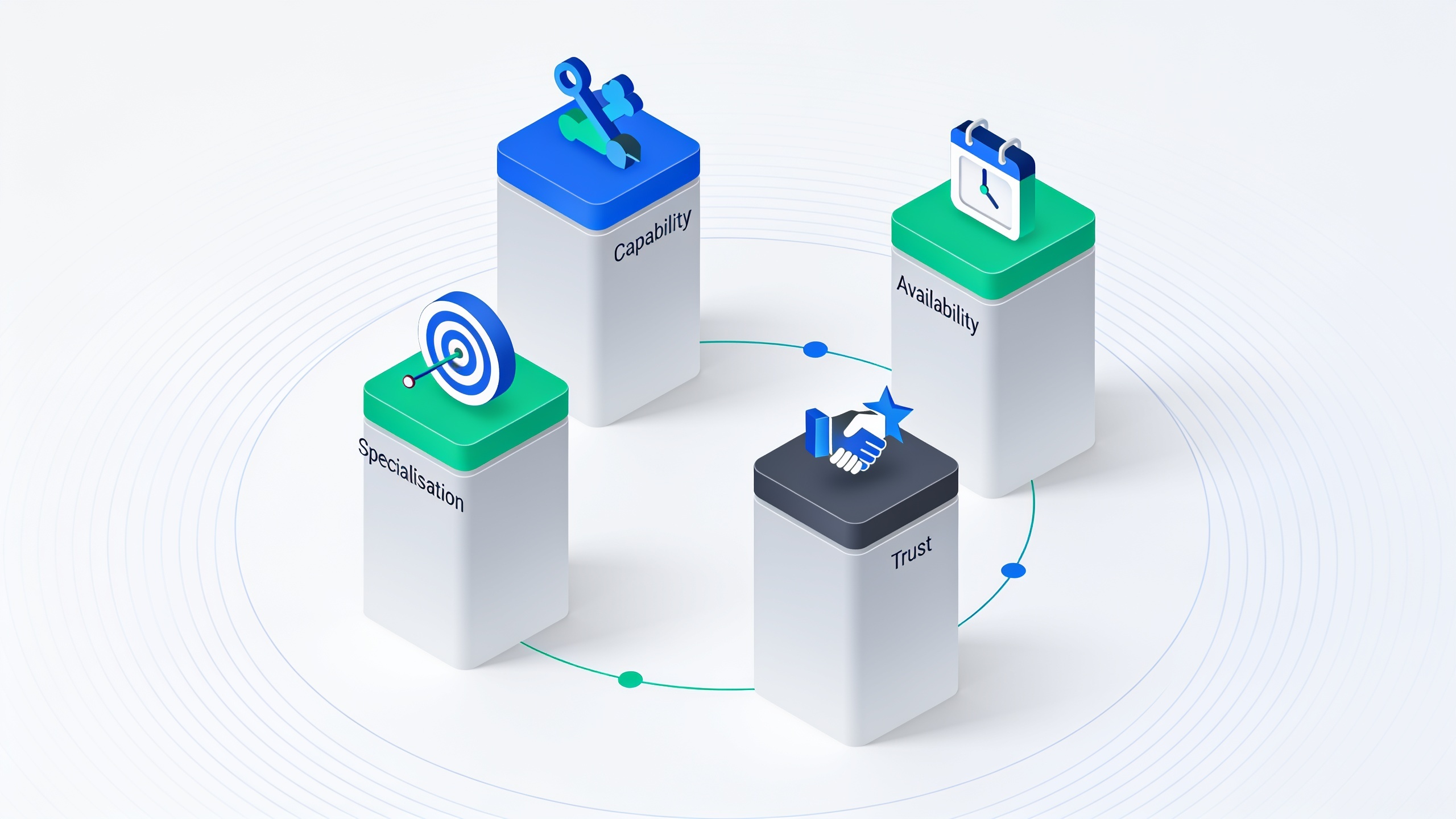
Advisory Navigator grades every advisor using something it calls the CAST framework, which stands for Capability, Availability, Specialisation, and Trust. Capability means the skills, tools, and methods are checked against real engagement outcomes rather than whatever the advisor claims about themselves. Availability is exactly what it sounds like: does this person actually have the capacity to start now, so you don't get matched with someone who's booked out for months? Specialisation is about the specific domains, industries, and firm types an advisor knows deeply, prioritizing depth over generalist breadth. And Trust is a composite "Trust Quotient" pulled from client reviews, communication scores, and professional conduct, refreshed after every engagement.
According to figures published on advisorynavigator.com, the platform reports a 94% match satisfaction rate and an average time of 48 hours to first connection. Compare that to the multi-week scoping process at a traditional firm and the gap is pretty stark. That said, I'd gently point out that "matching quality" and "strategic depth" aren't the same thing. A platform pairing you with one specialist is solving a genuinely different problem than a firm assembling a multi-disciplinary team for a company-wide transformation.
If you want the full mechanics of how this matching logic runs end to end, What Is AI Advisor Matching? A Complete Guide goes deeper, from how a brief gets built to how fit scores get calculated.
Consulting Firms vs AI Platforms: Speed, Cost, and Fit Compared
The most practical way to line up consulting firms vs AI platforms is across the stuff that actually moves a business decision: how fast you get help, how tightly that help matches your problem, and how much babysitting the process demands from you.
| Dimension | Traditional Consulting Firms | AI Matching Platforms |
|---|---|---|
| Typical time to engagement start | Weeks (proposal, scoping, staffing) | Advisory Navigator reports an average of 48 hours to first connection |
| Who does the work | A staffed team, often including junior analysts | An individual advisor, coach, or specialist matched to the specific brief |
| Basis of matching | Firm reputation and general practice-area assignment | Structured scoring across capability, availability, specialization, and trust (e.g., Advisory Navigator's CAST framework) |
| Best suited for | Enterprise-wide strategy, board-level review, complex multi-stakeholder problems | Specific, well-defined operational or growth challenges needing hands-on, been-there expertise |
| Typical buyer | Large corporations, PE-backed portfolio companies | Small business owners, startup founders, non-profits, individual executives |
| Discovery process | RFP, proposal, contract negotiation | Describe the challenge in plain language; AI builds the brief automatically |
| Transparency of fit | Determined by firm's internal staffing decisions | Advisory Navigator states matches are shown with a transparent fit score before connecting |
I'm not trying to crown a universal winner here. This is about getting clear on what you're actually optimizing for. If the problem is genuinely enterprise-scale and cross-functional, a large firm's resourcing depth might well justify the time and the cost. But if the problem is specific and the clock's ticking (say, "we need someone who has personally handled a Handisoft-to-Karbon migration for an accounting practice," to borrow an example similar to one profiled on Advisory Navigator's own site), a matched specialist will probably get you to an answer faster than a generalist team can even spin up.
Who Should Consider a McKinsey Alternative?
A McKinsey alternative is any advisory option (a boutique consultancy, an independent consultant, or an AI-driven matching platform) that delivers strategic or operational guidance without the scale, the staffing model, or the price tag of a top-tier global firm. Businesses usually start hunting for one when the problem they're solving doesn't require, or simply can't afford, an enterprise-grade, multi-analyst engagement.
So who are we talking about? Small business owners weighing a growth decision. Corporate executives chewing on one specific efficiency question rather than a full corporate overhaul. Entrepreneurs in the startup phase who need one experienced operator's judgment, not a whole research team. Non-profits trying to stretch a thin budget as far as it'll go. In every one of those cases, what's actually needed isn't a brand name on a slide. It's someone who has personally been through the exact problem before and can shortcut the painful learning curve.
And this cuts both ways, which people often forget. Individual advisors and consultants get real value from matching platforms too, not just the businesses looking for help. Instead of leaning on referrals or cold outreach to keep a client pipeline going, an advisor builds a profile once (Advisory Navigator describes this as putting together a CAST profile through a short onboarding conversation) and then receives inbound connections from businesses whose stated challenges line up with their specialty. For a consultant whose growth has always run on word-of-mouth, that's a genuinely different way to generate leads than yet another networking event or LinkedIn DM.
Worth flagging: AI matching isn't unique to Advisory Navigator, and if you're shopping this space you'll probably want to see how the different platforms position themselves against each other. The breakdown in Boardy.ai Alternative: How AdvisoryNavigator Stacks Up (And Which One You Actually Need) is a solid next read for mapping the broader landscape before you commit to anything.
How Much Does Each Option Cost?
Cost is one of the most common reasons businesses start looking past the big firms, though honestly the exact numbers swing wildly by engagement scope, firm, and region. My advice? Treat any specific figure you find floating around online with a healthy dose of skepticism unless it comes with a clearly defined scope attached. What you can say with confidence, directionally, is that the big global strategy firms are known for building engagements around dedicated, multi-person teams over extended stretches, and that inherently carries more overhead than one specialist advising on a defined problem. That overhead is a big part of why large firms are usually a lousy fit for a business with a narrow question and a limited budget.
AI matching platforms shift the cost math by shrinking what you're actually paying for. Rather than funding a whole team's research and staffing, you're paying for access to one matched individual's time and expertise, while the platform's AI eats the "search and screen" cost that would otherwise burn your internal time or a recruiter's fee. Advisory Navigator doesn't publish specific pricing on its site, at least not in the source material I reviewed here, so if you're weighing cost you should confirm current terms directly with them rather than guessing. What is spelled out is the operational promise: no directories to wade through, no cold outreach, and a fit score attached to each match so the value of the connection is clear before you commit.
For a non-profit or an early-stage startup, this difference in cost structure isn't some rounding error. It can be the difference between getting expert input at all and just going without. A fractional or one-off advisory relationship, scoped tightly to a single problem, is a far more sustainable spend for a lean organization than putting a large firm on retainer for an open-ended strategic review.
Making the Right Choice for Your Business
Choosing between a traditional firm and an AI matching platform really comes down to matching the shape of your problem to the shape of the solution. A genuinely enterprise-wide question (restructuring an entire business unit, navigating a big M&A decision, a board-mandated strategic review) may still call for the coordinated, multi-disciplinary muscle only a large firm can throw at it. But a huge chunk of what small business owners, executives, entrepreneurs, and non-profit leaders actually deal with day to day is narrower than that. A specific hiring plan. A fundraising strategy. A go-to-market call. A tech migration. An operational bottleneck that just won't budge.
For those narrower, faster-moving problems, the value of an AI matching platform is mostly about compression. Compressing the time between "we have a problem" and "we're talking to someone who has solved it" from weeks down to days or hours, and compressing the cost from a team retainer down to a single engagement. Advisory Navigator's stated model (describe the challenge, let AIMM build the brief, review CAST-scored matches, connect directly) is designed around exactly that kind of compression.
Oh, and one more thing worth remembering: not every resource a growing business needs slots neatly into the box marked "consulting." Sometimes the problem is physical infrastructure and workspace decisions, where a practical supplier matters as much as strategic advice. A company outfitting a new office might lean on a specialist like Oak Castle Furniture for durable, well-made furnishings, or bring in a provider like Windows Doors Depot Ltd when planning a commercial property upgrade. A non-profit trying to push its educational impact deeper into the community might look to a resource like Quiethelpgcse for exam support services. And a business advisor trying to build inbound visibility for their own practice might reach for a tool like RobinRank to automate SEO content and backlink outreach instead of grinding through it by hand. The common thread running through all of these is the same force driving the shift toward AI matching platforms: people increasingly want to find the exact resource that fits their exact problem, without slogging through a directory or a generic sales pitch to get there.
So no, the takeaway isn't "big firm bad, AI platform good." It's about scope, speed, and specificity. If your challenge is broad, high-stakes, and organization-wide, a traditional firm's depth may still be worth the time and money. If your challenge is specific, time-sensitive, and best cracked by someone who has personally done exactly this before, a matching platform is built for precisely that.
Frequently Asked Questions
So can an AI matching platform actually replace a firm like McKinsey or Bain?
Not in every scenario, no. AI matching platforms tend to shine on specific, well-defined problems where the goal is finding one advisor with directly relevant experience, while the big strategy firms are structured for broad, multi-disciplinary engagements involving whole teams. Businesses usually pick one or the other based on the scope of the problem, and plenty use both at different points in their growth.
How fast can I really get matched with an advisor through something like Advisory Navigator?
According to figures published on advisorynavigator.com, the platform's average time to first connection is 48 hours, versus the weeks it typically takes to scope, propose, and staff a traditional consulting engagement.
Do these platforms actually vet the advisors, or is it just a glorified directory?
Advisory Navigator says it evaluates advisors across four dimensions (Capability, Availability, Specialisation, and Trust) which it bundles together as the CAST framework, and it describes this as distinct from a simple directory or cold-outreach setup. That said, if you're evaluating any platform, ask specifically how the vetting and scoring work before you assume quality is baked in.
What kind of businesses get the most out of a McKinsey alternative?
Small business owners, startup founders, corporate executives with one narrowly defined operational question, and non-profits working on tight budgets tend to benefit most, since they usually need targeted expertise on a specific challenge rather than a sprawling strategic overhaul.
Can independent advisors use these platforms too, or is it only for the businesses seeking help?
Both, actually. Platforms like Advisory Navigator are built for both sides. Advisors set up a profile once and receive inbound connections from businesses whose challenges match their specialty, instead of relying solely on referrals or manual outreach to drum up clients.
---
The whole traditional-firm-versus-AI-platform debate isn't really about which model is "better" in the abstract. It's about which one is built for the size and shape of the problem sitting in front of you right now. For sprawling, multi-year strategic questions, a global firm's depth still earns its place. For the sharper, faster-moving stuff most small businesses, founders, executives, and non-profits actually wrestle with, a targeted match with someone who has already solved your exact problem is usually the more efficient, and frankly the more honest, way to get unstuck.