
Table of Contents
- What Is Advisor Matching, and Why Do Businesses Need It Now?
- How to Use AdvisoryNavigator: The Advisor Matching Walkthrough in Three Steps
- What Is the CAST Framework, and How Does It Score Every Match?
- Advisor Matching Walkthrough: Traditional Referrals vs. AI-Powered Matching
- How Long Does the Advisor Matching Process Take?
- What Happens After You're Matched With an Advisor?
- Who Uses AdvisoryNavigator, and How Does the Walkthrough Change by Audience?
- Frequently Asked Questions About the Advisor Matching Walkthrough
What Is Advisor Matching, and Why Do Businesses Need It Now?
Advisor matching is the process of connecting a business with a consultant, coach, mentor, or fractional expert whose actual skills line up with a specific, stated problem, instead of dumping you into a broad bucket like "business consultant" or "growth coach." And the reason it matters right now is pretty simple. Business problems have gotten weirdly specific. A Handisoft-to-Karbon migration. A Series A go-to-market plan. A nonprofit impact-measurement overhaul. Meanwhile, most ways of finding advisors have stayed frustratingly generic.
Referrals and directories both dump the filtering work squarely on you. You explain your problem to a friend, they toss out three names, and now you've signed yourself up for two weeks of discovery calls just to figure out which one of those three has ever done the thing you need. Directories might be worse, honestly. You're basically matching keywords in a bio against keywords in your head, with zero verification that some advisor's "20 years of experience" has anything to do with your situation. Plenty of founders and operators end up grinding through this manual research the same way they'd skim an industry outlet like Newsrum for trend signals, piecing together scraps and hoping a pattern shows up, instead of just getting a straight answer.
AdvisoryNavigator was built to yank that manual filtering step out entirely. Instead of browsing profiles, you describe your challenge in plain language, and the platform's AI (it's called AIMM, for Advisory Intelligence Matching Model) builds a structured brief and scores available advisors against it before you ever lay eyes on a single result. Per AdvisoryNavigator's own platform data, this shakes out to a 94% match satisfaction rate and an average time to first connection of 48 hours. That's a real shift from the weeks that referral hunts usually eat up.
How to Use AdvisoryNavigator: The Advisor Matching Walkthrough in Three Steps
The core walkthrough on AdvisoryNavigator runs in three steps: describe your challenge, let AIMM build your brief, and meet your match. No multi-page forms. No tick-box questionnaires. No cold outreach. The whole thing is built to take you from a written problem statement to a scored shortlist of advisors in one sitting.
Step 1 — Describe Your Challenge in Plain Language
It kicks off with a single open text field: "Tell us what challenge you're trying to solve." And that's on purpose. Instead of forcing you to pick from a dropdown of pre-baked categories, AdvisoryNavigator wants you to write the way you'd explain the problem to a colleague over coffee. Your industry, your stage, what kind of help you're actually after.
The platform throws out a few example request types just to show the range: scaling a sales team, building a fundraising strategy, putting together a go-to-market plan. But you're not boxed in by those. Maybe you're a small business owner trying to figure out why your margins keep quietly shrinking. Maybe you're a corporate exec looking to tighten up operations, or a nonprofit director trying to prove measurable impact to a funder. Same instruction either way: get specific about context and let the system handle the categorizing.
This step matters way more than it looks. Everything downstream, the brief, the scoring, the shortlist, hangs on how much real detail you cram into this first description. "I need help growing my business" gives AIMM almost nothing. Something like "I run a 12-person accounting practice migrating from Handisoft to Karbon and need someone who's done this exact migration before"? Now we're cooking.
Step 2 — Your Brief Is Built Instantly
Once you hit submit, AIMM takes your plain-language description and turns it into what AdvisoryNavigator calls a structured Request for Advice. It pulls out your context, industry, urgency, and scope automatically. No extra tick-boxes on your end.
That Request for Advice ends up including desired outcomes, an estimated timeline, a budget range, and an urgency rating, all inferred from how you described things. This is the part that does the heavy lifting the old way never could. It takes something as narrow as "migrating from Handisoft" and treats it as a precise match signal rather than a fuzzy keyword, using domain taxonomy extraction to pin down the exact specialist subdomain you need. AIMM also maps your brief to standardized industry classifications, NAICS codes included, so the advisors it surfaces later are actually sector-relevant instead of generalists padded out to look like a fit. If you want the technical nuts and bolts of this stage, AdvisoryNavigator's own breakdown of how advisor matching works inside its process walks through exactly how AIMM turns messy text into a scoring-ready brief.
Step 3 — Meet Your Match
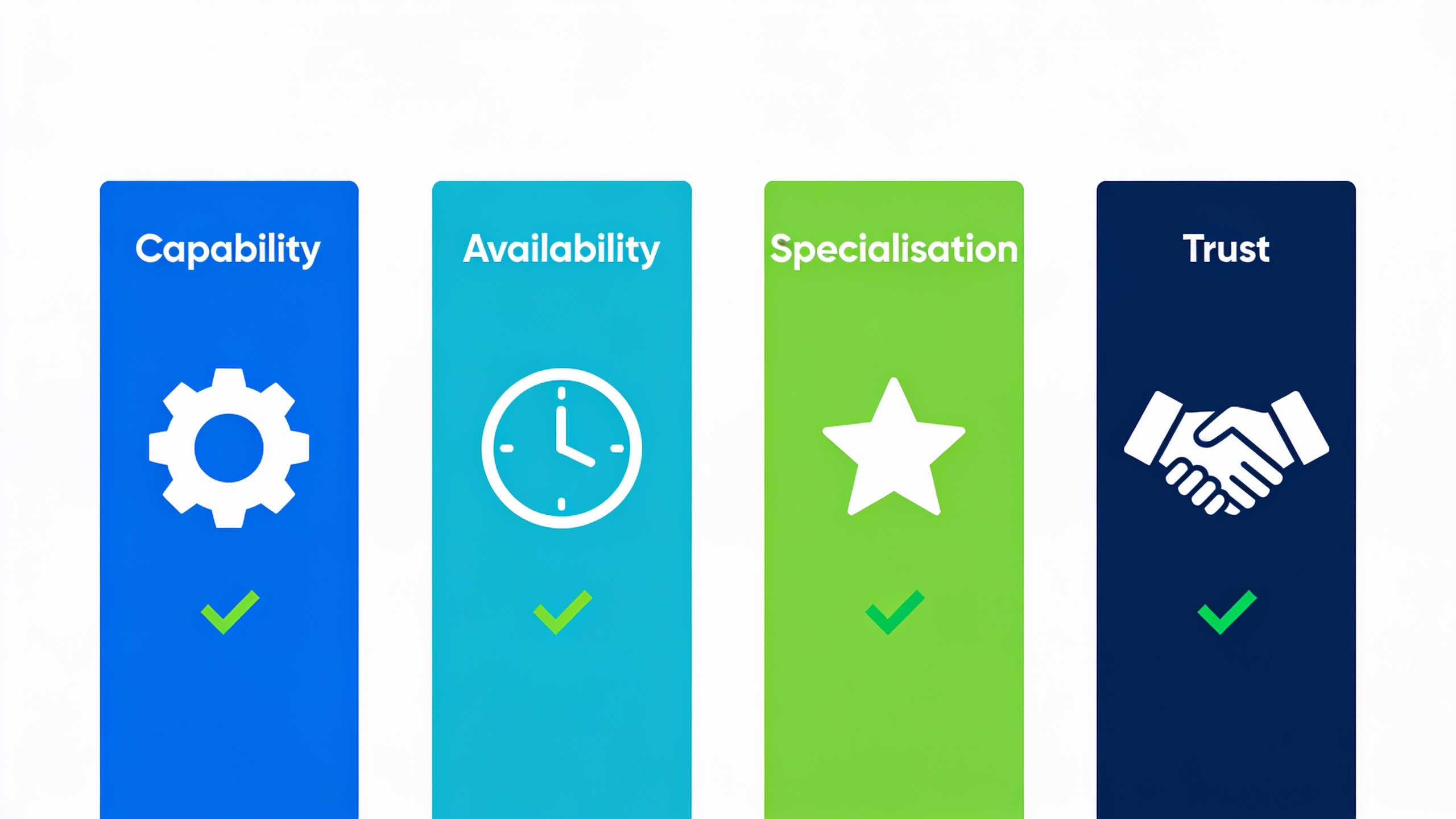
With the brief built, AdvisoryNavigator scores every eligible advisor against it across four dimensions: Capability, Availability, Specialisation, and Trust. Together those make up the CAST framework, which I'll get into properly in the next section. Then you see who fits, plus a clear explanation of why, before you connect with anyone.
This is where the "search to solution" thing actually pays off. You're not handed ten names to vet one by one. You get a ranked, scored set of matches, and you pick who to talk to based on visible fit instead of a gut feeling. No directories. No cold messages. The connection happens because the system already did the filtering grunt work that used to be your job.
What Is the CAST Framework, and How Does It Score Every Match?
The CAST framework is the scoring system AdvisoryNavigator runs every advisor through, across four dimensions: Capability, Availability, Specialisation, and Trust. Instead of one vague "rating," each advisor carries a composite score built from those four, so you can see not just that someone's a match, but exactly why.
Here's what each one actually measures. Capability reflects skills, tools, and methods verified against real engagement outcomes, not whatever somebody typed into their resume or LinkedIn summary. Availability checks whether the advisor genuinely has room to take you on right now. The platform is upfront that it won't surface matches with people who can't start for months, which, thank god. Specialisation captures the domains, industries, and firm types an advisor knows cold, on the logic that depth beats breadth when your problem is narrow and specific. And Trust is a composite "Trust Quotient" pulled from client reviews, communication scores, and professional conduct, and it updates after every engagement instead of being a static badge someone earned once and coasts on.
Here's a real example of how it looks. Take Marcus Webb, an accounting practice technology and migration specialist with 12 years of experience listed on the platform. He carries a Trust Quotient of 72.2 and a specialization list covering practice management, Handisoft migration, platform selection, change management, and go-live planning across firms running Handisoft, MYOB Practice, Karbon, and XPM. That kind of specificity, versus a lazy "business consultant" label, is exactly what CAST is designed to surface for everyone on the platform.
And because Trust Quotient scores are visible to matched requestors and get updated continuously, the framework behaves less like a dusty credential and more like a live read on how an advisor is actually performing lately. That's a genuine difference from directories, where a five-star badge from three years ago might mean absolutely nothing today.
Advisor Matching Walkthrough: Traditional Referrals vs. AI-Powered Matching
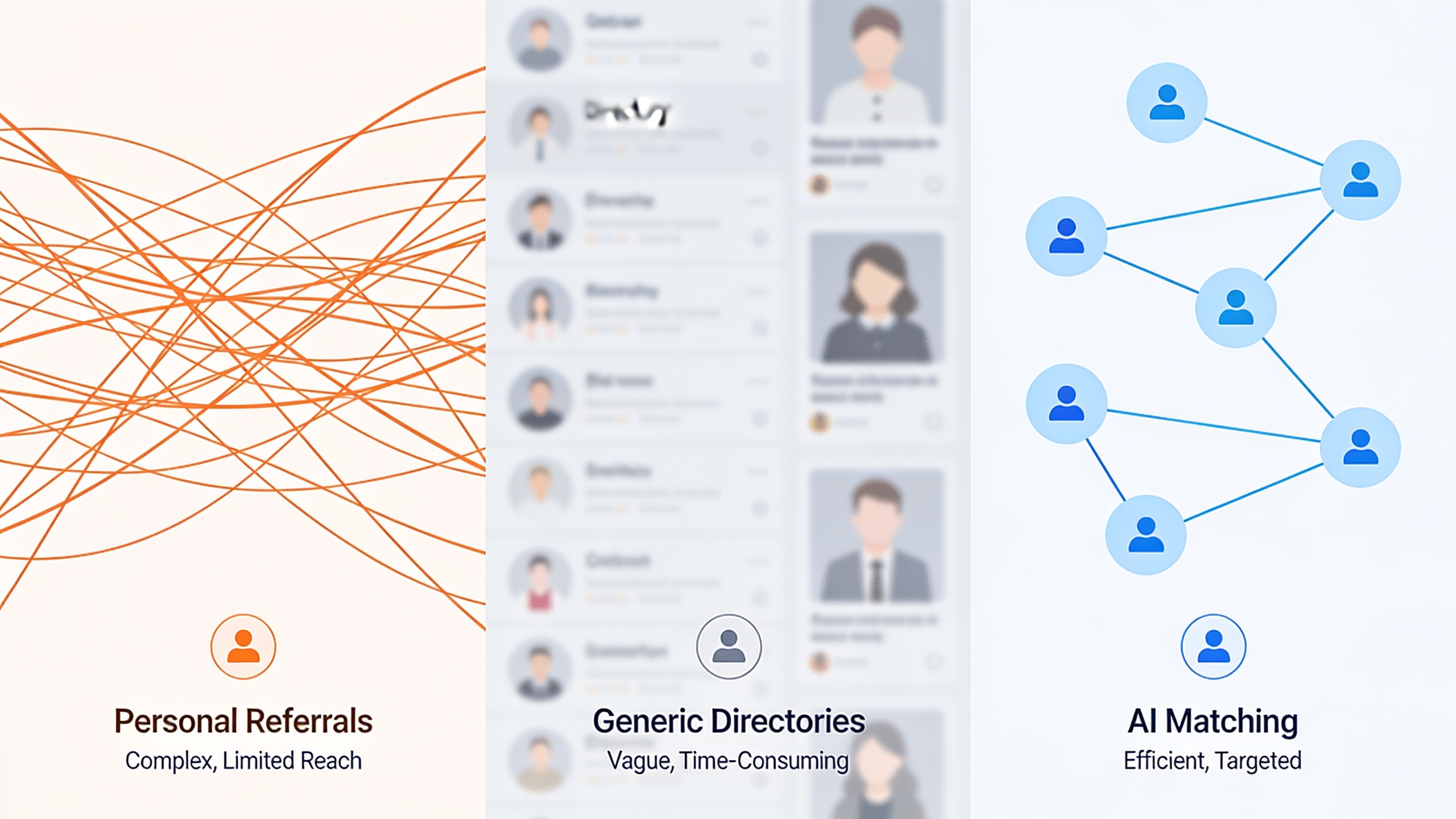
Honestly, the clearest way to see what AdvisoryNavigator's walkthrough changes is to line it up against the two alternatives businesses lean on today: personal referrals and static directories.
| Factor | Personal Referrals | Directory Listings | AdvisoryNavigator Walkthrough |
|---|---|---|---|
| Time to first connection | Days to weeks, depending on network | Hours to browse, but no guarantee of fit | Averages 48 hours to first connection (per platform data) |
| Fit verification | Based on trust in the referrer's judgment | Self-reported bios and keyword search | Scored across Capability, Availability, Specialisation, Trust (CAST) |
| Specificity of matching | Depends on how well the referrer understands your problem | Often generalist categories (e.g., "business consultant") | Domain taxonomy extraction from your own description (e.g., specific software migrations) |
| Availability check | Not verified until you reach out | Not verified until you reach out | Built into the CAST score before you see the match |
| Outreach effort required | High — you contact and vet each suggestion | High — you browse, shortlist, and cold-message | Low — AIMM builds the brief and surfaces scored matches automatically |
| Transparency of "why this match" | Informal, based on the referrer's reasoning | Minimal — often just filtered search results | Explicit fit score shown before you connect |
Now, this isn't the only AI-driven approach to advisor matching floating around. Some folks comparing platforms have also kicked the tires on tools like Boardy.ai. If you're stuck deciding between AI matching platforms rather than between AI matching and old-school referrals, this look at how AdvisoryNavigator stacks up against Boardy.ai as an alternative is worth a read.
How Long Does the Advisor Matching Process Take?
The advisor matching process on AdvisoryNavigator averages 48 hours from submitting your challenge to your first connection with a matched advisor, going by the platform's own reported metrics. Worth being clear: that's the average across the three-step flow (describe the challenge, let AIMM build the Request for Advice, review the CAST-scored matches), not a guaranteed turnaround stamped on every single request.
A few things probably nudge that timing around, even though AdvisoryNavigator doesn't publish a detailed breakdown. The specificity of your initial description is the obvious one. A rich, detailed brief hands AIMM way more signal to pull industry, urgency, and specialization from right away, while a vague one leaves it doing more guesswork. How narrow your ask is matters too. If you need someone with a very particular technical specialization (say, one specific software migration), you're drawing from a smaller pool than a broad "help me with growth strategy" request, and that can affect how many CAST-scored matches are sitting there waiting at any given moment.
One more thing worth flagging. AdvisoryNavigator has described its advisor-side onboarding as a pilot, capped at 100 seats at the time of writing. A limited advisor pool during a pilot is totally normal for an early-stage platform. But if you're timing an advisor search against a hard deadline, it's relevant context. I'd confirm current availability directly on the platform rather than assuming that pilot capacity stays wide open forever.
What Happens After You're Matched With an Advisor?
Once you're matched, you connect with the advisor directly. No middleman, no cold outreach, no directory to go dig through afterward. The platform's whole design principle, repeated throughout the walkthrough, is "no directories or cold outreach," and it holds at the connection stage too. Match gets scored, gets shown to you, and the next move is a direct request to connect. That's it.
This is where the CAST score stops being interesting trivia and becomes genuinely useful. Because you can already see the advisor's Capability, Availability, Specialisation, and Trust scores before you reach out, that first conversation starts from a much better place than a cold referral call ever would. You already know the person has verified specialization in your exact problem area and actual current availability. Those are two things that normally eat up an entire discovery call to nail down in a referral scenario.
For advisors on the other side, the logic just runs in reverse. Instead of chasing referrals or babysitting a static directory profile, an advisor builds a CAST profile once (it comes out of a short onboarding conversation) and then gets inbound connection requests from businesses whose briefs actually line up with their specialty. Their live Trust Quotient stays visible to every matched requestor, which quietly creates an incentive where reputation keeps getting reflected instead of frozen at signup.
Who Uses AdvisoryNavigator, and How Does the Walkthrough Change by Audience?
The core walkthrough (describe, brief, match) stays identical no matter who's using it. What changes is the content of the challenge description, depending on who's typing it in. AdvisoryNavigator serves a pretty wide range of business contexts, and it's the specificity of the brief that lets AIMM handle each one differently while running the exact same underlying process.
Take a small business owner in their late 30s or 40s chasing strategic growth. They might submit a challenge around scaling a sales team or breaking into a new market, and AIMM would map that against relevant NAICS codes and match it to advisors with proven specialization in that specific vertical, not just some grab-bag of "small business consultants." A corporate exec focused on operational efficiency is describing a totally different animal, maybe streamlining a supply chain process or restructuring a department, and the resulting brief would push advisors whose Capability scores show verified operations outcomes rather than strategy or fundraising.
Startup founders tend to submit briefs built around fundraising strategy or go-to-market planning (two of the platform's own listed "popular requests"), and they'd get matched with advisors whose Specialisation reflects early-stage experience specifically, not people who mostly work with mature enterprises. Nonprofits are their own distinct case. A brief describing a need for better impact measurement or funder reporting gets scored against advisors with nonprofit-sector specialization instead of generalist for-profit consultants, because CAST's Specialisation dimension is deliberately built around domain and firm-type depth, not just broad "experience."
And then there are the advisors themselves, the flip side of the same walkthrough. Rather than describing a challenge, an advisor builds a CAST profile through a short onboarding chat and starts receiving inbound match requests aligned to their specialty. Basically the walkthrough experienced in reverse, as the expert being matched rather than the business doing the matching.
Frequently Asked Questions About the Advisor Matching Walkthrough
Do I have to fill out some giant form to get matched?
Nope. The walkthrough starts with a single open-text field where you describe your challenge in plain language. AIMM pulls the structured details (industry, urgency, scope, timeline, budget) automatically, so there's no multi-page form or tick-box questionnaire waiting to torture you.
How does AdvisoryNavigator actually know which advisor is right for my problem?
Every advisor gets scored against your specific brief using the CAST framework: Capability, Availability, Specialisation, and Trust. AIMM also extracts domain-specific signals straight from your own description (a specific software migration, say, or an industry code) instead of leaning on generic keyword matching. That's the thing that separates this from scrolling a standard directory.
How long does it usually take to connect with a matched advisor?
Per AdvisoryNavigator's own reported data, the average time to first connection is 48 hours from when you submit your challenge. Real-world timing can swing depending on how specific your request is and how many advisors are currently available in your specialization.
Does it cost anything to use this as a business owner?
Specific pricing wasn't stated publicly on the pages reviewed for this walkthrough. If you need exact costs, check current details directly on advisorynavigator.com before you submit a request.
Can advisors join, or is this only for businesses looking for help?
Both. Advisors can build a CAST profile through a short onboarding conversation and then receive inbound connection requests from businesses whose briefs match their specialty. Just keep in mind AdvisoryNavigator has described its advisor onboarding as a pilot currently capped at 100 seats, so availability may be limited at any given time.
---
Whether you're a founder trying to un-stall a go-to-market motion, an exec hunting for operational wins, or a nonprofit leader trying to prove impact to a funder, the road from "I have a problem" to "I'm talking to someone who's already solved it" doesn't have to run through weeks of referral calls and directory scrolling. The walkthrough I've laid out here, describe, brief, match, is built to squeeze that road down into one transparent process where you can see exactly why a given advisor got suggested before you ever pick up the phone.