
So that's what this piece is really about. Eight of the problems that tend to melt away once the right person is finally in the room, plus how AI-driven matching (the kind Advisory Navigator runs on) swaps out the guesswork and awkward cold emails for something structured and actually scored.
Because here's what I keep noticing about stuck businesses: the problem usually isn't unsolvable. It's unmatched. The founder doesn't need "an advisor." She needs the one person who has personally dragged an accounting practice off Handisoft, or built three separate sales teams from five reps up to fifty, or walked a nonprofit through the whole gut-wrenching founder handoff. Big difference. And the expert matching examples scattered through this article are basically all variations on that one theme, what changes when specificity replaces vague advice.
Table of Contents
- What Does "Business Challenges Advisor Solutions" Actually Mean?
- How Does Expert Matching Solve Business Challenges Differently Than Traditional Consulting?
- Top 8 Business Challenges Solved Through Expert Matching
- Expert Matching Examples: Challenge, Advisor Type, and Focus Area
- How Long Does It Take to Get Matched With the Right Advisor?
- Choosing the Right Business Challenges Advisor Solutions for Your Stage
- Frequently Asked Questions
What Does "Business Challenges Advisor Solutions" Actually Mean?
Business challenges advisor solutions means taking a specific, clearly defined business problem and connecting it with an advisor, coach, mentor, or fractional expert whose actual track record lines up with that exact problem. Not hiring a jack-of-all-trades and crossing your fingers their broad experience somehow translates. And that distinction matters more than people think, because most businesses don't die from a shortage of advice. They die from a shortage of relevant advice, delivered too late, in language too generic to act on.
Think about how traditional advisory usually starts. Someone knows someone who "does strategy" or "is good with numbers." Sometimes that works out fine. But it's a low-precision system, honestly. It only works if your referrer happens to have a wide enough, current enough network to know the right person for this specific problem, at this specific stage, in this specific industry. That's a lot of coincidences to stack up.
AI matching tries to replace that whole referral chain with something structured. Advisory Navigator, for example, runs a model called AIMM (Advisory Intelligence Matching Model). You describe your challenge in plain English, and it converts that into a structured Request for Advice, desired outcomes, timeline, budget, urgency, the whole thing, before it ever surfaces a single advisor. The result is a quiet but important shift. You stop looking for "someone who does this kind of work" and start looking for "the person who has solved this exact problem before." That's the thread running through all eight challenges below.
How Does Expert Matching Solve Business Challenges Differently Than Traditional Consulting?
Expert matching works by scoring advisors against a structured brief across several dimensions, instead of leaning on a slick bio, a sales pitch, or a friend-of-a-friend intro, so you don't just see who's available. You see why they fit. That's the line between a real matching platform and just Googling "business consultant near me" and hoping.
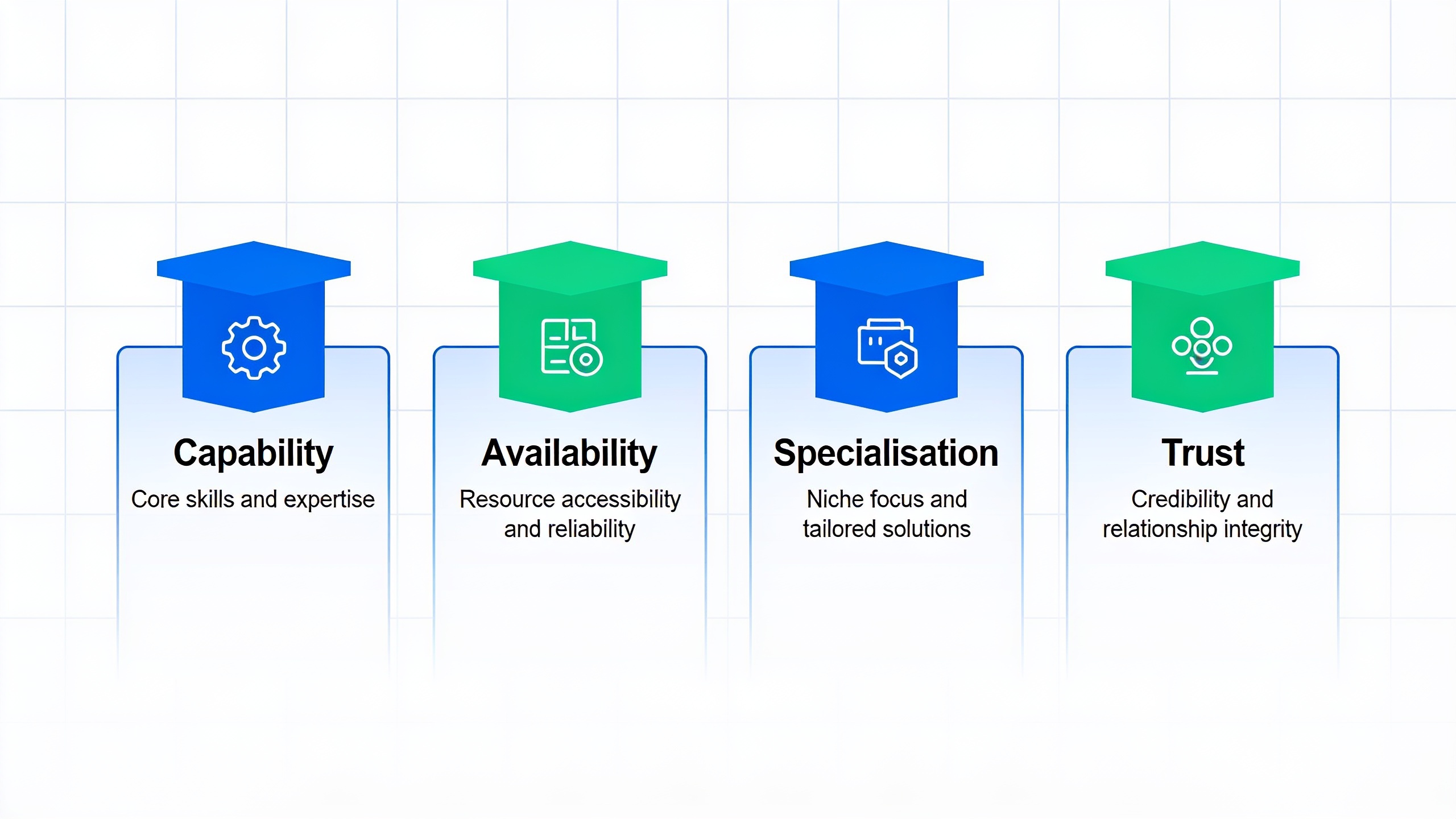
Advisory Navigator's version of this, which they lay out in more detail in How Advisor Matching Works: Inside AdvisoryNavigator's Process for Connecting You With the Right Expert, runs every advisor through what they call the CAST framework. Capability, Availability, Specialisation, Trust. Capability gets measured against verified engagement outcomes, not whatever the advisor decided to claim about themselves. Availability quietly filters out the people who look incredible on paper but can't actually start for three months. Specialisation is the depth stuff, accounting practice migrations, SaaS go-to-market, nonprofit board restructuring, rather than broad generalist experience. And Trust is a composite pulled from client reviews, communication ratings, and professional conduct, refreshed after every single engagement.
Underneath all that sits a step I find genuinely clever. The platform maps your brief to standardized industry codes (NAICS) to find sector-relevant people, and it pulls specialist subdomains straight out of your own words. So when you type "migrating from Handisoft," that becomes a precise match signal instead of getting lost in some vague "accounting help" bucket. Per Advisory Navigator's own published figures, this whole process delivers a 94% match satisfaction rate and an average time to first connection of 48 hours. Keep those two numbers in your back pocket as we go, because they explain a lot about where this actually earns its keep.
Top 8 Business Challenges Solved Through Expert Matching
These eight are the ones people ask for most when they finally sit down and describe their problem in plain language. Here's the kind of specialist that tends to fix each one.
1. Scaling a Sales Team Without It Falling Apart
Scaling a sales team is one of the most-cited challenges founders bring to these platforms, and it shows up as a "popular request" for a painfully obvious reason. The stuff that worked beautifully with five reps just... stops working at fifteen. The advisor who actually solves this is usually someone who has personally built and run a sales org through that exact inflection point. They get quota design, territory splits, and the compensation restructuring that has to happen before you add headcount, not after everything's already on fire.
2. Fundraising Strategy and Investor Readiness
Fundraising keeps coming up because the skill set is so situational it barely transfers. Building a data room, framing a narrative for one specific type of investor, sorting out a cap table before you raise. A generalist coach can cheer you on. But an advisor who has actually closed a seed or Series A in your industry can tell you the exact objections investors are going to throw at you and how to head them off. This one leans hard on the Specialisation side of CAST, because fundraising advice that worked for a hardware startup rarely survives contact with a SaaS raise.
3. Building a Go-to-Market Plan From Scratch
Go-to-market planning lands third on the most-requested list, and I get why. Launching a product with no real plan for positioning, channels, and pricing is one of the most expensive mistakes an early company can make. The advisor you want here has usually launched something comparable into a comparable market. The value isn't marketing theory. It's pattern recognition from someone who's already run this exact launch motion and remembers where the bodies were buried.
4. Cash Flow and Financial Runway Management
Cash flow problems almost never introduce themselves as "cash flow problems." They show up as a missed payroll, a vendor payment you keep pushing back, or a founder lying awake doing runway math. The right fit here is usually a fractional CFO or an accounting specialist who has rebuilt financial models for businesses at a similar revenue stage. And because the brief captures urgency directly, this is one category where Availability really earns its spot in the scoring. A brilliant financial advisor who can't start for six weeks is useless to a business three weeks out from a payroll gap. Doesn't matter how good they are.
5. Leadership Transitions and Succession Planning
Leadership transitions, a founder stepping back, a key exec walking out, a family business handing the keys to the next generation, are messy in ways that are both emotional and operational. Which is exactly why generic advice faceplants here. The right match has usually lived through something comparable, whether that's an operator who scaled a company after the founder exited or a governance specialist who's rebuilt a leadership structure for a similar-sized org. This is where Trust, the fourth CAST piece, really matters, because a transition advisor is almost always sitting on sensitive, high-stakes information.
6. Technology and Practice Migration Projects
Not every challenge is some grand strategic thing. Some are stubbornly operational, like moving an entire practice from one software platform to another. Advisory Navigator's own advisor profiles show this off nicely. A specialist with a documented history in Handisoft migration, platform selection, and go-live planning for accounting firms is a level of specificity a plain "IT consultant" search would basically never cough up. If you're moving accounting practice management between MYOB Practice, Karbon, or XPM, you want someone whose Specialisation score reflects that transition. Not just general "I've done software implementations before" familiarity.
7. Hiring, Talent Structure, and Team Design
Hiring challenges run the full range, from writing the very first job description for a founding team all the way to redesigning a whole department's reporting lines. Advisors who live in this space bring real frameworks for role scoping, comp benchmarking, and interview design that generalists just tend not to have. And it's worth pointing out that fit-scoring tech isn't only running on the advisor side of things. On the candidate side, platforms like JobScans use the same basic logic, generating a compatibility score between someone's CV and a specific job posting so applicants in India can see where they genuinely fit before they apply. Same underlying idea driving advisor matching, really. Precise, structured fit-scoring beats a generic application, or a generic advisory relationship, every time.
8. Operational Efficiency and Growth Plateaus
The growth plateau might be the most common challenge of the bunch, and it's definitely the most misdiagnosed. Revenue that used to climb now just sits there, flat, and the founder can't quite put their finger on why. Fixing it usually takes an operational specialist who can audit workflows, pricing, and customer retention all at once rather than picking them off one at a time. There's a detailed account of exactly this in How One Small Business Owner Finally Broke Through Her Growth Plateau, which walks through how a structured advisor match, not another round of generic strategy sessions, ended up being the turning point.
Expert Matching Examples: Challenge, Advisor Type, and Focus Area
Here's the eight categories at a glance, with the type of advisor usually matched to each and the CAST dimension that tends to carry the most weight.
| Business Challenge | Typical Advisor Type | Primary CAST Dimension | Common Urgency Level |
|---|---|---|---|
| Scaling a sales team | Sales leadership / fractional VP of Sales | Capability | Medium |
| Fundraising strategy | Investor-side operator or former founder | Specialisation | High |
| Go-to-market planning | Product marketing / launch specialist | Specialisation | Medium |
| Cash flow management | Fractional CFO / accounting specialist | Availability | High |
| Leadership transitions | Governance or succession specialist | Trust | High |
| Technology/practice migration | Platform migration specialist | Capability | Medium |
| Hiring and team design | HR / organizational design advisor | Capability | Medium |
| Growth plateau / operations | Operational efficiency consultant | Specialisation | Low to Medium |

This isn't every problem advisor matching can touch, obviously. But it covers the categories owners describe most often when they put their problem into plain words, the same ones that keep popping up as popular requests on these platforms.
How Long Does It Take to Get Matched With the Right Advisor?
On platforms built around AI matching instead of manual referrals, the gap between describing your challenge and connecting with a scored match is measured in hours, not weeks. Advisory Navigator publishes an average time to first connection of 48 hours. Compare that to the old way: asking around your network, waiting for intros, then scheduling calls with two or three candidates before you commit. That routinely stretches into weeks.
And speed matters way more for some challenges than others. A cash crisis or a surprise leadership exit carries genuine time pressure, which is exactly why the "urgency classification" step in the brief exists. It routes those requests toward advisors verified as immediately available, not just the most credentialed name in a directory. For the lower-urgency stuff, like a long-term efficiency review, the priority swings back toward nailing the Specialisation match even if the search takes a bit longer.
But let me be honest about what "matched in 48 hours" does and doesn't promise. Fast matching means you're talking to a scored, relevant advisor quickly. It absolutely does not mean your problem is solved in two days. Fundraising, leadership transitions, migrations, these unfold over weeks or months, no way around it. The point of speed is that those weeks get spent working with the right person from day one, instead of burning the first month realizing you picked the wrong one.
Choosing the Right Business Challenges Advisor Solutions for Your Stage
The right solution depends way less on how big your business is and way more on the exact combo of industry, growth stage, and the specific nature of your problem. Which is exactly why a structured brief beats a lazy category like "startup" or "small business." A ten-person SaaS company raising a seed round and a fifteen-year-old accounting practice migrating software both technically count as "small business." They need wildly different specialists.
Small business owners, roughly the 30 to 50 crowd, usually show up with scaling and operational efficiency problems. The plateau I described earlier is a classic at this stage, where the model's clearly proven but nobody's cracked what breaks the ceiling. Corporate executives tend to frame things around efficiency at scale instead, restructuring a department, squeezing margins, running a leadership transition inside an org that already exists rather than building one from nothing. Entrepreneurs in the startup phase overwhelmingly ask for fundraising and go-to-market help, which tracks, since those two dominate the earliest and highest-stakes stretch of a company's life. Nonprofits bring their own distinct mix, governance, succession, impact measurement, and they need advisors with actual sector experience, not for-profit operators. The incentive structures, funding models, and stakeholder accountability are just genuinely different between those two worlds.
For advisors, by the way, the whole thing runs in reverse. Instead of chasing referrals or firing off cold emails, you build a structured profile, the kind that captures a documented specialty like "Handisoft migration" instead of a mushy "business consulting" label. Then the model surfaces you specifically when a business describes a problem that maps to what you've actually done.
Frequently Asked Questions
So what's the actual difference between an advisor, a coach, and a mentor here?
An advisor gives you specific, engagement-based expertise tied to a defined problem, fundraising strategy or a tech migration, say. A coach tends to work on an ongoing basis around leadership development or how you make decisions. A mentor is usually the informal, longer-term relationship with no defined scope at all. Platforms like Advisory Navigator are built to surface whichever one fits your challenge, because it's the underlying problem, not the job title, that decides which kind of expert you actually need.
How does AI matching even know which advisor fits my problem?
It converts your plain-language description into a structured brief, then scores available advisors against it across defined dimensions. Advisory Navigator's model, for instance, scores on Capability, Availability, Specialisation, and Trust, and maps your brief against standardized industry codes so it doesn't hand you a generalist for a problem that clearly needs sector-specific depth.
Can matching help with stuff that isn't purely financial or strategic, like a software migration?
Yep. Operational and technical challenges, like moving an accounting practice between platforms, get matched the same way as strategic ones, by finding an advisor whose documented specialization covers that exact transition rather than some general technology consultant who's "pretty comfortable with software."
Is this only useful for startups, or does it work for established businesses too?
Works across every stage. Startups bring fundraising and go-to-market challenges. Established small businesses lean more toward scaling and growth plateaus. Corporate executives bring efficiency and leadership transitions. But the logic never changes, specific problem, specific track record, regardless of how old or big the company is.
How fast can I realistically expect to connect with a matched advisor?
Going by Advisory Navigator's published figures, the average time to first connection is 48 hours from when you describe the challenge. The urgency classification in your initial brief helps push time-sensitive stuff, like a cash flow crisis, toward advisors verified as immediately available.
Business problems almost never sort themselves out on generic advice. And the companies that get unstuck fastest are, pretty consistently, the ones who find someone who's already solved their exact problem, not just someone with a related title on their LinkedIn. Whether it's a sales team that's stopped scaling, a cap table you need to fix before a raise, or a migration you've been quietly avoiding for a year, the pattern holds. Specificity, not credentials alone, is what turns advice into something that actually moves the needle.