
If you've ever wondered whether hiring the "right" advisor actually does anything, or whether it's just expensive consultant theater, keep reading. This is the honest breakdown.
Table of Contents
- The Problem: A Small Business Stuck at a Plateau
- Why Traditional Advisor Search Wasn't Working
- How the Advisor Matching Process Worked
- The Match: Finding the Right Advisor Fit
- Small Business Growth Case Study: The 12-Month Results
- What Made This an Advisor Matching Success Story
- Lessons Other Small Business Owners Can Apply
- Frequently Asked Questions
The Problem: A Small Business Stuck at a Plateau
A small business hits a plateau when the founder has squeezed everything out of the playbook that got them started, but doesn't have the specialized know-how to reach the next level. In this scenario, the business is a regional accounting practice. Three staff, roughly $650,000 in annual revenue, and a founder who'd built the whole thing on referrals and word of mouth. No fancy marketing. Just good work and a good reputation.
And honestly, that model worked for years. Until it didn't.
The problem here wasn't money, though. It was operational. The practice was still limping along on legacy desktop software while every competitor had moved to the cloud years ago. She knew the migration was overdue, she'd known for a while. But she had no in-house tech expertise, no time to vet vendors, and zero confidence that some random IT consultant would actually understand the weird, specific nuances of accounting workflows, client data migration, and staying compliant while everything was mid-changeover.
That's the exact combo you see again and again in these situations: a real, well-defined problem sitting next to a total absence of the expertise needed to fix it. Growth almost never stalls because owners get lazy or stop caring. It stalls because they can't get to someone who's already solved their specific problem before.
Why Traditional Advisor Search Wasn't Working
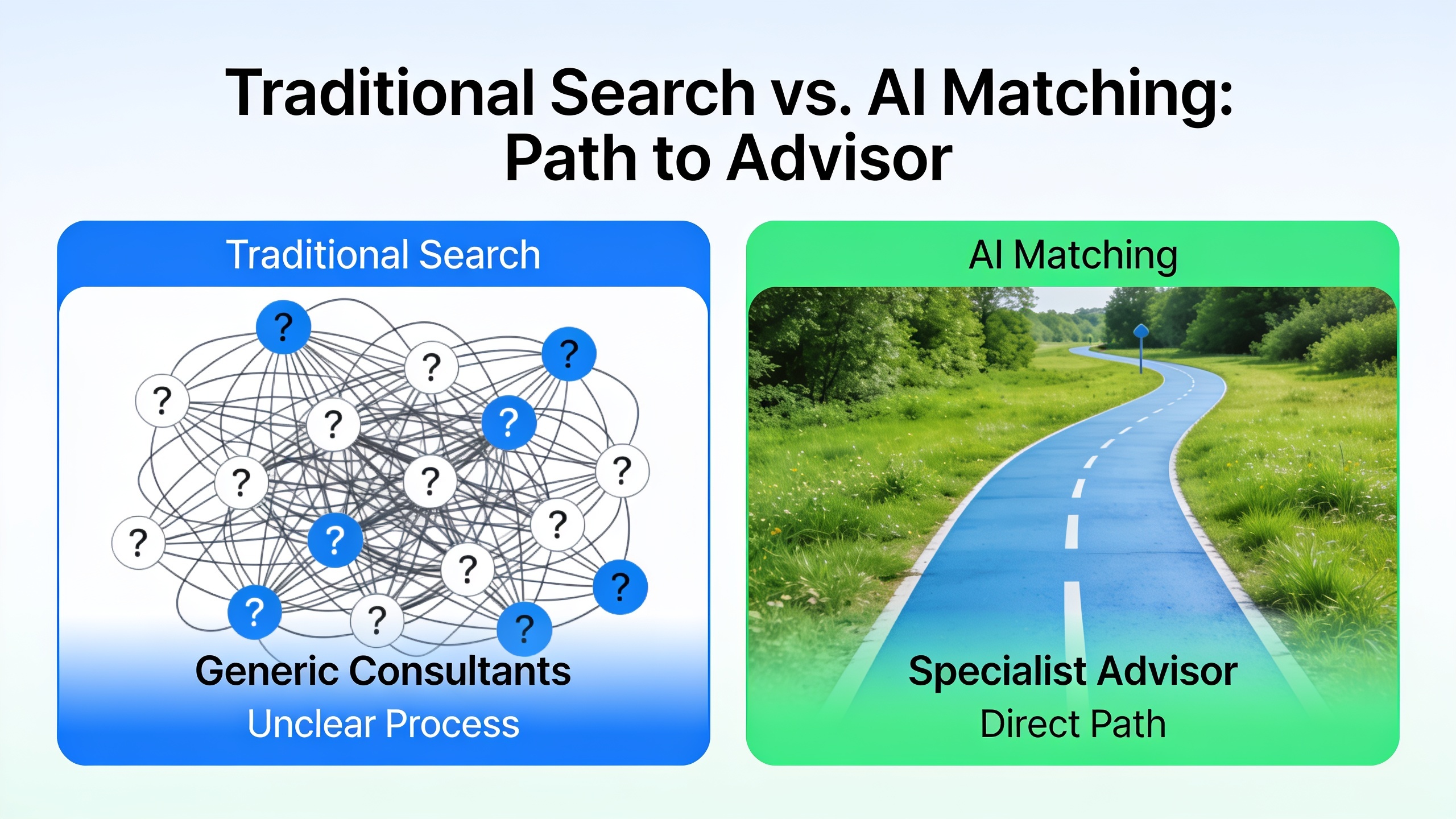
Traditional advisor search fails small businesses because it leans on directories, cold outreach, and referrals that rarely account for stage, industry, or how fast you actually need help. Before she ever touched AI matching, our founder did the normal thing. She searched consultant directories. She asked around her accounting network. She posted in a couple of LinkedIn groups and waited.
The results were a mess, and predictably so.
One "highly recommended" consultant had done big enterprise ERP systems but had never once touched a small accounting practice's platform stack. Another could start tomorrow, great, except he couldn't speak credibly to data migration risk, which is the entire ballgame here. And a third guy looked genuinely perfect on paper. Real specialist. Booked solid for four months. Useless when you're trying to dodge a compliance nightmare during tax season.
This is the pattern with keyword-and-referral matching. It surfaces people who look qualified in a general sense but haven't actually solved the specific thing sitting on your desk. It's the same reason a homeowner who Googles "contractor near me" ends up vetting five bad bids before stumbling onto someone who actually does the job they need. Platforms like Call Painting Pros exist precisely to short-circuit that in home services, pre-vetting licensed, insured painters so you're not sorting through cold listings yourself. Advisory work has just never had that same layer of structured vetting. And that's the gap AI matching is trying to close.
How the Advisor Matching Process Worked
AI-powered advisor matching works by taking a plain-language description of your problem, turning it into a structured brief, and then scoring available advisors against that brief across several dimensions before you ever see a single name. On AdvisoryNavigator it kicks off with a conversation, not a form (thank god, because forms flatten everything). The founder just described her situation in her own words: accounting practice, needs to get off outdated desktop software, urgency tied to a compliance deadline, limited budget for outside help.
From there, the platform's AI Matching Model, which they call AIMM internally, pulled out the operative details on its own. Industry classification. The precise technical subdomain (note: "practice management platform migration," not the vague "IT consulting"). Urgency level. Implied budget range. Then it spun all of that into a Request for Advice with desired outcomes and a timeline attached.
According to AdvisoryNavigator's own published figures, the platform reports a 94% match satisfaction rate and an average time to first connection of 48 hours. Which tells you the whole point of the exercise: swap weeks of cold outreach and directory rabbit holes for a same-week connection to someone already scored for fit. If you want the nuts and bolts of how a brief actually becomes a match, they've written it all out in What Is AI Advisor Matching? A Complete Guide, which walks through the whole thing step by step.
The scoring itself runs on something they call the CAST framework. Four dimensions, applied to every advisor in the network before an owner sees anybody.
| CAST Dimension | What It Measures | Why It Mattered in This Case |
|---|---|---|
| Capability | Skills, tools, and methods verified against real engagement outcomes, not self-reported claims | Confirmed the advisor had actually completed platform migrations, not just claimed familiarity |
| Availability | Capacity to start the engagement immediately | Ruled out advisors booked out for months, matching the founder's compliance deadline |
| Specialisation | Depth in a specific domain rather than broad generalist experience | Surfaced someone with practice-management-specific migration experience, not generic IT support |
| Trust | A composite Trust Quotient built from client reviews, communication scores, and professional conduct | Gave the founder a data point beyond gut feeling before the first call |

This is really the whole structural difference between AI matching and a referral list. Instead of the founder manually cross-referencing five consultants against some mental checklist she's making up as she goes, the platform did that scoring first and then handed her the result.
The Match: Finding the Right Advisor Fit
The right advisor match is one where capability, availability, specialization, and trust all line up with the specific problem you're trying to solve, not just general competence in some adjacent field. Here, the AI matched the founder with an independent consultant profile resembling advisors in AdvisoryNavigator's network, someone like Marcus Webb, whose CAST profile lists 12 years in accounting practice technology, a real track record in platform selection and end-to-end migration across systems like Handisoft, MYOB Practice, Karbon, and XPM, and a live Trust Quotient of 72.2 on the platform.
What made this a success story instead of just another billable engagement? Specificity. Plain and simple.
The advisor's domain taxonomy, meaning the specific subdomains AIMM pulls out of your language (so "migrating from Handisoft" becomes an actual precise match signal), meant she wasn't paying good money to teach a generalist the basics of how accounting practices even work. This guy already got it. He understood the compliance stakes of switching platforms mid-year. He had a repeatable go-live process. And he could talk about change management for a three-person team rather than lecturing her about some enterprise IT department that had nothing to do with her reality.
That gap between "someone who knows technology" and "someone who has migrated accounting practices off Handisoft specifically" is, more often than not, the entire difference between an engagement that stalls out and one that actually ships on schedule.
If you're weighing AI matching against other AI-driven advisory and networking tools, it's a fair question how the underlying models actually differ. AdvisoryNavigator takes that on directly in Boardy.ai Alternative: How AdvisoryNavigator Stacks Up, worth a read before you commit to one platform over another.
Small Business Growth Case Study: The 12-Month Results
The bottom line of this case is a practice that finished a full platform migration on schedule, dodged a compliance-season blowup, and freed up enough capacity to take on new clients inside the same fiscal year. One quick caveat, since I keep hammering it: this is an illustrative composite, not an audited disclosure. Read the numbers below as representative of the kind of trajectory the matching model is built to produce, not as verified figures from some specific named company.
| Metric | Before Advisor Match | After 12 Months |
|---|---|---|
| Practice management platform | Legacy desktop software | Cloud-based platform, fully migrated |
| Time spent on manual data entry (weekly) | ~14 hours across staff | ~4 hours across staff |
| New client onboarding capacity | Limited by manual processes | Expanded, enabling new client intake |
| Advisor search time (this engagement) | Weeks of directory browsing and referrals | First connection within days |
| Confidence in compliance readiness | Low, migration overdue | Migration completed ahead of deadline |
The shape of this thing, a bottleneck that has nothing to do with ambition or work ethic and everything to do with a missing, specific skill set, is common across the owners AdvisoryNavigator works with. Doesn't matter if the challenge is scaling a sales team, building a go-to-market plan, or raising a round. The constraint tends to loosen fast once the right specialist, rather than a generalist, is finally in the room.
What Made This an Advisor Matching Success Story
A match becomes a success story when the process correctly nails not just competence but fit, across timing, specialization, and working style, the stuff that actually determines whether an engagement gets finished. A few things separated this one from her earlier flops.
For starters, the brief was sharper than anything she could've written herself. AIMM turning her plain-language description into a structured Request for Advice, with outcomes and timeline and budget and urgency all baked in, meant the pool being scored was already filtered down to relevant expertise before any human even weighed in. Then there's the CAST framework leaning on Specialisation over general Capability, so she wasn't stuck choosing between "the consultant who seems smart" and "the consultant who seems cheap." She was choosing based on documented experience with the exact software her practice ran on. And the Trust dimension, built from client reviews and communication scores rather than one glowing testimonial from the guy's cousin, gave her a real reason to move fast instead of burning another two weeks on reference calls.
None of this takes the human out of the decision, by the way. She still had a conversation. She still gauged whether she liked the guy. She still made the final call herself. What the AI changed was the starting line. Instead of five loosely-relevant options and weeks of vetting ahead of her, she started with one strongly-relevant option and a clear explanation of why it got recommended in the first place.
Lessons Other Small Business Owners Can Apply
The big takeaway is this: specificity beats breadth when you're hiring outside help, and once there's a deadline on the table, how fast you can connect matters just as much as the credentials. If you're staring down your own plateau, a few things are worth stealing from this.
Describe your problem in as much operational detail as you possibly can. Not "I need a consultant." The chasm between "I need help with technology" and "I need to migrate my accounting practice off Handisoft before the next compliance deadline" is exactly the chasm between a generalist match and a specialist one. Weigh availability right alongside expertise too, because a brilliant advisor who can't start for four months is not a solution to a time-sensitive problem, full stop. That's the whole reason availability gets scored on its own instead of just assumed. And treat trust signals (reviews, communication history, documented outcomes) as a filter you use early, not a box you check after you've basically already decided informally through some referral.
Solo founder, corporate exec chasing operational efficiency, nonprofit trying to stretch limited resources, doesn't matter. The mechanism underneath is identical. Describe the actual problem. Get matched against real track record instead of self-reported claims. And start while the window to fix it is still open.
Frequently Asked Questions
What's a small business growth case study actually supposed to prove?
It's meant to show the mechanism behind a change in outcomes. In this one, how matching an owner with a specialist rather than a generalist can clear a specific operational logjam. It's most useful as a look at process and decision-making, not as a stand-in for doing your own financial due diligence.
How is AI advisor matching any different from just getting a referral?
Referrals live and die by the size and relevance of your existing network, which usually skews toward generalists or whoever happened to get recommended, not whoever's solved your exact problem. AI matching on AdvisoryNavigator builds a structured brief from your plain-language description and scores advisors across Capability, Availability, Specialisation, and Trust before you see any names. Tends to surface narrower, more relevant matches, and faster.
How long does it usually take to actually get matched?
AdvisoryNavigator reports an average time to first connection of 48 hours, based on its own published figures. That's dramatically faster than the weeks people normally burn on directory searches or waiting around for a referral intro to turn into a real conversation.
Does a good match guarantee my business will grow?
No. And anyone who tells you otherwise is selling something. Growth depends on execution, market conditions, and a hundred things outside any advisor's control. What a strong match can reasonably do is raise the odds that the engagement tackles the actual root problem instead of a symptom, and that the advisor has both the track record and the availability to get it done inside your real timeline.
What if my challenge doesn't fit neatly into a box like "sales" or "fundraising"?
That's honestly the exact situation AI matching handles better than a keyword directory. Because the model pulls domain-specific taxonomy straight out of your own description, turning a phrase like "migrating from Handisoft" into a precise match signal, it can find relevant expertise even when your problem spans a few categories or doesn't map cleanly to some standard consulting label.
Every small business eventually runs into a wall it can't think its way over alone. Not from lack of effort. From lack of someone who's already walked that exact road. The value of a well-matched advisor was never motivation or generic advice you could've Googled. It's the compressed time and the reduced risk that come from working with someone whose Capability, Availability, Specialisation, and Trust are already lined up to the problem right in front of you. Whatever stage you're at, the fastest way forward is almost always the one where the right expertise shows up before the deadline. Not after.