
So in this guide I'll walk through how the whole thing works, why it's different from the old-school consulting hunt, and why small business owners, founders, execs, and non-profit folks are ditching the guesswork-and-referrals routine for something a little smarter.
Table of Contents
- What Is AI Advisor Matching?
- How Does AI Advisor Matching Work?
- AI Advisor Matching vs. Traditional Consulting Search
- Why Businesses Are Adopting Business Advisor Technology
- What Are the Benefits of AI-Powered Advisor Matching?
- How Much Does AI Advisor Matching Cost?
- How to Choose the Right AI Advisor Matching Platform
- Frequently Asked Questions
What Is AI Advisor Matching?
AI advisor matching is a system that uses artificial intelligence to analyze your specific business challenge and automatically pair you with an advisor, mentor, or consultant whose track record actually fits your situation. Instead of you personally sifting through dozens of profiles or texting around for recommendations, the software does the grunt work. It cross-references what you're dealing with against a database of advisor expertise, industry background, past results, and even how somebody likes to communicate.
If you strip away the jargon, this is really just a supply-and-demand problem. It's the same basic idea behind hiring platforms matching candidates to jobs, or Netflix guessing what you want to watch next. The difference is what's on the line. Match with the wrong advisor and you've burned months of time plus thousands in retainer fees you'll never see again. Match with the right one, someone who's genuinely done this before, and you might blow past a growth plateau, fix a broken process, or dodge a hiring disaster that would've haunted you for a year.
Platforms built on this idea, like AdvisoryNavigator, let you describe your problem in plain English. Something like, "our churn rate jumped 12% after we changed pricing." From there, natural language processing figures out what's really going on underneath (pricing strategy and customer retention, in that example) and surfaces advisors who've actually wrestled with that exact thing.
How Does AI Advisor Matching Work?
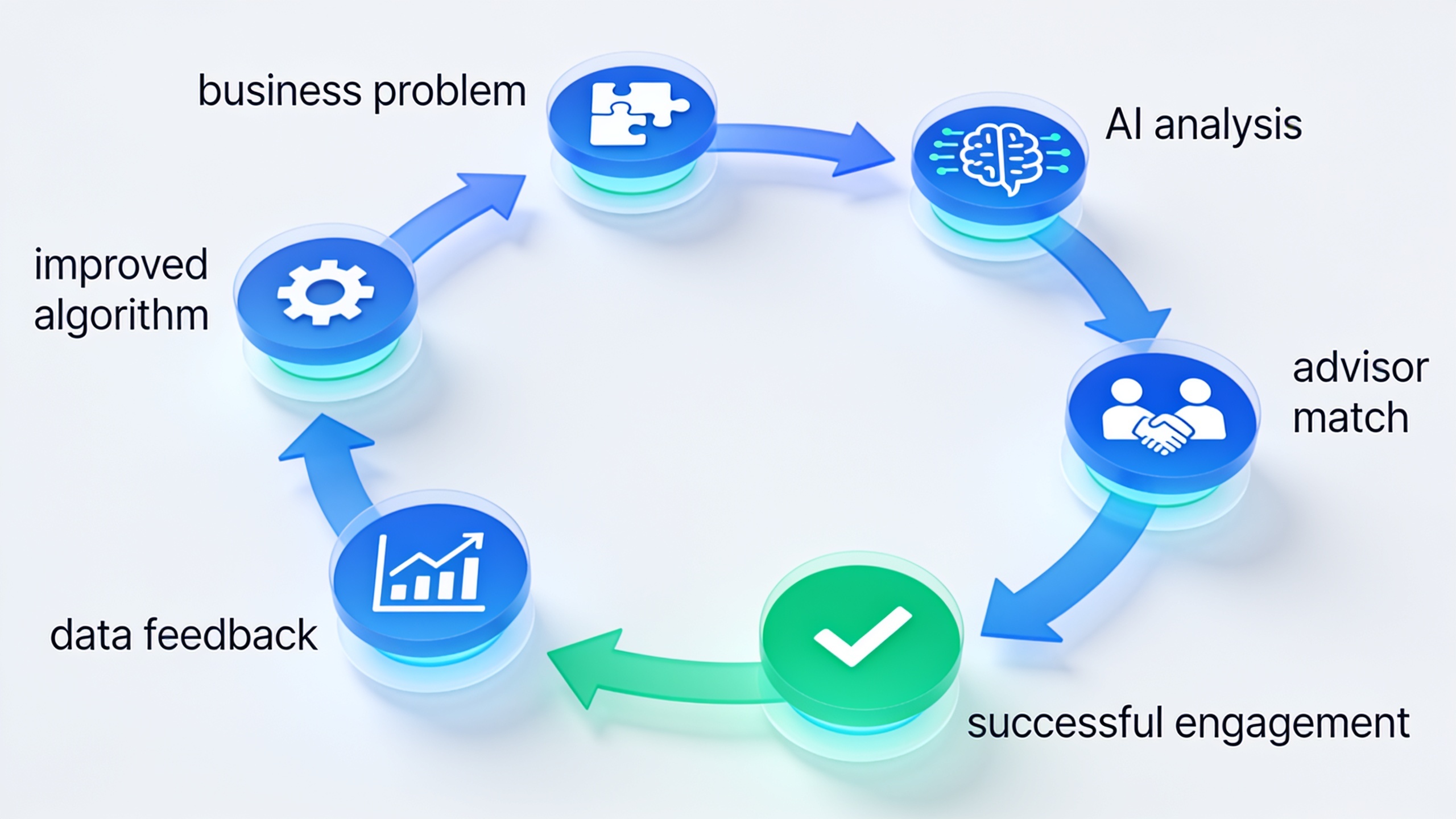
AI advisor matching works by turning your stated problem into structured data, then running that data against a pool of vetted advisors using a scoring algorithm that ranks fit based on experience, outcomes, and availability. Roughly speaking it happens in three moves: intake, analysis, and ranked matching. Nothing mystical about it once you see the pieces.
Data Inputs
The system pulls information from both sides of the marketplace. From you, it wants the nature of the challenge, your industry, company size, growth stage, budget, and timeline. From advisors, it keeps profiles that go way past a resume. We're talking specific engagements, industries served, actual measurable outcomes ("helped a 15-person SaaS company cut customer acquisition cost by 30%"), and even their preferred working style.
And this is where it splits from those directory-style sites, where advisors just slap up a generic bio and pray the right client stumbles onto them. Structured data is the whole trick. It's what lets the engine tell the difference between someone who vaguely "does growth strategy" and someone who has specifically fixed churn in subscription businesses. Big difference.
Matching Algorithms
Once the data's in, the algorithm runs natural language processing (NLP) over your description to pull out keywords, sentiment, and intent. Then it compares that against the advisor database using weighted criteria, stuff like industry match, problem-type match, past outcomes, availability, and sometimes budget compatibility. What you get back isn't one random suggestion. It's a short ranked list of genuinely relevant people instead of an overwhelming directory of a few hundred consultants you'll never read through.
Some platforms keep sharpening the algorithm over time with feedback loops. When a match turns into a successful engagement, that outcome feeds back into the system and improves the next round of recommendations. Same principle that makes recommendation engines in shopping and streaming better the more you use them. The more data, the sharper the aim.
AI Advisor Matching vs. Traditional Consulting Search
The core difference between AI advisor matching and traditional consulting search is speed and precision: AI matching usually hands you a shortlist of relevant advisors within minutes to a day, while the old way (referrals, directories, RFPs) drags on for weeks and leans hard on who you happen to know. The traditional route also assumes you've correctly diagnosed your own problem and know the right words to describe it. Which is a real hurdle for founders who know something's off but can't quite put a name to it.
| Factor | Traditional Consulting Search | AI Advisor Matching |
|---|---|---|
| Time to first match | Days to weeks | Minutes to a few days |
| Basis for matching | Referrals, reputation, generic bios | Structured data on outcomes, industry, and problem type |
| Discovery method | Manual research, cold outreach, RFPs | Automated shortlist based on described challenge |
| Vetting depth | Often surface-level (LinkedIn, website) | Verified track record and past engagement data |
| Scalability | Difficult to compare many advisors at once | Can rank dozens of advisors instantly |
| Cost transparency | Often unclear until proposal stage | Frequently visible upfront or early in the process |
| Best suited for | Long-standing relationships, niche/local networks | Fast-moving decisions, specific and well-defined problems |
Now, I'm not saying the traditional way is dead. A solid referral from a fellow founder still carries real weight, and some of the best advisory relationships form slowly over years. But if you need expertise now, not whenever the right introduction magically appears, AI matching strips out a ton of friction. Either way, before you sign with anyone, it's worth skimming these 10 questions to ask before hiring a business advisor so you actually know how to judge fit no matter how you found them.
Why Businesses Are Adopting Business Advisor Technology
Businesses are adopting this technology because it cuts down the time and risk of finding real expertise, and frankly because modern business just doesn't leave room for a months-long search. A 2023 survey by the National Small Business Association found that small business owners consistently name time constraints as one of the top barriers to seeking outside help. They know they need it. But the search itself feels like a second full-time job piled on top of running the company.
Small Business Owners
Say you're a small business owner somewhere between 30 and 50, juggling operations, sales, and staffing all at once. The pitch here is dead simple: describe the problem once, get matched with someone who's already solved it, and skip the expensive trial-and-error of hiring the wrong consultant. If you're drowning in cash flow issues, you don't need a generalist. You need somebody who has specifically dug their way out of seasonal revenue gaps in a business like yours.
Startups and Entrepreneurs
Founders in the early days usually need help with business development, fundraising, or product-market fit, and picking the wrong mentor when your runway is short can genuinely sink you. AI matching lets you skip past advisors whose experience is all theory and connect with people who've actually built and scaled something comparable. Staying disciplined once you get the advice matters just as much, though. Plenty of founders lean on focus tools like Xenith to track daily intentions and guard their deep work time while they put the advice into action. Because getting matched with a great advisor is only half the job. Execution is the other half, and it's the harder one.
Corporate Executives
Corporate execs chasing operational efficiency aren't usually shopping for a generic management consultant. They need someone who's cracked a very specific bottleneck, whether that's supply chain visibility, cross-department communication that's gone quiet, or a digital transformation that's stalled out. AI matching lets big organizations skip the whole grinding RFP process for smaller, targeted work where a giant consulting firm would be overkill and a random freelancer would just torch the budget.
Non-Profit Organizations
Non-profits hunting for advisory help are almost always working with tight budgets and even tighter time to vet anyone. Matching tech points them toward advisors with real non-profit experience, somebody who actually gets grant cycles, board governance, or donor retention. Not a for-profit consultant trying to jam a framework onto them that doesn't quite fit the world they operate in.
What Are the Benefits of AI-Powered Advisor Matching?
The main benefits of AI-powered advisor matching are speed, relevance, and a much lower chance of a bad hire. You get a shortlist of pre-qualified experts instead of losing weeks to directories and cold emails. But there are a few less obvious upsides that make it worth adopting if you're serious about growth.
For one, it takes the pressure off self-diagnosis. A lot of owners can feel something's wrong but can't pin down the root cause. Is it sales? Product? Pricing? Operations? A decent matching system reads your description, spots the pattern, and routes you to the right category of advisor. It's basically a triage step before the real consulting even starts, and that alone saves people from chasing the wrong fix.
Then there's accountability, which comes from the data itself. Because these platforms track engagement outcomes, advisors have a real reason to deliver results instead of just running up billable hours, and you can see proof of past wins before you commit a dime. That's a big move away from the old reputation game, where a slick website and a fat follower count could stand in for actual competence.
It also blows open access that used to be locked by geography or your social circle. A small business in a mid-sized city isn't stuck with whatever local consultants happen to exist anymore. AI matching can connect you with the right person anywhere, usually working remotely. And that matters more as advisory work moves onto video calls and shared dashboards, where dumb little technical snags cost you more than you'd think. Tools like What Is My Screen Size? let both sides quickly confirm resolution and display specs before a screen-share, so you're not burning ten minutes of paid consulting time fighting with a monitor.
Oh, and one more thing worth saying: this helps advisors too, not just the businesses hiring them. Instead of pouring time and money into marketing, advisors can get matched straight to businesses that need their exact skillset. That's a big part of why so many independent consultants and coaches are looking at the reasons business advisors should list on AdvisoryNavigator for better lead generation rather than grinding out referrals and cold outreach to keep the pipeline full.
How Much Does AI Advisor Matching Cost?
The cost of AI advisor matching swings widely depending on the platform and the advisor's own rates, but the matching service itself is often free or cheap for the business, while the advisor's hourly or project fee is set separately and shown upfront. It's a lot like freelance marketplaces work. The platform's value is in the matching and vetting, not in charging you just to run a search.
Actual engagement costs cover a big range depending on experience and scope. A specialized coach or mentor might run $150 to $400 an hour, while a seasoned operational consultant on a defined project could charge a flat fee anywhere from $2,000 to $20,000 or more, depending on how gnarly and long the work is. Because these platforms usually surface pricing early, sometimes before you've even had a discovery call, you can filter by budget instead of finding out three conversations deep that you can't afford somebody. That mismatch, by the way, is one of the most maddening parts of the old-school search.
And the "cost" of a bad match isn't just money. Research on consulting failures, the kind that gets cited constantly in advisory literature, consistently ranks misaligned expertise and poor communication among the top reasons engagements flop. A matching system that screens for both technical fit and working-style compatibility knocks down that risk before any money moves. Honestly, that's probably a bigger saving than whatever the platform fee would've been.
How to Choose the Right AI Advisor Matching Platform
Choosing the right platform really comes down to three things: how deeply advisors are vetted, how transparent the matching criteria are, and whether the platform actually knows your specific industry or problem area. Fair warning, not everything branded "AI-powered" is doing anything meaningful under the hood. Some just apply basic filters and call it AI. So look closely at how the thing actually works before you trust it.
Start with vetting. A strong system verifies real outcomes and industry experience instead of taking self-reported bios at face value. Then look for transparency in the matching itself. Can you see why a particular advisor got suggested, or is it a total black box? Platforms that show their reasoning (shared industry experience, similar problem solved, comparable company size) tend to produce better results, mostly because you can sanity-check the recommendation instead of blindly trusting an algorithm you don't understand.

It's also worth thinking about the wider tech ecosystem a platform sits in. A lot of modern SaaS tools, matching systems included, now run AI workflows behind the scenes for things like content analysis and pattern recognition. You see the same trend everywhere in the AI tooling world, from writing assistants to creative production tools like ComfyUI Templates, which offers ready-made AI workflow templates for everything from image generation to style transfer. The lesson underneath it all is the same across industries: well-structured templates and workflows, whether they're generating images or matching advisors, beat ad hoc, make-it-up-as-you-go processes basically every time.
Last thing. Consider how a platform treats advisors on the supply side, because a healthy pool of quality advisors depends on it being worth their while to show up. Platforms that also help advisors with visibility and lead generation, including marketing tools like the SEO automation platform RobinRank, which helps professionals actually get found online, tend to pull in a more active, engaged advisor base. And that circles right back to benefiting you, the person doing the searching.
Frequently Asked Questions
Do I need to be tech-savvy to use AI advisor matching?
Nope. The whole point is to make the search simpler for any business owner, whatever your comfort level with technology. Most platforms just want you to describe your challenge in plain language, kind of like typing a question into Google, and the system handles all the technical matching in the background.
How's this actually different from a regular business directory?
A directory just lists advisors and dumps all the searching and vetting on you. AI advisor matching actively reads your problem and ranks advisors by relevant experience and outcomes. Directories are basically unstructured lists you have to comb through yourself. Matching platforms run algorithms to float the most relevant options to the top instead of making you review every single profile.
Can it replace human judgment completely?
No, and any decent platform won't pretend otherwise. Think of AI matching as a filtering and shortlisting tool that narrows a huge pool down to a handful of strong candidates. The final call on fit, chemistry, and trust still needs a real human conversation, usually a quick intro call. No algorithm's going to tell you whether you actually click with someone.
What info do I need to hand over to get matched?
Most platforms want a description of your challenge, your industry, company size or stage, a rough budget range, and your timeline. The more specific you get, the better the match. A vague input like "we need help growing" spits out broad, useless results, whereas something like "we need help reducing customer churn in our subscription pricing model" gets you far closer to the right person.
Do advisors pay to be on these platforms?
Depends on the platform. Some charge advisors a listing or subscription fee, some take a commission on completed engagements, and some do a mix of both. If you're the one searching, it's worth checking the model, since it can occasionally shape which advisors get bumped up in your results.
At the bottom of all this, AI advisor matching is a pretty practical shift in how businesses find expertise. It swaps the slow, referral-dependent scramble for a faster, data-informed process that puts the right problem in front of the right person, someone who's genuinely solved it before. As more owners, founders, execs, and non-profit leaders look to move fast without settling for worse guidance, this kind of technology is going to feel less like a novelty and more like the obvious first move whenever a new problem lands on the desk.