
The good news? A short, well-run conversation upfront prevents almost all of that. Knowing what to actually ask before you sign anything is the single most effective way to catch a mismatch early, before it drains your budget and your patience.
So this is the list I wish someone had handed me years ago. Ten questions that work whether you're vetting a fractional CFO, a growth strategist, or an operations consultant. There's also a rough checklist near the end you can steal for your next discovery call.
Table of Contents
- Why Asking the Right Questions to a Business Advisor Matters
- What Should You Ask About Experience and Track Record?
- How Do You Evaluate Working Style and Communication?
- Questions About Cost, Structure, and Deliverables
- Questions to Ask a Business Advisor About Fit and Accountability
- Your Hiring a Consultant Checklist: Putting It All Together
- Red Flags to Watch for When Vetting a Business Advisor
- FAQ
Why Asking the Right Questions to a Business Advisor Matters
Asking pointed questions before hiring an advisor matters because it reveals whether they've actually solved your problem before, not just something that rhymes with it. A business advisor gives strategic guidance on growth, operations, finance, or how you're structured as a company. They work alongside your leadership rather than doing the day-to-day grunt work themselves.
And here's where people trip up. There's a massive gap between someone who has "helped companies grow" (whatever that means) and someone who's helped a company that looks exactly like yours get through the specific mess you're in right now. One gives you generic advice you could've found in a business book. The other gives you direction that's actually worth paying for.
There are plenty of people out there happy to take your money, too. Management analysts and consultants numbered over 1 million professionals in the U.S. as of recent occupational employment data (U.S. Bureau of Labor Statistics), so options aren't the problem. Choosing badly is. A structured interview built around real questions weeds out the folks who sound impressive on a call but don't have the hands-on chops to back it up.
One thing before you start interviewing anyone: get clear on your actual problem first. If you're not even sure your business is at the point where an advisor makes sense, it's worth reading 5 Signs Your Business Needs a Strategic Advisor Now first. Walk in with a real problem statement, not a vague "we need help" feeling. Trust me, the conversations go so much better.
What Should You Ask About Experience and Track Record?
Start by figuring out whether their experience actually maps to your industry, your company size, and your current headache, not just how many years they've been at it. Broad-sounding experience can be surprisingly shallow once you poke at it. So poke.
1. What industries and business sizes have you worked with?
Someone who spent a decade coaching enterprise manufacturers is probably going to give useless advice to a 12-person SaaS startup. And vice versa. It's not about who's smarter. It's about pattern recognition, and their patterns come from wherever they've spent their time.
Ask for two or three recent client profiles that look like you, meaning similar revenue, similar headcount, same-ish sector. If you run something specialized, say a home goods retailer roughly the scale of a company like Oak Castle Furniture, you want somebody who gets retail supply chains, seasonal cash flow, and inventory financing. Not somebody whose entire mental model is B2B software.
2. Can you share specific results from past clients?
A good advisor can point to concrete stuff. A client that cut churn by X percent. Costs trimmed within a specific window. A funding round that actually closed. When someone says "oh yeah, I helped them grow a ton" with no numbers, no timeline, no context, that's your cue to dig harder.
And ask to talk to a past client directly. If they get cagey about it? That hesitation is the answer.
3. What's your professional background and credentials?
Credentials aren't everything. But they matter a lot more in regulated or technical fields like finance, compliance, healthcare, and disability services. A nonprofit or care provider hiring an operations advisor should reasonably expect them to know the sector-specific compliance tools, the same way organizations running platforms like Medinex need advisors who actually understand NDIS-style workforce and participant management, not just generic business software.
Ask flat out about their education, certifications (CPA, MBA, CMC, PMP, whatever's relevant), and any specialized training. It's a fair question. Anyone worth hiring won't flinch at it.
How Do You Evaluate Working Style and Communication?
Figuring out working style just means confirming that their rhythm, how often they meet, how they run things, how they collaborate, actually fits how your team operates. Because even a brilliant advisor becomes a nightmare if their pace clashes with yours.
4. How often will we meet and how will we communicate?
Some advisors love weekly hour-long check-ins. Others prefer to send you written reports and hop on a strategy call once a month. Neither is better, honestly. But a mismatch here is one of the most common ways these relationships go sour.
Nail it down. Email? A shared project tool? Scheduled video calls? Some mix? And ask how fast they respond to questions between sessions. That last bit matters more than people expect.
5. What does your typical engagement process look like?
A seasoned advisor can walk you through a repeatable process without missing a beat. Discovery, then some kind of diagnostic or audit, then a strategy proposal, then implementation and review. If someone leaps straight to recommendations before they've even looked at your financials, your team structure, or your existing systems, they're running a one-size-fits-all playbook. That's a red flag dressed up as decisiveness.
This matters even more for operational work. A company bringing in a firm like SamaiSolutions for systems integration should absolutely expect a proper assessment phase before anyone starts recommending software changes or new processes. Same principle applies to any advisor.
6. How do you handle disagreements or pushback?
Good advisors don't just tell you what you want to hear. Ask how they've handled a client who pushed back on their advice, and listen carefully. Do they describe working through it together? Or did they just fold to keep the peace?
Honestly, an advisor who never disagrees with you is almost as useless as one who's rigid and won't budge. You're paying for honest input. Not a yes-person.
Questions About Cost, Structure, and Deliverables
Getting the fee structure and deliverables sorted upfront kills the two most common ways these relationships blow up: scope creep and surprise invoices. Have the money talk before work starts. Not after the first bill lands in your inbox and ruins your afternoon.
7. How do you structure your fees?
Advisors bill in a handful of ways, and each one comes with its own set of incentives and traps.
| Fee Model | How It Works | Best For | Watch Out For |
|---|---|---|---|
| Hourly rate | Billed per hour worked, often with a monthly cap | Short-term, narrowly scoped projects | Costs can escalate if scope isn't well defined |
| Fixed project fee | Flat rate for a defined deliverable or engagement | Clear, bounded projects (e.g., a growth plan or financial audit) | Advisor may cut corners if scope is underpriced |
| Monthly retainer | Ongoing fixed monthly fee for continued access | Long-term strategic relationships | Value can be unclear if hours aren't tracked or reported |
| Equity or performance-based | Compensation tied to results or ownership stake | Startups with limited cash but high growth potential | Can create misaligned incentives if targets aren't well structured |
| Hybrid (retainer + performance bonus) | Base fee plus bonus tied to milestones | Advisors deeply embedded in growth or turnaround work | Requires very clear, measurable milestone definitions |
Get a written estimate or proposal that spells out not just the total but what triggers extra charges. Extra meetings, expanded scope, rush jobs. That's where the surprises hide.

8. What deliverables can I expect, and on what timeline?
Are you paying for advice alone, or advice plus actual stuff you can hold? A written strategic plan, a financial model, a hiring roadmap, process documentation? Figure that out now. And if you can, ask to see a sample deliverable from a past gig.
This is also the moment to talk timelines like an adult. A full operational assessment for a 20-person company might take four to six weeks, fair enough. A quick "here's my gut read on your strategy" conversation could wrap in a single session. Just get everyone on the same page about what "done" looks like.
Questions to Ask a Business Advisor About Fit and Accountability
The last batch of questions is about measuring success and figuring out what happens if things go sideways. Because sometimes an advisor is genuinely qualified and still turns out to be the wrong fit for your team, or the wrong fit for where your company is right now. It happens.
9. How will we measure success?
Get the advisor to help you define two or three measurable outcomes before the work starts. Revenue growth percentage. Cost reduction targets. A funding round closed. Something like on-time delivery rates improving. Anything concrete.
If someone dodges this and keeps repeating "results take time" without offering a single benchmark? That's a problem. You'll have no way to tell whether you got your money's worth, which is a pretty terrible spot to be in.
10. What happens if it's not working out?
Every agreement should spell out the exit terms. Notice periods. Refunds or proration on unused retainer time. Confidentiality that sticks around after you part ways. A professional will happily talk about this because it protects both of you.
But if a candidate gets visibly uncomfortable when you bring up the exit clause? Note that. It tells you exactly how they'll handle friction once you're actually working together.
Your Hiring a Consultant Checklist: Putting It All Together
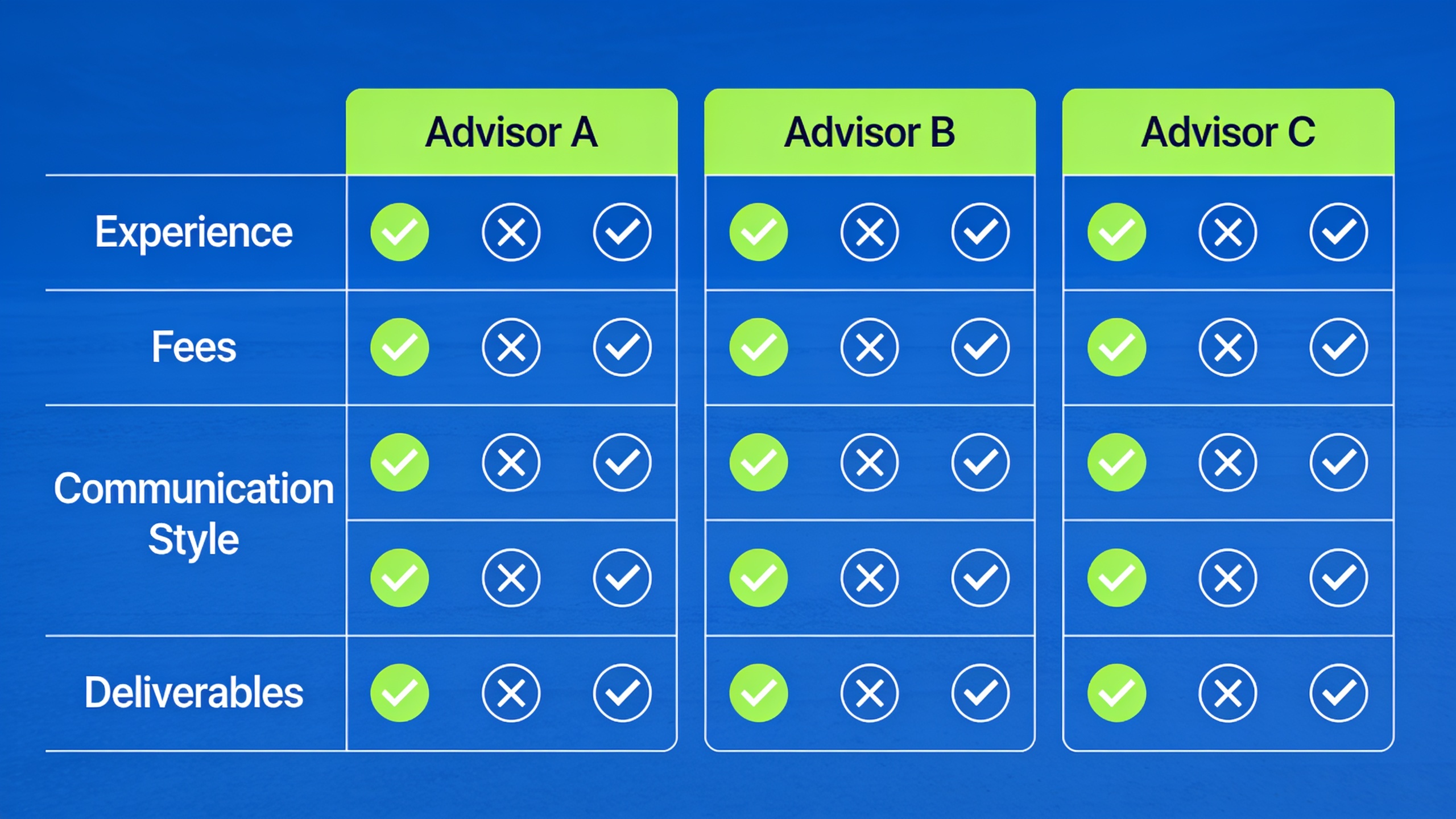
Here's the whole thing boiled down into something you can actually run for every candidate, so you're comparing apples to apples instead of going on gut feeling.
Before you even schedule a discovery call, write down the specific problem you're solving in a sentence or two. Not "we need growth help." Something like "we need to cut customer acquisition cost by 20% within two quarters." On the call, confirm they've got relevant industry and company-size experience, ask for two concrete client outcomes with actual numbers, and get clear on their communication cadence and process. Get the fees in writing before the second conversation. Ask what deliverables you'll receive and when. Then lock in two or three success metrics and sort out how you'd end things if it flops.
Running everyone through the same checklist, instead of loosening up your questions because someone's charming and confident, is the whole ballgame. It's what separates a disciplined hire from an emotional one. (And confidence is not competence, no matter how good it feels in the room.)
Advisors benefit from understanding this from the client's side, too. Any advisor looking to sharpen their positioning and pull in better leads can check out 7 Reasons Business Advisors Should List on AdvisoryNavigator for Better Advisor Lead Generation. Being upfront about experience, fees, and process attracts better-fit clients, not fewer.
Red Flags to Watch for When Vetting a Business Advisor
The clearest red flags are vague answers about past results, dodging any request to put fees in writing, and refusing to define what success even looks like before starting. Those three alone should give you serious pause.
Beyond that, be really wary of anyone who guarantees outcomes. No legit consultant can promise a specific revenue bump or a funding result, because too many variables live outside their control. Anyone who promises otherwise is either naive or selling you something.
Also watch for advisors who lean on generic frameworks without ever adapting them to your actual situation, and the ones who get squirmy when you ask how they'll measure their own effectiveness. Oh, and pay attention to how they talk about tools and technology in their own practice. With AI-assisted platforms like RobinRank now automating content, SEO, and even backlink outreach, an advisor's comfort (or total cluelessness) with modern operational tools tells you a lot about how current their broader knowledge really is. Someone who dismisses relevant tech out of hand, without actually evaluating it, is probably running on outdated playbooks in other areas too.
Last thing. Notice how they react when you ask for references. Some confidentiality is normal, sure. But a flat refusal to show any verifiable proof of past work, especially paired with pressure to sign a long contract fast? That's about the loudest warning signal there is. Walk away.
FAQ
How many advisors should I actually interview before deciding?
At least three. Comparing answers to the same questions makes the inconsistencies and the standouts jump right out at you. Interview just one person and you've got nothing to benchmark them against, which means you're basically guessing on experience, style, and price.
Should I ask for references, and how many is reasonable?
Yes, and asking for two or three references from clients in a similar size range or industry is completely standard. It's not intrusive or weird. A credible advisor usually has willing references ready to go, sometimes with case studies already written up.
What's the actual difference between a business advisor, a consultant, and a coach?
A consultant is typically hired to solve one specific, defined problem and hands over a concrete plan or project. A business advisor tends to give ongoing strategic guidance across multiple areas over a longer relationship. A coach mostly works on developing you, your skills, your decision-making, rather than delivering outside analysis. In real life these lines blur constantly, which is exactly why nailing down scope and deliverables during the interview matters so much.
How much does hiring a business advisor usually cost?
It's all over the map depending on experience, scope, and geography. Anywhere from a few hundred dollars an hour for narrow consulting to several thousand a month for ongoing retainer-based advisory. Instead of fixating on one number, get itemized proposals from a few candidates and compare based on what your business actually needs.
Is it normal for an advisor to want equity instead of cash?
It happens, mostly with early-stage startups that are cash-poor but have real growth potential. It's not universal, though. If someone proposes equity, get a lawyer to look over the terms carefully, because equity comp creates long-term ownership and governance implications that can stick around long after the advisory work is done.
At the risk of stating the obvious: choosing the right advisor comes down to preparation, not luck. Walk into every conversation with these ten questions and a clear sense of the problem you're trying to solve, and a nerve-wracking hiring decision turns into a structured evaluation you can run again and again with confidence.