
So let's talk about the five clearest signals it's time to bring in outside help, when a consultant makes more sense than a long-term advisor (they're not the same thing), and how tech is quietly changing the way owners actually find the right person.
Table of Contents
- What Are the Key Business Advisor Signs Every Owner Should Know?
- Sign #1: Growth Has Stalled Despite Your Best Efforts
- Sign #2: Operational Bottlenecks Are Slowing You Down
- Sign #3: There's a Leadership or Skills Gap at the Top
- Sign #4: You're Making Decisions Based on Gut Feeling, Not Data
- Sign #5: You Feel Isolated as the Sole Decision-Maker
- When to Hire a Consultant vs. When to Hire a Full-Time Advisor
- How AI Matching Makes Finding the Right Advisor Faster
- Frequently Asked Questions
What Are the Key Business Advisor Signs Every Owner Should Know?
The five biggest tells are stalled revenue growth, the same operational bottlenecks showing up over and over, a leadership or skills gap at the top, decisions made on instinct instead of data, and that lonely feeling of being the only one steering the ship. If two or more of those describe your business right now, that's a pretty loud signal that outside help would speed things up, not just pad your payroll.
Here's what people miss, though: these things almost never show up alone. A leadership gap breeds operational bottlenecks, which stall growth, which leaves you feeling even more isolated and reactive than before. Round and round it goes. A good strategic advisor is basically trained to break that loop by chasing the root cause instead of swatting at symptoms one at a time. And honestly? Owners between 30 and 50 are the worst about putting this off, mostly because asking for help feels like admitting they screwed up. It's not. Companies that lean on external advisors and mentoring resources actually report higher five-year survival rates than the ones who tough it out solo (Small Business Administration).
Sign #1: Growth Has Stalled Despite Your Best Efforts
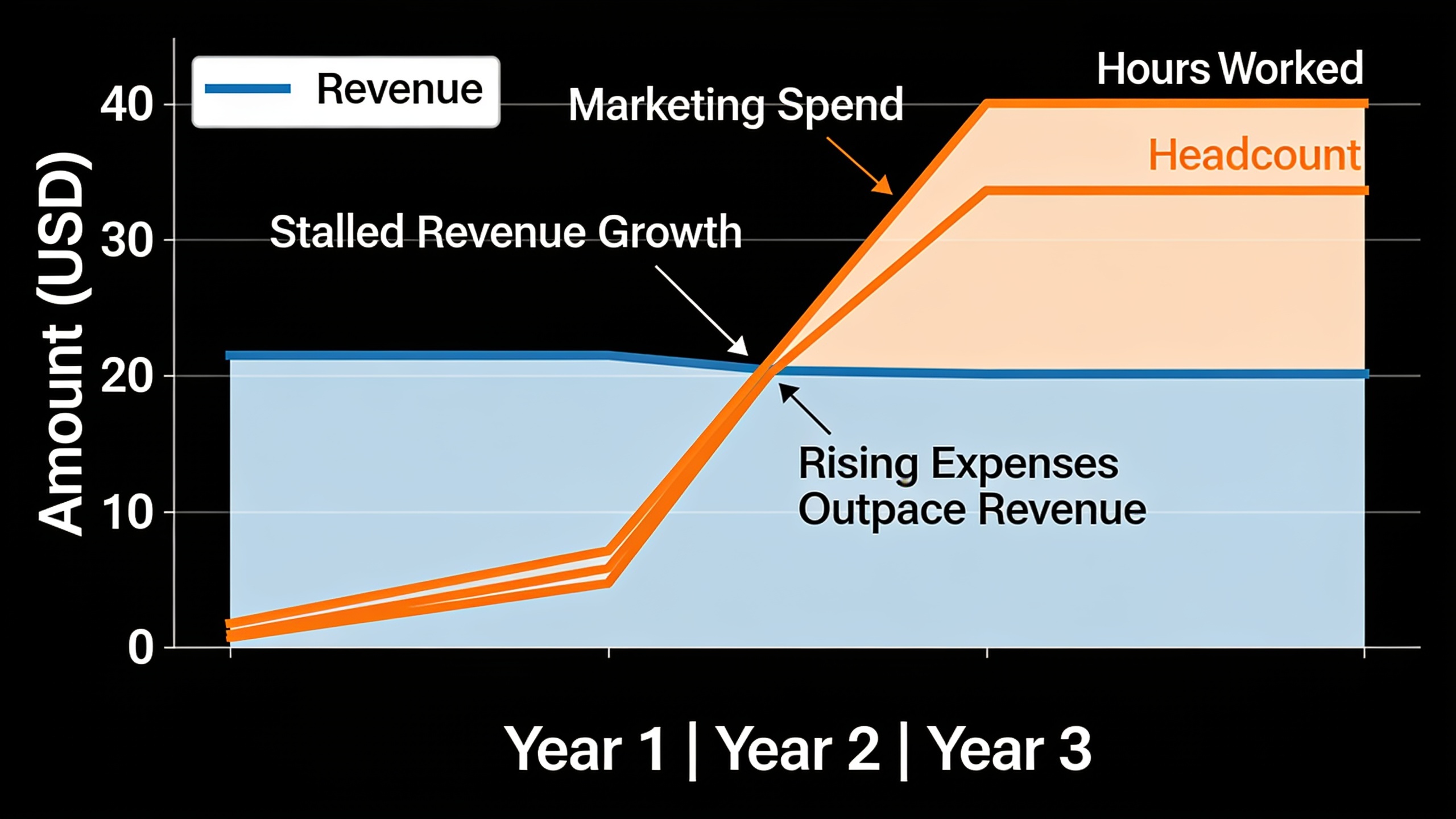
If your revenue, customer base, or market share has sat flat for two or more quarters straight, despite you throwing time and money at it, that's a direct signal you need outside strategic input. This isn't a seasonal dip. It's a plateau that shrugs off all the tactics that used to move the needle.
Why does this happen? Because the strategies that got you from zero to where you are now tend to quit working at the next level up. I've seen it a hundred times. A founder scales to $2 million a year on charm, personal relationships, and sheer grind, then hits a wall trying to push past $5 million because the market's different, the team's bigger, and the operational demands are a whole other animal. A strategic advisor brings pattern recognition to the table. They've walked other companies through the exact same choke point you're stuck at, so they can tell you whether the real problem is your pricing, your sales process, your positioning, or just that your team's maxed out. Which is genuinely hard to see when you're the one living inside it every day.
How to Confirm This Is the Problem
Pull your last three years of monthly revenue and lay it out side by side. If growth flattened while your marketing spend, headcount, or hours went up? Yeah. You've hit a ceiling that grinding harder won't crack.
Sign #2: Operational Bottlenecks Are Slowing You Down
Operational bottlenecks are those recurring spots in your workflow, fulfillment, customer service, hiring, approvals, wherever, where work piles up and gums up everything downstream. If your team keeps missing deadlines, doing the same thing twice, or sitting around waiting on one person (usually you) to sign off on routine stuff, that's a structural problem. Not a staffing one.
Bottlenecks are one of the most common reasons people finally call for help, and they're brutal precisely because they don't always show up on the balance sheet right away. What they cost you instead: lost customers, fried-out employees, and opportunities that slip past while faster competitors grab them. McKinsey found that companies which systematically tackle process bottlenecks can boost throughput by 20% or more without hiring a single extra person, just by rethinking how work actually moves through the place. That's exactly the kind of win a sharp operations-focused advisor knows how to dig up.
This is also where the type of help matters. A generalist coach can nudge your mindset and priorities, sure, but a bottleneck buried in systems and tech usually needs a specialist. Firms like SamaiSolutions zero in on operational efficiency through better systems integration and process automation, the tactical, technical fix a strategic advisor might point you toward once they've figured out what's actually broken. And knowing when to bring in a consultant for a targeted job like that, versus keeping an advisor around for the ongoing strategy? That's a decision worth getting right on its own.
Sign #3: There's a Leadership or Skills Gap at the Top
A leadership gap is just what happens when the skills your next phase demands don't line up with the skills your leadership team actually has right now. And it's incredibly common. It's not a knock on anyone's competence. The skills that launch a company are simply not the same skills that scale one.
Founders are often brilliant at product, sales, or client relationships and totally green when it comes to financial forecasting, org design, or building a real management layer under themselves. Corporate execs get a version of this too. Somebody gets promoted into a senior operational role because they crushed it as an individual performer, then suddenly they're expected to juggle multiple departments or sway board-level strategy with zero experience doing either. And funnily enough, this isn't a private-sector-only thing. Even in rigidly structured worlds like law enforcement, people moving up benefit from targeted coaching to close the gap between where they are and what the new job demands. That's literally why platforms like State6 offer AI-powered promotion coaching for UK police officers. Same logic in business: an advisor can pinpoint exactly which leadership muscles are missing and build a plan to grow them, instead of leaving you to figure it out by trial and (expensive) error.
Common Symptoms of a Leadership Gap
- Decisions stall out waiting for one person's blessing, even on things outside their wheelhouse.
- Managers dodge giving feedback because nobody above them does it well.
- There's no succession plan. If you or a key exec vanished for six months, the wheels would come off.
Sign #4: You're Making Decisions Based on Gut Feeling, Not Data
If your last three big calls came down to instinct, no data on customer behavior, unit economics, or where the market's heading, then your business has probably outgrown the gut-feel model. Instinct is gold in the early, foggy days. But it turns into a liability the moment the stakes and the complexity climb.
This one's sneaky. Gut instinct usually has a solid track record early on, which is exactly what makes it so hard to notice when it stops being trustworthy. A good advisor drops in some structure: cohort analysis for retention, scenario planning before you touch pricing, a bit of financial modeling before you make that big hire or open that second location. And look, even the wildly volatile corners of the economy have figured this out. Sites like Cryptocoinsjournal exist because even crypto investors, of all people, have learned that data, trend analysis, and real context beat pure guesswork over the long haul. Same rule for a plain old traditional business. As things get more complex, informed decisions win.
Non-profits deal with their own flavor of this, by the way. Donors and impact reporting increasingly want data-backed proof of outcomes, not just a nice story, which makes outside strategic guidance especially handy for mission-driven teams trying to actually measure and improve what they do.
Sign #5: You Feel Isolated as the Sole Decision-Maker
Founder and executive isolation is what you get when there's no peer, board, or advisor with enough context (and enough nerve) to challenge how you think. It's one of the most commonly reported signs and one of the least addressed, because it's an emotional and structural problem, not a line item you can spot on a spreadsheet.
Harvard Business Review's 2021 look at executive loneliness found that a big chunk of CEOs report feeling isolated in the role, and that this loneliness lines up with slower, more risk-averse decision-making over time. Your employees can chip in ideas, but they're almost never going to challenge your core strategic assumptions the way a seasoned outsider will. Early-stage founders get hit hardest here since they often haven't built a board or a peer network yet. But even execs inside massive organizations can feel weirdly alone if their role is niche enough. Bringing in an advisor, someone whose only real agenda is your business doing well long term, gives you back the honest sounding board that most solo decision-makers are quietly missing.
When to Hire a Consultant vs. When to Hire a Full-Time Advisor
The short version: hire a consultant for a defined, time-boxed project, and hire an advisor for an ongoing pattern that needs continuous guidance. Consultants are your people for a specific, scoped problem with a clear deliverable. Advisors are for the recurring, sprawling stuff across the whole business over months or years.
| Factor | Hire a Consultant | Hire a Strategic Advisor |
|---|---|---|
| Nature of the problem | Specific, well-defined (e.g., a systems audit, a marketing launch, a compliance review) | Broad, ongoing (e.g., growth strategy, leadership development, governance) |
| Engagement length | Weeks to a few months, project-based | Months to years, often retainer-based |
| Deliverable | A report, a completed project, or an implemented system | Ongoing counsel, accountability, and decision support |
| Best for | Owners with a clear, isolated pain point | Owners facing several of the five signs above at once |
| Relationship style | Transactional, expert-for-hire | Relational, invested in long-term outcomes |
| Cost structure | Fixed fee or hourly for defined scope | Retainer, equity, or ongoing hourly arrangement |
Plenty of businesses use both, just at different moments. You might bring in a consultant to unclog a specific operational bottleneck, then keep an advisor on to make sure the fix actually supports your bigger growth plan and doesn't quietly spawn a new bottleneck somewhere else six months down the road. The classic mistake? Hiring a consultant to fix something that's really just a symptom of a deeper strategic gap. Project wraps, everyone's happy, and then the same problem crawls right back a quarter later.
How AI Matching Makes Finding the Right Advisor Faster
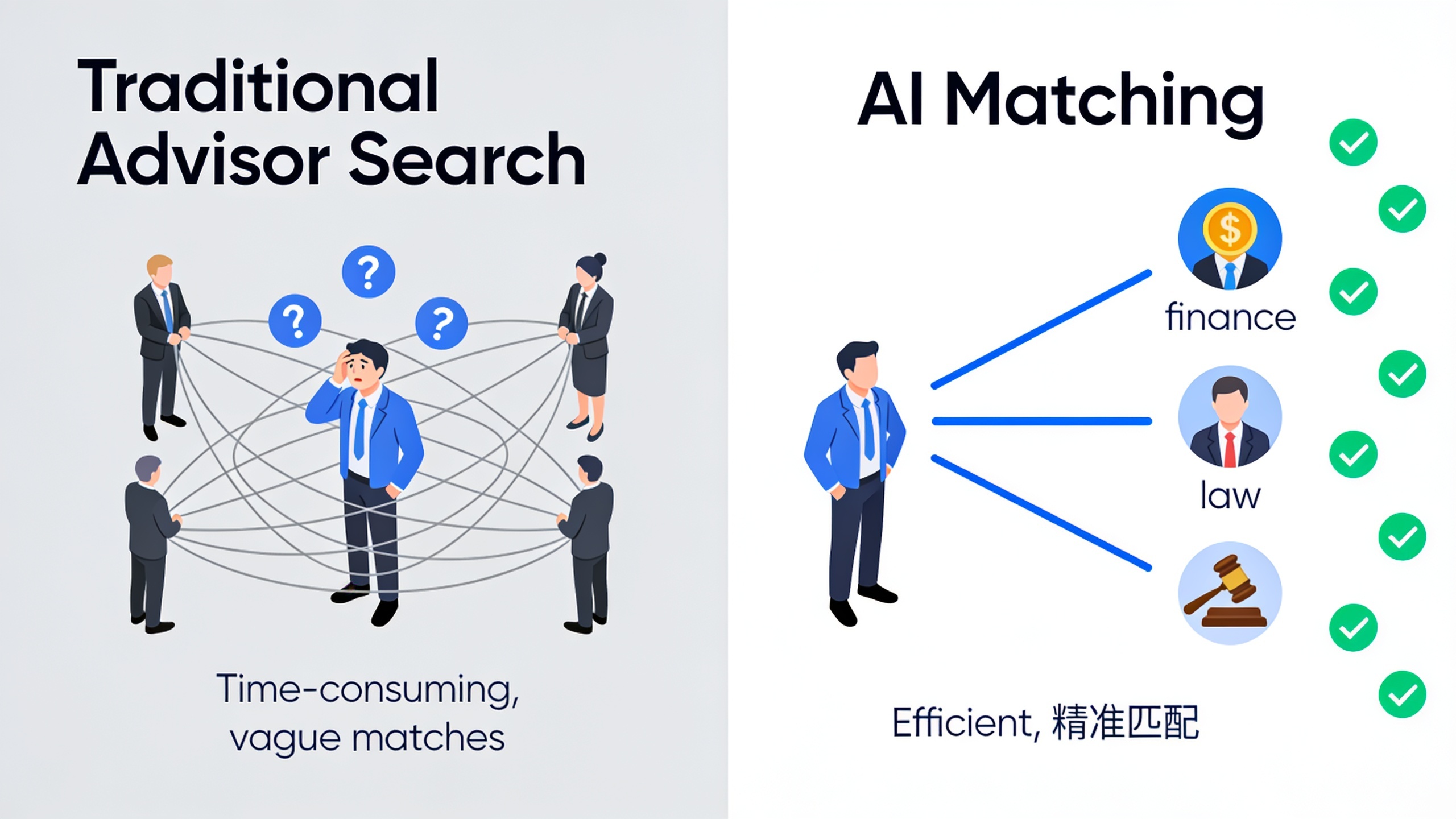
You can find the right advisor a lot faster now thanks to AI-powered matching platforms that pair your specific challenge with someone who's already solved that exact problem before. It cuts out most of the guesswork, the referral-chasing, and the trial-and-error that used to make this whole process slow and pricey.
The old way was clunky. You'd find advisors through your personal network, an industry association, or some big consulting firm stacked with generalists. And the problem there is obvious once you say it out loud: your buddy's referral might be a lovely person with completely the wrong specialty, and the big firm might hand your problem to a junior associate who's never actually lived through your growth stage. That's the exact gap AdvisoryNavigator.com was built to close. Instead of making you dig through directories or gamble on a generic recommendation, it uses AI matching to connect you with the right expertise based on the actual challenge you describe, whether that's stalled growth, a bottleneck, a leadership gap, or a need to finally make decisions on data.
This kind of matching is especially handy for exactly the people most likely to be Googling this stuff at 11pm: small business owners in their 30s and 40s trying to punch past a plateau, corporate execs hunting for an outside read on operational efficiency, and early-stage entrepreneurs who need real guidance without the cost of a full executive team. Oh, and it works the other way too. Advisors, coaches, and mentors chasing better leads get matched with businesses whose problems genuinely fit what they're good at, instead of blasting out generic marketing and hoping the right client stumbles in.
Frequently Asked Questions
How do I know if I actually need an advisor, or if I just need to give it more time?
If the problem's been hanging around for two-plus quarters despite you honestly trying to fix it in-house, waiting longer probably won't save you. Here's a quick gut check: are the same tactics that built your early wins still working? If they're not, that's your business outgrowing its current approach, not a patience problem.
What's the actual difference between a business coach, a consultant, and a strategic advisor?
A coach mostly works on you, your mindset, habits, leadership development. A consultant is hired for a defined project with a specific deliverable, like a systems audit or a marketing campaign. A strategic advisor works broadly and continuously with the business, giving ongoing counsel across growth, operations, and leadership, usually over months or years instead of a one-off engagement.
How much does a strategic advisor usually run?
It's all over the map, honestly. Depends on their experience, the scope, and your industry. You might pay a few hundred bucks a month for a part-time advisory setup with an early-stage startup, or several thousand a month for a seasoned pro working with an established mid-market company. A lot of advisors also do project-based or equity deals, especially with startups, which makes the whole thing way more flexible than a traditional full-time hire.
Can a small business with barely any revenue still get value out of an advisor?
Yes, and honestly they often get more bang for the buck, because one smart strategic correction can genuinely swing their whole trajectory. Loads of advisors offer scaled setups, like a few hours a month, specifically so smaller businesses can get real strategic input without committing to a full-time salary or a giant consulting retainer.
How long before I actually see results after bringing someone in?
Some operational fixes, like clearing out a specific bottleneck, can show measurable improvement in 60 to 90 days. The bigger strategic stuff, repositioning your growth strategy or closing a leadership gap, usually takes six months to a year to really show up in the numbers, since you're changing processes, team behavior, and sometimes how the market sees you. No quick magic there.
Bringing It All Together
Stalled growth, bottlenecks, leadership gaps, gut-feel decisions, and founder isolation almost never announce themselves clearly. They creep in slowly, dressed up as "a busy quarter" or "just how things are right now." Catching these signs early, and knowing whether you need a consultant for a quick fix or an advisor for the long game, gives you a real shot at course-correcting before a temporary plateau hardens into a permanent ceiling. And the businesses that break through these moments? They're usually not the ones with the deepest pockets. They're just the ones willing to bring in the right outside perspective at the right time.