
How It Works

Find the right advisor through a more structured process

Advisory Navigator helps businesses move from a complex challenge to a better-fit advisor shortlist through AI-guided intake, AIMM-powered matching, and transparent Trust Quotient scoring.

Traditional advisor discovery is often slow, inconsistent, and difficult to evaluate. Advisory Navigator replaces fragmented referrals and broad directory searching with a clearer workflow: define the challenge, structure the advisory need, review better-fit matches, and connect with more confidence.

AI intake screenshot

AI-guided intake captures the business challenge with more context from the start.

A better way to move from business need to advisor fit

Most businesses do not struggle to find advisors because options do not exist. They struggle because the process of evaluating fit is fragmented. Context gets lost, requirements stay vague, and decisions rely too heavily on referrals, surface-level profiles, or manual filtering.

Advisory Navigator is designed to solve that problem. The platform helps translate a business challenge into a structured advisory brief, applies AIMM to identify stronger-fit advisors, and surfaces Trust Quotient scoring so decision-makers can understand alignment before they connect.

Request brief screenshot

The platform turns a business challenge into a structured advisory request.

1

Define the challenge

Start with the business problem, not a keyword search.

2

Structure the request

Capture goals, context, and advisory needs in a clearer brief.

3

Review advisor fit

Evaluate a focused shortlist with visible Trust Quotient signals.

4

Connect and move forward

Advance conversations in a more private, professional workflow.

AI intake screenshot

Start with the business challenge, not a generic advisor category.

Step 1

Capture the advisory need with more context

Advisory Navigator starts by helping the business define the challenge it is trying to solve. Instead of forcing teams through a static form or generic category search, the platform uses AI-guided intake to capture the context behind the request.
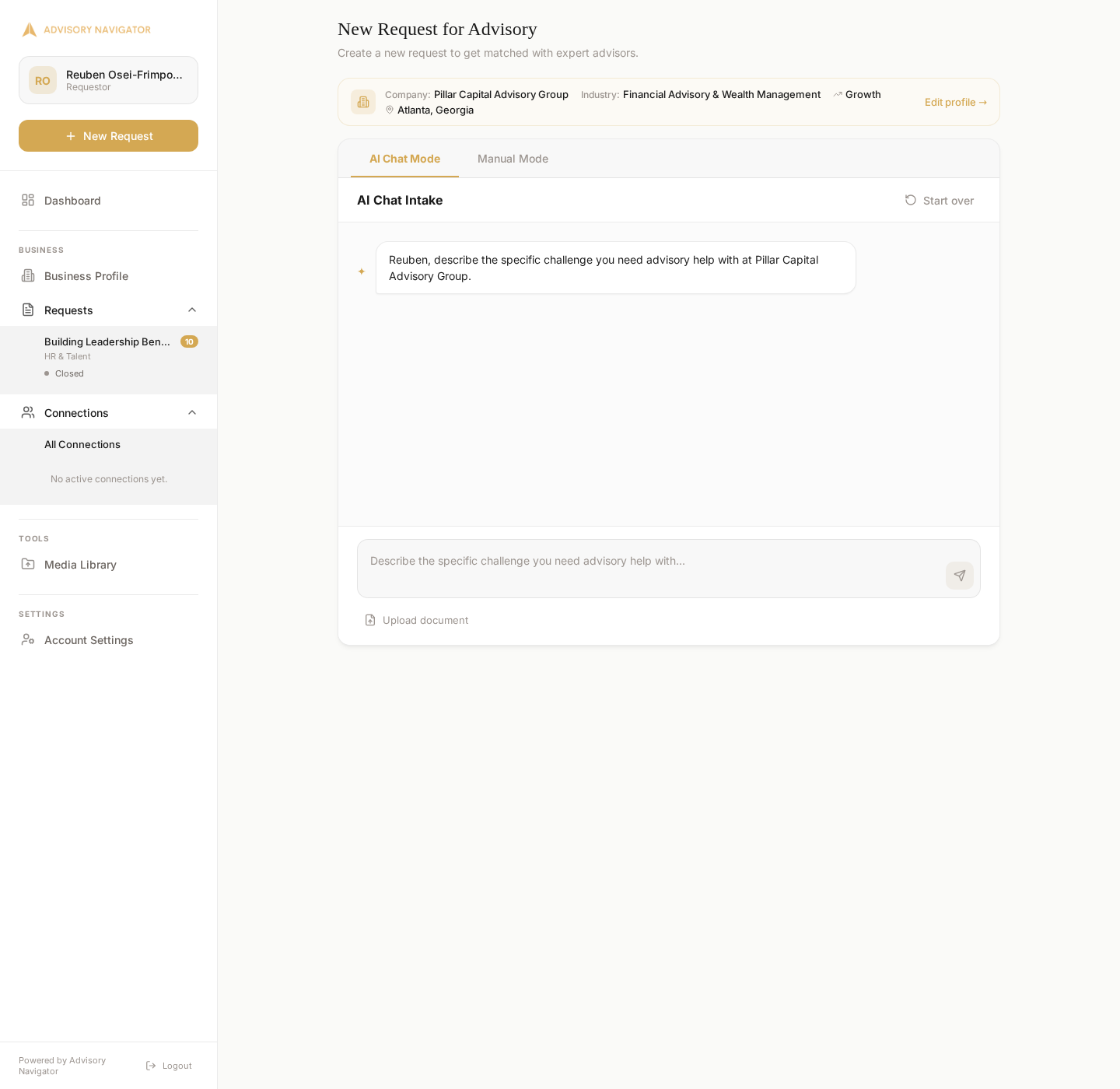
That creates a stronger foundation for matching. The platform can work from the actual business need, the desired outcome, and the broader operating context — not just a title or service label.

Learn more about this feature
Step 2

Turn the challenge into a structured advisory brief

Once the challenge is captured, Advisory Navigator organizes that input into a more structured request. This makes it easier to define the engagement, clarify objectives, and create a more consistent basis for evaluating advisors.
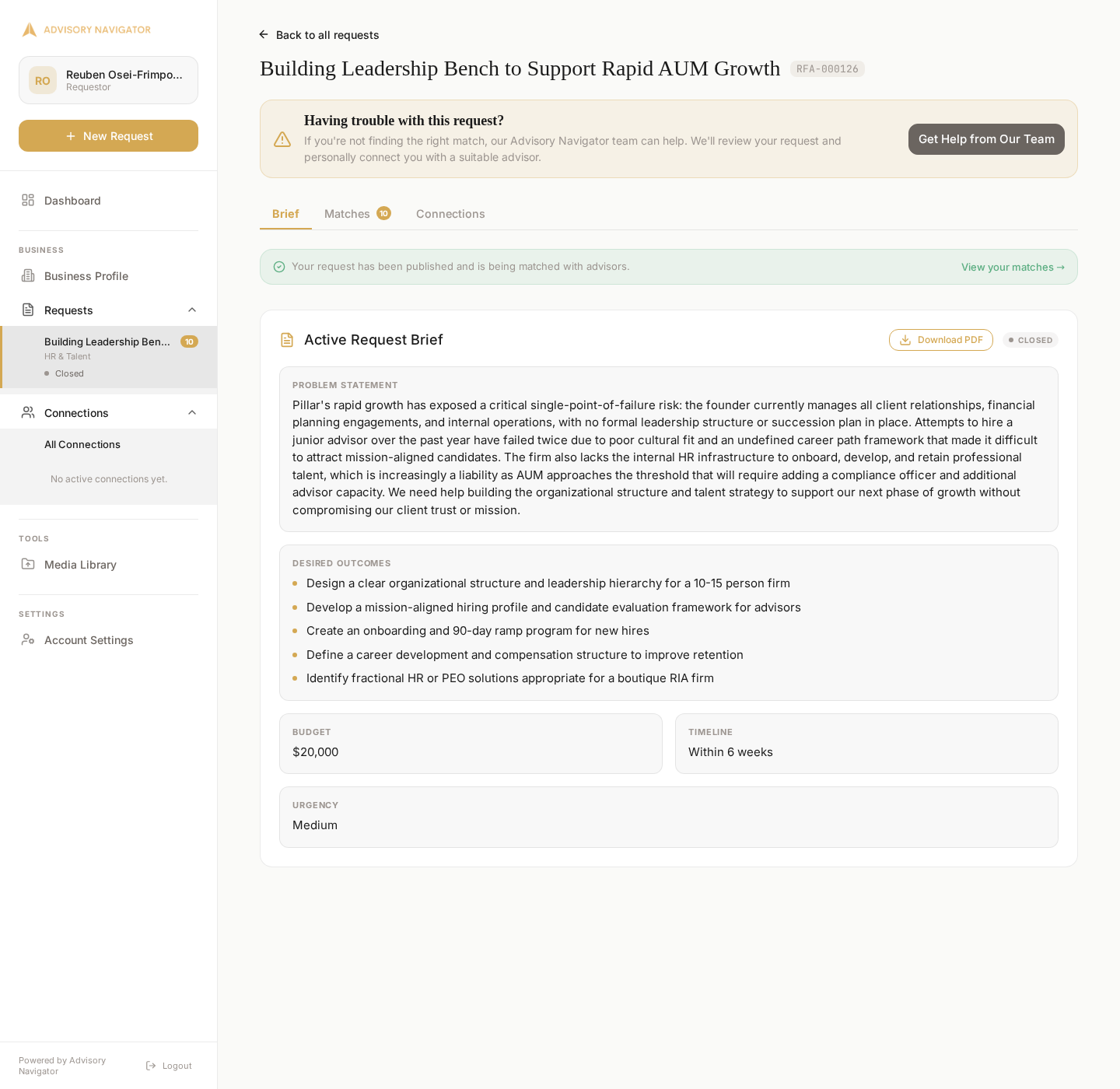
For businesses, this reduces ambiguity early in the process. For advisors, it creates a clearer signal about what the company actually needs.

Learn more about this feature
Request brief screenshot

A structured brief gives both sides a clearer starting point.

Requestor matches screenshot

AIMM supports a more focused shortlist instead of a broad browse experience.

Step 3

Use AIMM to narrow the field to better-fit advisors

After the request is structured, Advisory Navigator applies AIMM to evaluate advisor alignment more intelligently. Rather than leaving the business to sort through a large pool of profiles, the platform focuses attention on a more relevant shortlist.
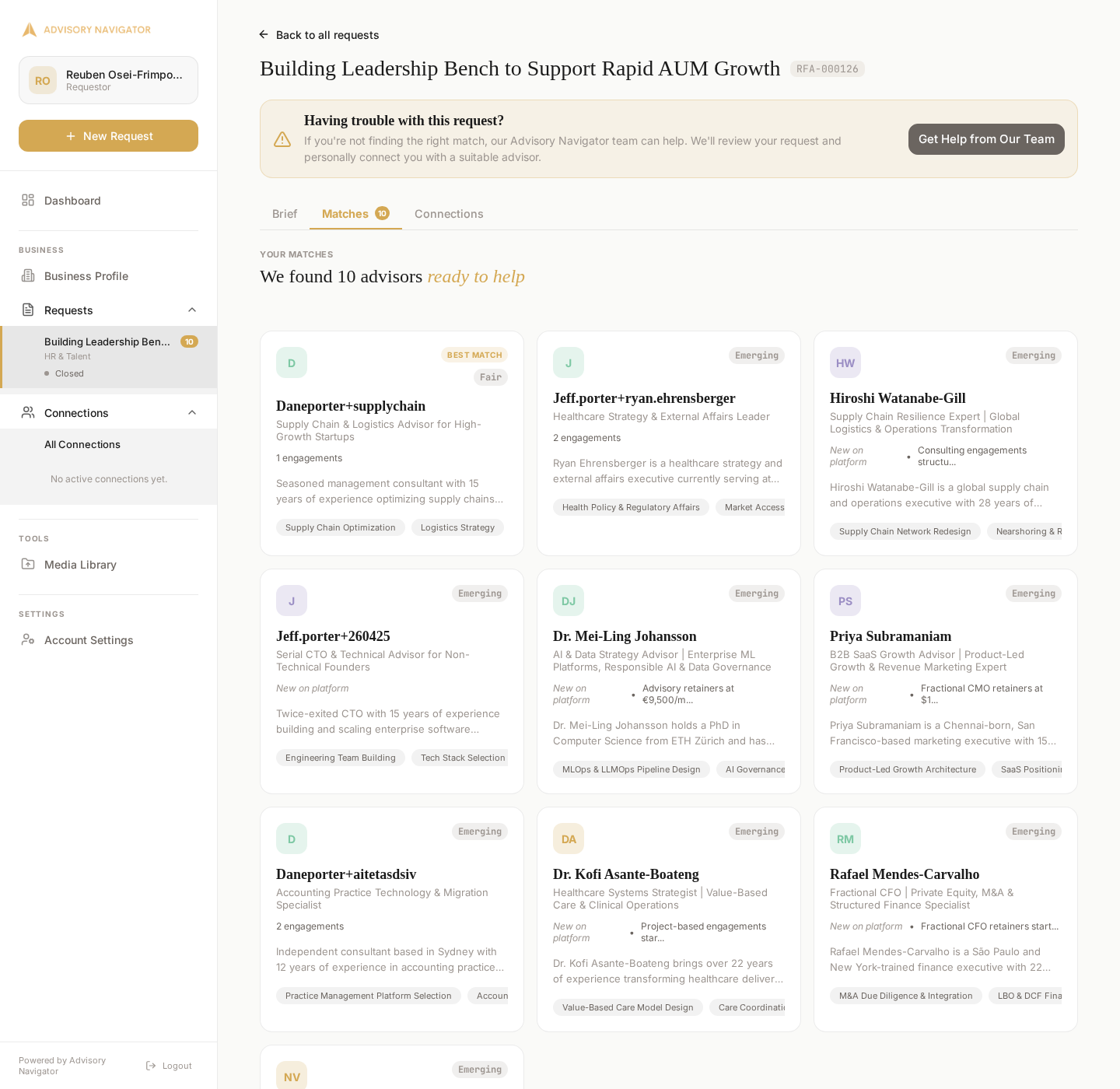
The goal is not to maximize volume. It is to improve fit. That means helping businesses spend less time screening loosely relevant options and more time evaluating advisors who are better aligned to the request.

Learn more about this feature
Step 4

Review Trust Quotient signals before you connect

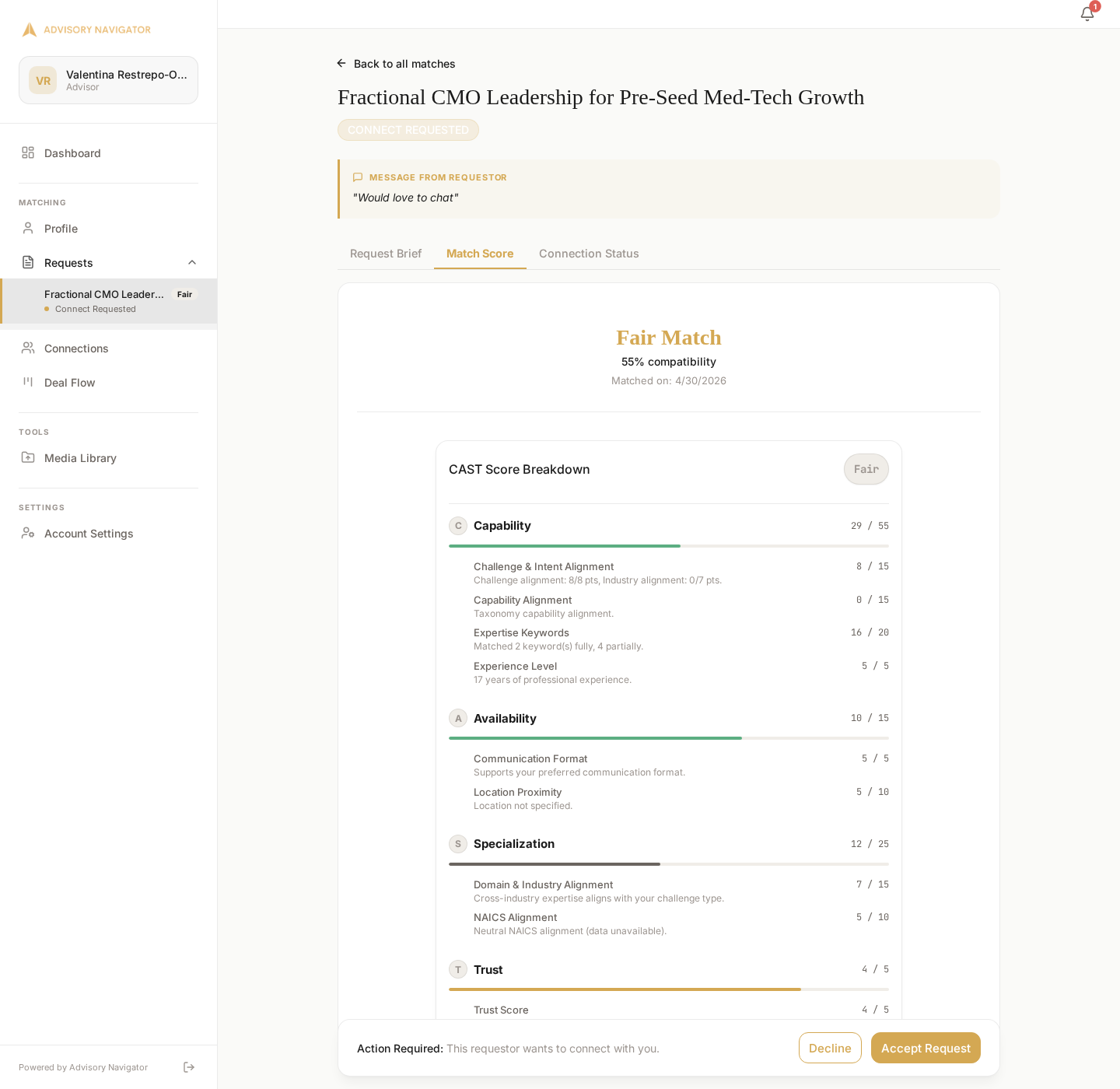
One of the biggest weaknesses in advisor discovery is the lack of visibility into why a recommendation was made. Advisory Navigator addresses that through Trust Quotient scoring.

Instead of presenting matches as a black box, the platform gives users clearer signals about alignment. That helps businesses make more informed shortlisting decisions and gives advisors more context when deciding whether to engage.
Learn more about this feature
Match score screenshot

Trust Quotient adds visible fit signals before either side commits.

Advisor dashboard screenshot

The workflow continues after the match, from review to pipeline management.

Step 5

Move from matching to a more professional engagement workflow

Advisor discovery should not end at introduction. Advisory Navigator supports the next phase of the process as well, helping both sides move into a more organized workflow for review, connection, and ongoing engagement.

That continuity matters. It reduces friction after the match, keeps activity centralized, and creates a more professional experience for both businesses and advisors.

Learn more about this feature

The system behind the workflow

Advisory Navigator combines structured intake, AIMM-powered matching, and transparent Trust Quotient scoring to support better-fit decisions.

Structured intake

The platform captures advisory needs with more context than a standard search or form submission.

AIMM-powered matching

AIMM helps organize the request and narrow the field toward advisors who better align with the challenge.

Trust Quotient visibility

Trust Quotient provides clearer fit signals so users can understand match quality before connecting.

Business profile screenshot

Structured business context improves the quality of matching and evaluation.

Why businesses use a more structured advisor search process

Choosing an advisor is often a high-impact decision. The cost of a weak fit is not just wasted time. It can affect execution, strategic momentum, and confidence in the engagement itself.

Advisory Navigator is built to reduce that risk. By improving how advisory needs are captured, matched, and evaluated, the platform helps businesses make stronger decisions earlier in the process.

Match score screenshot

Better structure at the start supports better decisions later.

A clearer alternative to manual advisor discovery

Traditional approach
Advisory Navigator
Broad directories, referrals, and fragmented outreach
A structured request workflow built around the actual business challenge
Limited visibility into why an advisor appears relevant
Trust Quotient scoring adds clearer fit signals before connection
Too much manual filtering and inconsistent shortlisting
AIMM supports a more focused shortlist of better-fit advisors
Disconnected tools across discovery, review, and follow-up
A more continuous workflow from intake through engagement

For businesses

Advisory Navigator helps teams define complex needs more clearly, evaluate advisor fit with more transparency, and move faster toward qualified conversations.

For advisors

The platform helps advisors review better-qualified opportunities, understand fit more clearly, and participate in a workflow built around structured demand rather than generic lead generation.

Advisor dashboard screenshot

The platform is designed to create value for both sides of the advisory relationship.

Make advisor discovery more structured, transparent, and effective

Advisory Navigator gives businesses a clearer path from challenge definition to advisor connection — and gives advisors a more qualified path to relevant opportunities.

See how AI-guided intake, AIMM-powered matching, and Trust Quotient scoring work together in one platform.

Or explore the full feature set