
And this stuff matters more than people think. A bad advisor match is rarely a small mistake. It can burn months of runway for a small business owner, blow a critical fundraising window for a founder, or torch a nonprofit's credibility with the donors it depends on. So let me lay out why the data-driven route beats the old trial-and-error approach, what a structured matching model actually looks like when the rubber meets the road, and how you can dodge the guesswork next time you need real help.
Table of Contents
- What Advisor Guesswork Actually Looks Like
- The Hidden Cost of Trial-and-Error Advisor Selection
- How Does Data-Driven Advisor Matching Work?
- What Makes the CAST Framework Different From Referrals and Directories?
- Traditional Search vs. Data-Driven Advisor Matching: A Side-by-Side Look
- How Much Time Does Data-Driven Matching Actually Save?
- A Real-World Case: Breaking Through a Growth Plateau
- How to Avoid Advisor Guesswork in Your Next Search
- Frequently Asked Questions
What Advisor Guesswork Actually Looks Like
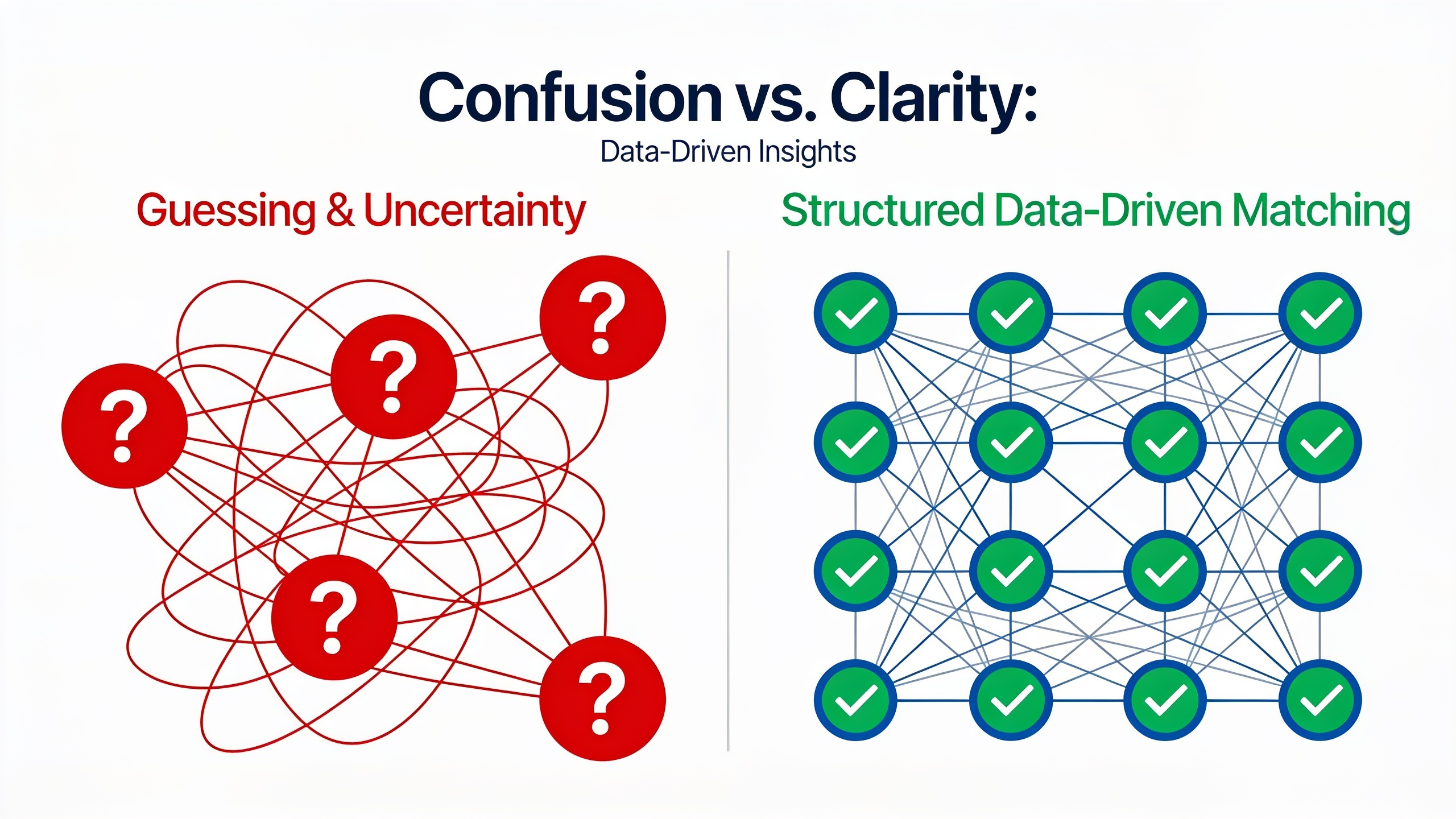
Advisor guesswork is what happens when you pick a consultant, coach, or mentor based on incomplete information: a referral, a search ranking, a directory listing, anything except real evidence that the person has solved your specific problem before. And honestly, it's the default for most businesses. Not because people are lazy, but because until recently there just wasn't a better option lying around.
It usually plays out the same way. A business owner hits a wall. Maybe they're trying to scale a sales team, or plan a go-to-market launch, or migrate off some ancient accounting platform. So they turn to a peer and ask, "Hey, do you know anyone good?" The name they get back might be a genuinely excellent advisor. But excellent at what, exactly? There's zero guarantee that person has actually worked in the owner's industry, at their stage, with their specific technical headache. And directories? They're not much better. They tell you who's available, not who's qualified for the thing in front of you. They almost never say a word about whether the person has bandwidth, whether they'll return your emails, or whether they've done this kind of work well before.
So you end up choosing based on proxies. Reputation. Likability. Whoever happens to be one text message away. None of which actually predict whether the engagement will work. That's the whole problem data-driven matching is trying to solve.
The Hidden Cost of Trial-and-Error Advisor Selection
Trial-and-error advisor selection is expensive in ways that never show up on the invoice. When you pick someone off a referral or a cold search instead of a real evaluation, the bill comes due later. Stalled projects. Mismatched expectations. And that awful moment where you realize you have to start the whole search over with someone new.
Think about what you're really doing when you vet advisors by hand. Multiple discovery calls. Squinting at vague credentials trying to figure out if they mean anything. Checking references who may or may not tell you the truth. Negotiating scope before you even know whether the person has any real depth in your world. Every one of those steps eats hours you could've spent, you know, actually running your business. And if the match turns out wrong, if they didn't have the specialization you needed or couldn't start for months, you're back at square one. Weeks gone. Weeks you didn't have.
This gets really painful when the clock is ticking. A founder in the middle of a raise. A nonprofit staring down a grant deadline. An executive who needs an operational fire put out before the next board meeting. None of these people can afford a leisurely, drawn-out search. Guesswork doesn't just risk a bad result. It risks a slow one, right when speed is the entire game.
How Does Data-Driven Advisor Matching Work?
Data-driven advisor matching works by turning your challenge into a structured brief, then scoring advisors against that brief across defined, evidence-based dimensions, all before a single human conversation takes place. The trick is that it doesn't start with a directory search. It starts with your actual problem.
Advisory Navigator is a good example of how this looks in practice. You describe your challenge in plain English. Something like "I'm scaling my sales team" or "I need a fundraising strategy." No thirty-field intake form. Their Advisory Intelligence Matching Model (AIMM) pulls the context out on its own: industry, urgency, scope, what outcome you're after. Then it turns that plain-language input into a structured Request for Advice, timeline and budget parameters and urgency classification included.
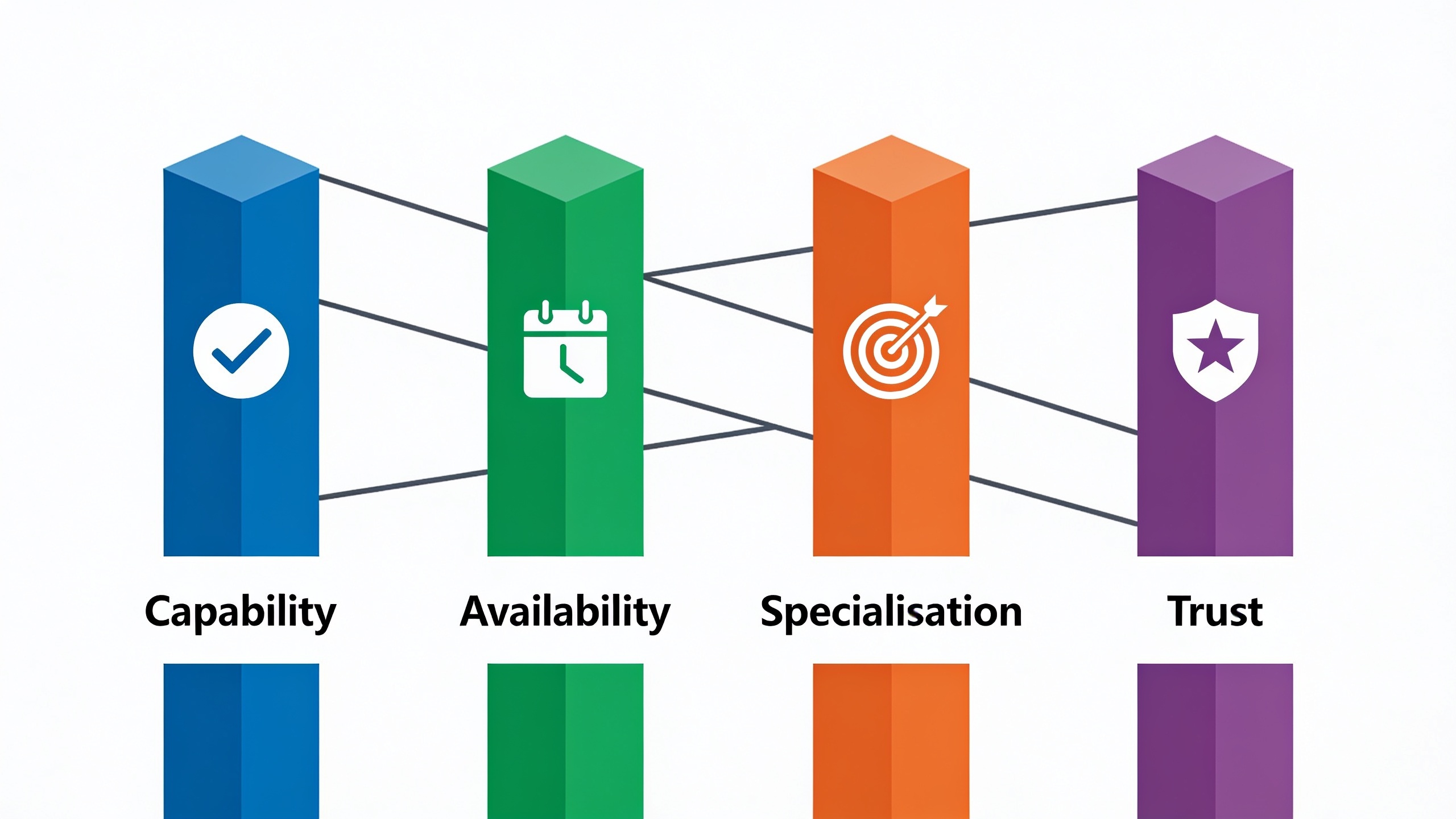
From there AIMM runs every advisor in the network through four dimensions: Capability, Availability, Specialisation, and Trust. Together those spell CAST. It maps your brief against standardized industry classifications (NAICS codes) so you get advisors who are genuinely sector-relevant instead of jack-of-all-trades generalists, and it digs specific domain signals out of your own words. So a brief that mentions "migrating from Handisoft" becomes a precise match signal, not just a fuzzy keyword. That's how you end up connected with, say, an accounting practice technology specialist who's actually done that exact platform migration before. According to Advisory Navigator's own platform data, the system reports a 94% match satisfaction rate and an average time to first connection of 48 hours. Which is a pretty wild contrast to the weeks manual vetting can chew through.
If you want to see the whole thing broken down step by step, Advisory Navigator's guide to how advisor matching works gets into the mechanics of AIMM and the CAST scoring model in a lot more detail.
What Makes the CAST Framework Different From Referrals and Directories?
The CAST framework is different because it scores advisors across four independently verified dimensions instead of leaning on one shaky signal, like "someone recommended them." CAST stands for Capability, Availability, Specialisation, and Trust, and each one answers a question a referral just can't.
Capability asks whether the advisor's skills, tools, and methods have actually been verified against real engagement outcomes. Not self-reported claims puffed up on a LinkedIn bio, but the real thing. Availability asks whether they can start now. And this one's underrated, because a brilliant consultant who's booked solid until next quarter is useless to you if you need help this month, and referrals almost never mention that little detail upfront. Specialisation goes deeper than "works in tech" or "does marketing." It's about the specific domains, industries, and firm types the person knows cold, because when your problem is narrow and technical, depth beats breadth every single time. And Trust is a composite Trust Quotient built from client reviews, communication scores, and professional conduct, updated after every engagement. So it's a living track record, not some glowing testimonial from three years ago that may or may not still be true.
Here's what bugs me about referrals and directories: at best they hand you one or two of these signals. Usually a vague reputation and maybe a rough sense of industry fit. They almost never tell you about current availability or a verified trust history. Which means you're still gambling on the two things most likely to blow up the engagement. Can they actually start soon, and will they actually deliver.
Traditional Search vs. Data-Driven Advisor Matching: A Side-by-Side Look
The gap between the old referral hunt and a structured, data-driven approach really jumps out when you put them next to each other.
| Factor | Traditional Search (Referrals/Directories) | Data-Driven Advisor Matching |
|---|---|---|
| Starting point | Ask peers or browse a directory listing | Describe the challenge in plain language |
| Brief creation | Informal, often verbal, easy to lose detail | Structured Request for Advice generated automatically (AIMM) |
| Industry relevance | Based on general reputation, not verified fit | Mapped to standardized industry codes (NAICS alignment) |
| Specialization check | Self-reported bios, resume-style claims | Domain taxonomy extraction from the actual brief |
| Availability visibility | Often unknown until after initial outreach | Assessed as part of the Availability score before matching |
| Trust verification | Anecdotal, based on a single referral source | Composite Trust Quotient from reviews and conduct history, updated after engagements |
| Typical time to connection | Can take days to weeks of vetting calls | Reported average of 48 hours on Advisory Navigator |
| Reported satisfaction | Not systematically tracked | 94% match satisfaction reported on Advisory Navigator |
To be clear, I'm not saying throw out referrals entirely. A trusted colleague's recommendation still counts for something real. But a referral on its own can't verify current availability or specialization depth the way a scoring model can, and that gap is exactly where trial-and-error tends to fall apart.
How Much Time Does Data-Driven Matching Actually Save?
Data-driven matching mostly saves time by squeezing down the discovery and vetting phase, which is the part where businesses traditionally sink the most hours with the least certainty they'll get anything good out of it. On Advisory Navigator that compression shows up as a three-step path: describe the challenge, get an AI-built brief instantly, meet a scored match. Average time to first connection, 48 hours.
Now compare that to doing it by hand. Without a matching tool, you're sourcing candidate names (which usually means a bunch of conversations with peers and partners), scheduling intro calls with each one, sizing up fit against criteria you probably never wrote down anywhere, and then hashing out scope and pricing before a lick of work gets done. Each of those steps can eat days on its own. And if you're being diligent, you're doing it for more than one candidate, so multiply accordingly.
But the time savings aren't just about going faster for the sake of it. Move quick and you can act on a problem while it's still fresh and clearly defined, instead of watching your momentum leak away during some endless search. For a founder trying to close a round, or an exec under the gun to fix something before the quarterly review, that speed can genuinely be the difference between solving the thing in time and missing the window.
One caveat worth saying out loud: speed only counts if the match is actually good. A fast connection to the wrong advisor is not a win, it's just a quicker way to fail. Which is exactly why Advisory Navigator runs that 48-hour average on top of the CAST model. The point is to cut the wasted time out of the search without cutting the diligence that makes the match reliable in the first place.
A Real-World Case: Breaking Through a Growth Plateau
Sometimes the abstract case only lands when you see it play out. There's a good one over in Advisory Navigator's resource library, how one small business owner finally broke through her growth plateau, and it shows what happens when a business stops swallowing generic advice and gets matched with someone whose specialization actually fits the stage and the obstacle they're stuck on.
And that pattern points to something bigger about advisory relationships. Generic strategic advice, no matter how well-meant, usually doesn't move the needle. Because it isn't calibrated to your real constraints: your industry, your stage, your team size, the specific operational thing that's got you jammed up. A data-driven matching process is built to close exactly that gap. It pulls those precise details out of your own description of the problem and uses them as the basis for scoring, instead of treating every advisory need as some interchangeable widget.
So if you're weighing whether to ditch your referral habit for a structured approach, cases like this make a decent gut check. Ask yourself honestly: has your current process ever actually verified specialization and availability before the first call? Or have you just been trusting somebody else's secondhand opinion and hoping for the best?
How to Avoid Advisor Guesswork in Your Next Search
Avoiding advisor guesswork starts with treating the search as a real decision instead of a casual favor you're calling in. Which means getting explicit about the challenge, the timeline, and what "success" even looks like before you reach out to anybody. Basically the same inputs a model like AIMM grabs automatically, except most manual searches skip them entirely.
In practice? Write the actual problem down in detail. Not "I need help with sales" but "I need to scale a five-person sales team to fifteen within two quarters without tanking our close rates." Ask straight up about the advisor's current capacity before you burn an hour on a discovery call, so you don't find out three weeks deep that they can't start for another two months. Look for evidence of real specialization, meaning has this person actually solved this exact problem in this exact industry, not just something adjacent. And find a trust signal that's more current than a testimonial from the Obama administration.
If you want to get systematic about gathering feedback on advisors after an engagement, or pulling structured input from your team before you even start looking, tools like Curio Surveys can help you build customized surveys for that. Everything from post-engagement satisfaction to internal alignment on what the search actually needs to solve, without getting boxed in by rigid question types or clunky logic rules.
Honestly though, the fastest way to skip the guesswork is to use a process built specifically to kill it. One that scores capability, availability, specialization, and trust before a name ever lands in front of you. Not after you've already spent hours learning the hard way.
Frequently Asked Questions
So what does "data-driven advisor matching" actually mean?
It means using real, structured data to connect you with an advisor. Verified capability, current availability, specific specialization, a trust history. Instead of relying on referrals, directory browsing, or whatever reputation floats around by word of mouth. On Advisory Navigator this runs through the AIMM model and the four-dimension CAST framework.
How's this any different from just using a business advisor directory?
A directory basically lists who's around, without checking whether they fit your specific challenge. Data-driven matching builds a structured brief from your description of the problem and scores advisors against it using standardized industry mapping and specialization signals. So it's doing the vetting work instead of dumping all of it on you.
How long does it usually take to actually get matched?
On Advisory Navigator the reported average time to first connection is 48 hours, from the moment you describe a challenge to meeting a scored advisor. That's the platform's own number, and it can shift depending on how complex and specific your request is.
Can this stuff still get it wrong?
Sure. No matching process can promise a perfect outcome every time, because advisory relationships come down to more than data. Communication style and plain old working chemistry still matter. What a model like CAST does is knock out the risk of a fundamentally mismatched search by verifying capability, availability, specialization, and trust before you invest time in a conversation. It's not trying to remove human judgment, just the dumb luck.
Is this only for big companies?
Nope. It works just as well for small business owners, startup founders, nonprofit leaders, and corporate execs alike. Anybody trying to solve a specific problem is better off with a process that verifies fit up front than one riding on who happens to be in their contacts.
Picking an advisor shouldn't feel like rolling dice on a name somebody happened to mention. When the search is built on verified capability, real availability, genuine specialization, and an honest trust record, you spend less time vetting and a lot more time actually solving the thing that sent you looking for help.