
Below, I'll walk through how the matching actually works, what happens behind the curtain when you hit submit, and how the scoring decides who's a genuine fit versus who just happens to be free that week.
Table of Contents
- What Is Advisor Matching, and Why Does It Matter?
- How Advisor Matching Works: The Three-Step Process
- Inside AIMM: The Engine Behind the Matches
- The CAST Framework: How Advisors Are Scored
- What Happens After You're Matched
- How This Compares to Traditional Advisor Search Methods
- Who Uses AdvisoryNavigator, and For What
- Frequently Asked Questions
What Is Advisor Matching, and Why Does It Matter? {#what-is-advisor-matching}
Advisor matching is the process of pairing a specific business challenge with an advisor, coach, or mentor whose actual skills and experience fit that problem, rather than just handing you whichever generalist happens to be available. And it matters because getting it wrong is expensive. Hire the wrong consultant and you lose time, money, and momentum, and usually end up starting the whole search from scratch a few months later, poorer and more annoyed.
For a long time this all happened through referrals, cold outreach, or those static directories where everybody looks equally qualified on paper. There was never any real way to compare one "fractional CFO" against another beyond a resume and your gut. AdvisoryNavigator's whole bet is that we don't need to keep guessing like this anymore. Instead of you doing the vetting, the AI pulls out the specifics of your situation (industry, stage, urgency, scope) and scores every advisor in its network against those specifics before you even see a single name.
This matters most for the people who don't have time to interview five consultants just to find the one who gets their niche. Honestly, if you're a small business owner and your growth has stalled, you often don't even know what kind of expert you need. Is it a hiring problem? A systems problem? A cash flow thing? You just know something's off. Advisor matching is supposed to take that vague "something's broken" feeling and turn it into a specific brief plus a shortlist of people who've solved that exact thing before.
How Advisor Matching Works: The Three-Step Process {#the-three-step-process}
At AdvisoryNavigator it comes down to three moves: describe your challenge, let the AI build a structured brief, and meet advisors scored against that brief. The company likes to say there are "no forms" and "no guessing" involved. The idea is that it works more like a conversation that turns into a match.
Step 1: Describe Your Challenge in Plain Language
It starts with a text box. Not a five-page intake form, just a box that asks: "What are you trying to solve?" You can go broad ("scaling my sales team") or hyper-specific ("migrating from Handisoft to a new practice management platform"). AdvisoryNavigator's own examples of popular requests include scaling a sales team, fundraising strategy, and building a go-to-market plan, which is a pretty wide spread, from scrappy early-stage startup stuff to more operational, established-business headaches.
And you don't need to talk like a McKinsey deck. No jargon, no checkboxes. You're just told to be as specific as you can about your industry, your business stage, and the kind of help you want, because the AI pulls context straight out of your own words. The more you tell it about where your business actually is and what "solved" would even look like, the sharper the classification.
Step 2: Your Brief Is Built Instantly
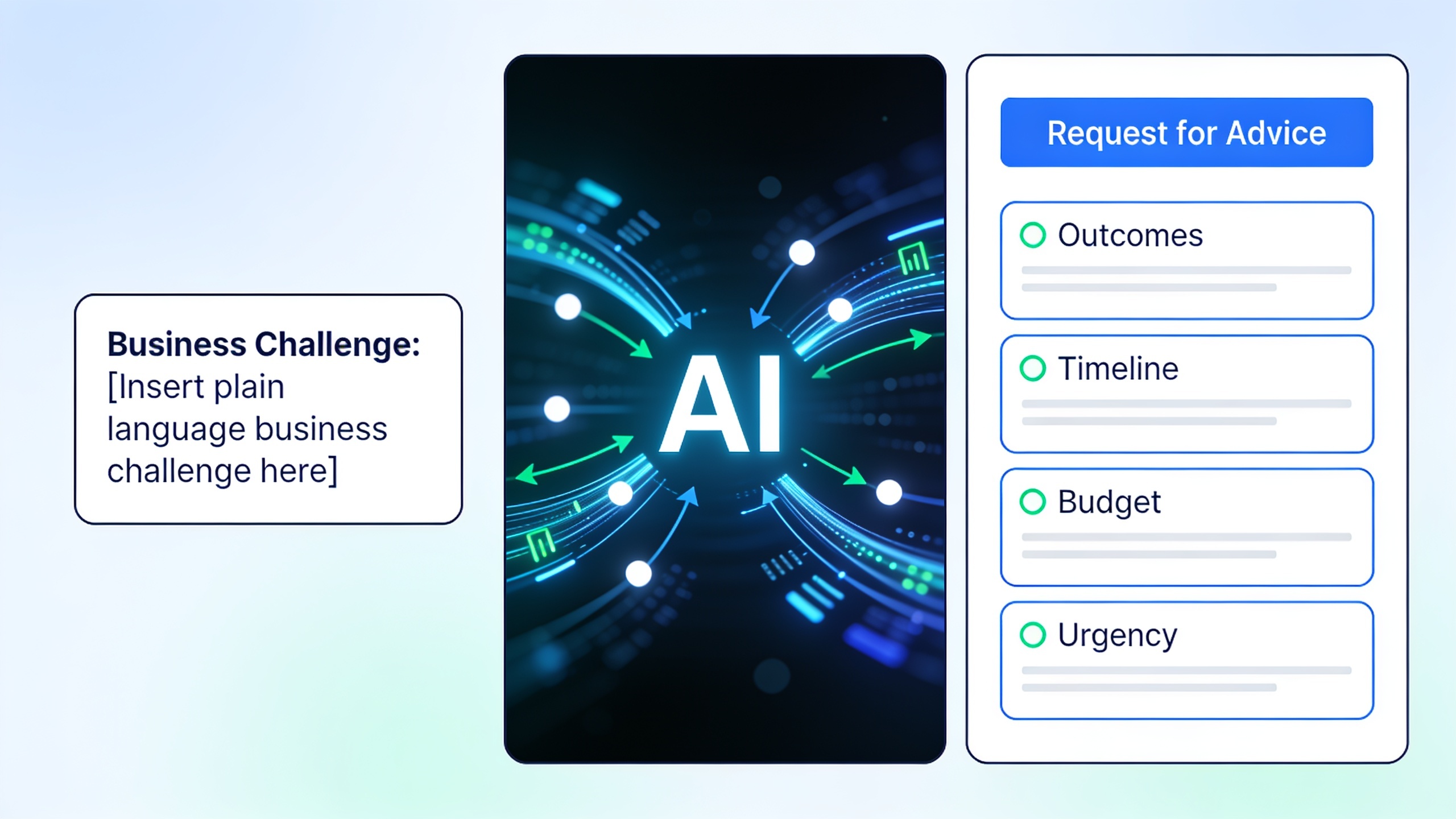
Once you've described the problem, AdvisoryNavigator's matching engine (it's called AIMM) turns your plain-language description into what they call a structured Request for Advice. That brief covers your desired outcomes, a timeline, a budget, and an urgency rating, all generated automatically from what you typed rather than from a bunch of dropdown menus.
This is the part where it really parts ways with a normal directory search. A directory assumes you already know the right filters: job title, industry tag, price range. AIMM reads your description the way a good human intake coordinator would and figures out the filters for you. Mention you're "migrating from Handisoft" and that phrase itself becomes a precise match signal, instead of something you'd have to go hunt for in a dropdown of software platforms.
Step 3: Meet Your Match
With the brief built, AdvisoryNavigator scores the advisors in its network against it across four dimensions: Capability, Availability, Specialisation, and Trust. (Together that's the CAST framework, which I'll get into properly below.) You see who fits and, according to the company, why they fit, before you connect with them directly. No cold outreach, no wading through a list of unranked names. The matches come with their fit scores already attached.
That's the core of the whole thing. It's built to squeeze what might otherwise be weeks of networking and vetting into a few minutes for the brief-building, and up to 48 hours on average for that first connection, per the company's numbers.
Inside AIMM: The Engine Behind the Matches {#inside-aimm}
AIMM, which stands for the Advisory Intelligence Matching Model, is the AI system that turns your plain-language description into a scored shortlist of advisors. AdvisoryNavigator describes it as matching that "understands context, not just keywords." In other words, it isn't just searching for advisors whose profiles happen to contain the same words you typed. It builds a taxonomy of your problem first, then scores alignment before anything shows up on screen.
It works across three specific jobs, based on how the company describes it. The first is NAICS industry alignment: AIMM maps your brief to standardized industry codes (NAICS is the North American Industry Classification System used across the US and Canada) to find advisors who actually work in your sector, not generalists who claim to work with "all industries." This fixes a really common frustration. Someone who's helped a dozen SaaS companies isn't automatically right for a non-profit or a construction firm, even if their consulting toolkit looks similar on paper.
The second job is domain taxonomy extraction, which is just a fancy way of saying it picks up specialist subdomains from the exact language you use. AdvisoryNavigator's own example says it best: "migrating from Handisoft" becomes a precise match signal rather than a generic "accounting software" tag. That distinction is everything for niche technical problems, where the gap between a generalist and a specialist is the gap between someone who's read about a platform migration and someone who's actually done one at 2am while the client panics.
And the third is CAST score alignment, where every advisor who could plausibly fit gets ranked against their live Capability, Availability, Specialisation, and Trust scores.
Because AIMM starts from your original description instead of a rigid set of category filters, it's meant to handle the messiness of real business problems, which almost never fit into a single tidy dropdown. Take a business owner describing a "sales team that's stalled at $2M in revenue." That's really a tangle of hiring, process, and maybe pricing issues all knotted together, and AIMM's job is to pull that apart into the subdomains and industry context needed to find someone who's actually climbed off that exact plateau before.
If you want to see how this AI-driven approach stacks up against just asking your network for a name, AI Matching vs. Referrals: Which Finds Better Advisors? digs into that comparison, including where referrals still win and where structured matching tends to pull ahead.
The CAST Framework: How Advisors Are Scored {#the-cast-framework}
The CAST framework is the four-part scoring system AdvisoryNavigator uses to size up every advisor in its network: Capability, Availability, Specialisation, and Trust. The company frames it as boiling everything down to "one score" so you always know what you're getting and why, instead of leaning on self-reported bios or star ratings.
Each dimension gets evaluated on its own, then they're combined into a fit score against your specific brief. Here's what each one is actually measuring, in the company's own words:
| CAST Dimension | What It Measures | Why It Matters for Matching |
|---|---|---|
| Capability | Skills, tools, and methods verified against real engagement outcomes — not self-reported claims | Ensures the advisor's expertise is backed by actual results, not just a polished profile |
| Availability | Capacity to take on your engagement right now | Prevents matches with advisors who are qualified but can't start for months |
| Specialisation | The domains, industries, and firm types the advisor knows cold | Prioritizes depth over breadth, since generalists don't solve highly specific problems |
| Trust | A composite Trust Quotient drawn from client reviews, communication scores, and professional conduct | Updated after every engagement, giving a live picture of reliability rather than a static rating |
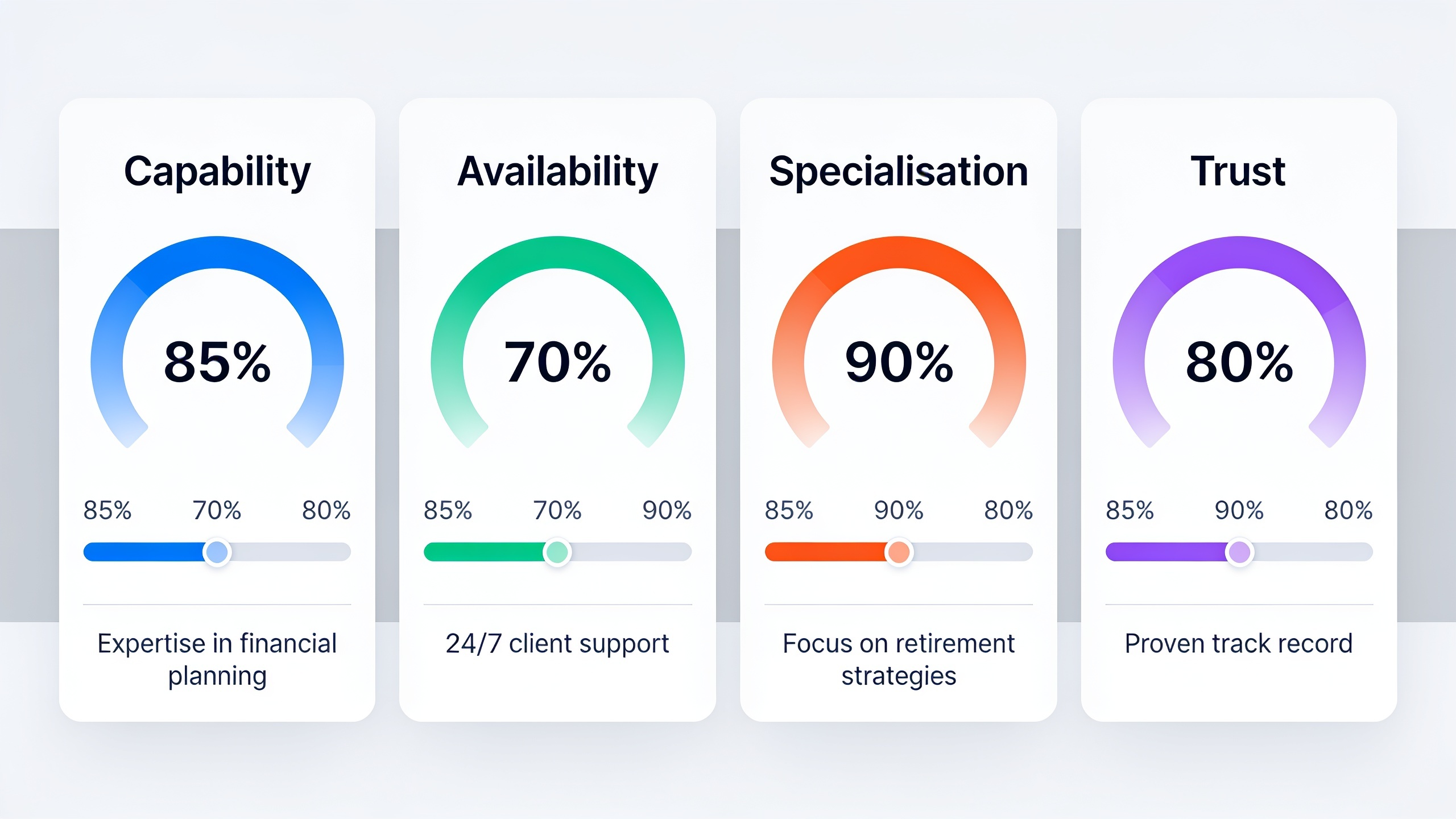
The Trust piece is worth slowing down on, because it's the one tied most directly to an advisor's track record. AdvisoryNavigator calls it the Trust Quotient, or TQ Score, and it shows up right on the advisor profiles. In one example profile on their site, an accounting practice technology specialist with 12 years of platform migration experience carries a TQ Score of 72.2, built from client reviews and professional conduct data and refreshed after every engagement rather than frozen at onboarding.
Why does that matter? Because a single glowing five-star review from three years ago tells you basically nothing about whether the person is still delivering today. A score that keeps updating is meant to reflect current performance, not just old reputation.
And because the CAST scores are broken out by dimension, the matching isn't simply ranking advisors "best" to "worst." It shows you where each person is strong and where they might not be your ideal fit. You could get an advisor with killer Specialisation and Trust scores for your industry but thin Availability right now, which is genuinely useful to know upfront and something no static directory listing would ever tell you. If you'd rather see a wider breakdown of how this scoring holds up next to competing platforms, Boardy.ai Alternative: How AdvisoryNavigator Stacks Up (And Which One You Actually Need) covers that head-to-head.
What Happens After You're Matched {#what-happens-after}
Once your matches come back, you connect straight with the advisor. No middleman booking process, no extra gatekeeping. AdvisoryNavigator calls it a "private, professional workflow," and reports a 94% match satisfaction rate along with that average 48-hour time to first connection, based on its own platform data.
But the matching doesn't just stop the second you're introduced. The Trust part of CAST is described as "updated after every engagement," so the system keeps learning from outcomes rather than treating a match as a one-and-done transaction. That creates a feedback loop: the more businesses work with advisors through the platform, the more each advisor's Trust Quotient becomes a current reflection of how they actually perform, not just how they pitched themselves during onboarding.
For advisors, the whole thing runs in reverse but follows the same logic. AdvisoryNavigator invites advisors, consultants, coaches, and fractional executives to build a CAST profile once, generated from what it calls "a short onboarding conversation" instead of some marathon application. After that, advisors get "inbound connections from firms aligned to your specialty" rather than having to chase referrals or cold-pitch clients. Their live Trust Quotient is visible to every matched requestor, which means there's a real, ongoing incentive to keep client outcomes and communication strong, since that score is part of what decides whether they show up in future matches at all.
One more thing worth knowing: AdvisoryNavigator has said it's currently running a pilot capped at 100 seats. So this is an early-growth platform, not something operating at massive scale yet, which is useful context if you're weighing whether to jump in now or hang back.
How This Compares to Traditional Advisor Search Methods {#how-this-compares}
The big difference between AI-driven scoring and the old ways really comes down to who does the vetting: you or the platform. Referrals, directories, cold outreach, they all have genuine strengths. But they share one limitation: none of them score fit against your specific brief before you burn an hour on a call.
| Method | How You Find an Advisor | Vetting Burden on You | Time to First Connection |
|---|---|---|---|
| Referral from your network | Ask colleagues, investors, or peers for a name | High — you still need to interview and assess fit yourself | Varies widely; often weeks |
| Online directory | Browse listings, filter by category or price | High — most directories don't verify outcomes or current availability | Varies; you do the outreach |
| Cold outreach / LinkedIn | Search and message advisors directly | Very high — no fit signal at all before first contact | Unpredictable, often slow |
| AdvisoryNavigator (AI matching) | Describe your challenge; AIMM builds a brief and scores advisors via CAST | Lower — fit scoring happens before you see results | Reported average of 48 hours |
None of this means the old methods are useless, by the way. A strong personal referral from someone who's actually worked with an advisor still carries real weight, and AdvisoryNavigator's own Trust Quotient is partly built from the same kind of qualitative signal (client reviews, communication scores) that makes referrals valuable in the first place. The difference is that the platform tries to systematize that signal across a whole network instead of relying on whichever referral happens to land in your inbox.
It's also worth noting this is part of a bigger shift toward AI-assisted discovery across all sorts of industries, from professional services to real estate. A platform like Viviendalista is trying to streamline how people search and evaluate property listings instead of digging through scattered classifieds, and AdvisoryNavigator applies pretty much the same logic to advisors: swap the fragmented manual hunt for a structured, criteria-based match.
Who Uses AdvisoryNavigator, and For What {#who-uses-it}
The company's stated popular requests are a decent window into who's actually showing up. The three they highlight (scaling a sales team, fundraising strategy, and building a go-to-market plan) cover a lot of ground, from early-stage startups raising money to more established companies trying to fix their revenue operations.
Small business owners in a growth phase tend to come knocking when they've hit a plateau they can't diagnose on their own. The "scaling my sales team" example is a really common entry point, since sales bottlenecks can come from hiring, process, comp structure, or market positioning, and it's honestly not always obvious which one is the actual culprit. Corporate executives chasing operational efficiency might use the same process to find someone with narrow, technical expertise, like that platform migration and change management specialist in AdvisoryNavigator's example profile, who focuses on accounting practice technology across Handisoft, MYOB Practice, Karbon, and XPM.
Startup founders often turn up with the "fundraising strategy" or "go-to-market plan" type of challenge, where the whole value of matching is finding someone who's specifically raised capital or launched products in a comparable industry and stage. Not just someone with a general finance or marketing background who'll wing it. Non-profits looking for advisory help to grow their impact would get similar mileage out of AIMM's NAICS industry alignment, since it's built to route requests toward advisors with genuine sector experience rather than for-profit generalists who might not grasp non-profit funding models or governance at all.
And then there are the advisors themselves, who are a core part of the user base, because the platform is deliberately built to run both directions. An advisor with a strong specialty who's sick of chasing referrals can build a CAST profile once and start receiving matched opportunities aligned to that specialty. That's a structural break from lead-gen models that live and die on constant manual outreach or pay-per-lead spending.
Frequently Asked Questions {#faq}
What if I honestly don't know what kind of expert I need?
That's fine, and it's kind of the point. You don't need to know the exact title or category. AIMM is built to pull your industry, urgency, and scope straight out of a plain-language description, then classify it into a structured Request for Advice for you. So you can describe a symptom (a stalled sales team, say) instead of a diagnosis, and let the system figure out which type of specialist actually fits.
What is the CAST framework and why should I care?
CAST stands for Capability, Availability, Specialisation, and Trust, the four dimensions AdvisoryNavigator uses to score every advisor in its network. It matters because it swaps vague, self-reported qualifications for a structured score built from verified outcomes, current capacity, depth of niche experience, and an ongoing Trust Quotient that updates after every engagement. Together, they're meant to take a lot of the guesswork out of picking someone.
How long does it actually take to get matched?
The brief-building happens instantly once you describe your challenge, and the company reports an average time to first connection of 48 hours across its platform. Real-world timing can vary depending on how many advisors are available for your particular niche and how complex your request is.
Is this only for startups, or does it work for established businesses too?
Both. The stated popular requests mix startup-flavored needs like fundraising strategy with more operational ones like scaling a sales team, and the example advisor profile (a 12-year accounting practice technology specialist) is about as far from purely startup-centric as you can get. The target users span small business owners, corporate execs, entrepreneurs, and non-profits.
Can advisors join, or is it only for businesses looking for help?
Advisors, consultants, coaches, and fractional executives can absolutely build a profile too. The company describes it as building a CAST profile once, generated from a short onboarding conversation, after which advisors get inbound connections from businesses matched to their specialty instead of grinding out referrals or cold outreach. As of this writing, AdvisoryNavigator has noted it's running a pilot limited to 100 seats.
Look, finding the right advisor shouldn't mean months of trial and error or crossing your fingers that someone useful happens to be in your network. By turning a plain-language description of your problem into a structured brief and scoring real advisors against it across Capability, Availability, Specialisation, and Trust, AdvisoryNavigator is built to get you talking to someone who's actually solved your specific problem before. Not just someone who was free to take the call.