
So let me walk through how each one actually works, where each one quietly falls apart, and why a growing crowd of small business owners, startup founders, corporate execs, and nonprofit leaders are rethinking the whole hunt.
Table of Contents
- What's the Real Difference Between AI Matching and Referrals?
- How Do Referrals Actually Work When Finding Business Advisors?
- How Does AI-Driven Advisor Matching Work?
- AI Matching vs Referrals: A Side-by-Side Comparison
- What Are the Hidden Risks of Relying on Referrals Alone?
- When Does AI Matching Outperform Referrals — and When Doesn't It?
- How Should Advisors Position Themselves as Buyers Shift to AI Matching?
- Frequently Asked Questions
What's the Real Difference Between AI Matching and Referrals?
The core difference is where the recommendation comes from: a referral comes from a personal relationship, while AI matching comes from a structured evaluation of an advisor's capability, availability, specialization, and reputation measured against your specific problem.
Think about what a referral really is. It's a suggestion from someone you already know. A fellow founder, a colleague, a friend from some professional group, pointing you at an advisor they've worked with or at least heard nice things about. It's quick to ask for, and it feels good, because the recommendation borrows the trust of an existing relationship. AI matching is the opposite kind of animal. It's a software process where an algorithm reads the details of your problem, cross-references them against a pool of vetted advisors, and scores each one before you ever lay eyes on a name.
Underneath, though, both are chasing the same fear: hiring an advisor who doesn't actually get your problem. They just go about reducing that fear differently. One uses social proof. The other uses data. Neither is a scam and neither is bulletproof, and here's what matters, they fail in completely different ways. That's the whole reason the comparison is worth having.
How Do Referrals Actually Work When Finding Business Advisors?
Referrals work by transferring trust from a personal relationship onto a stranger: somebody you trust vouches for an advisor, so you extend a little provisional trust to that advisor before you've checked a single thing yourself. It's the oldest method for finding business advisors and still the most common one, especially among small business owners and startup founders who lean hard on the people they already know.
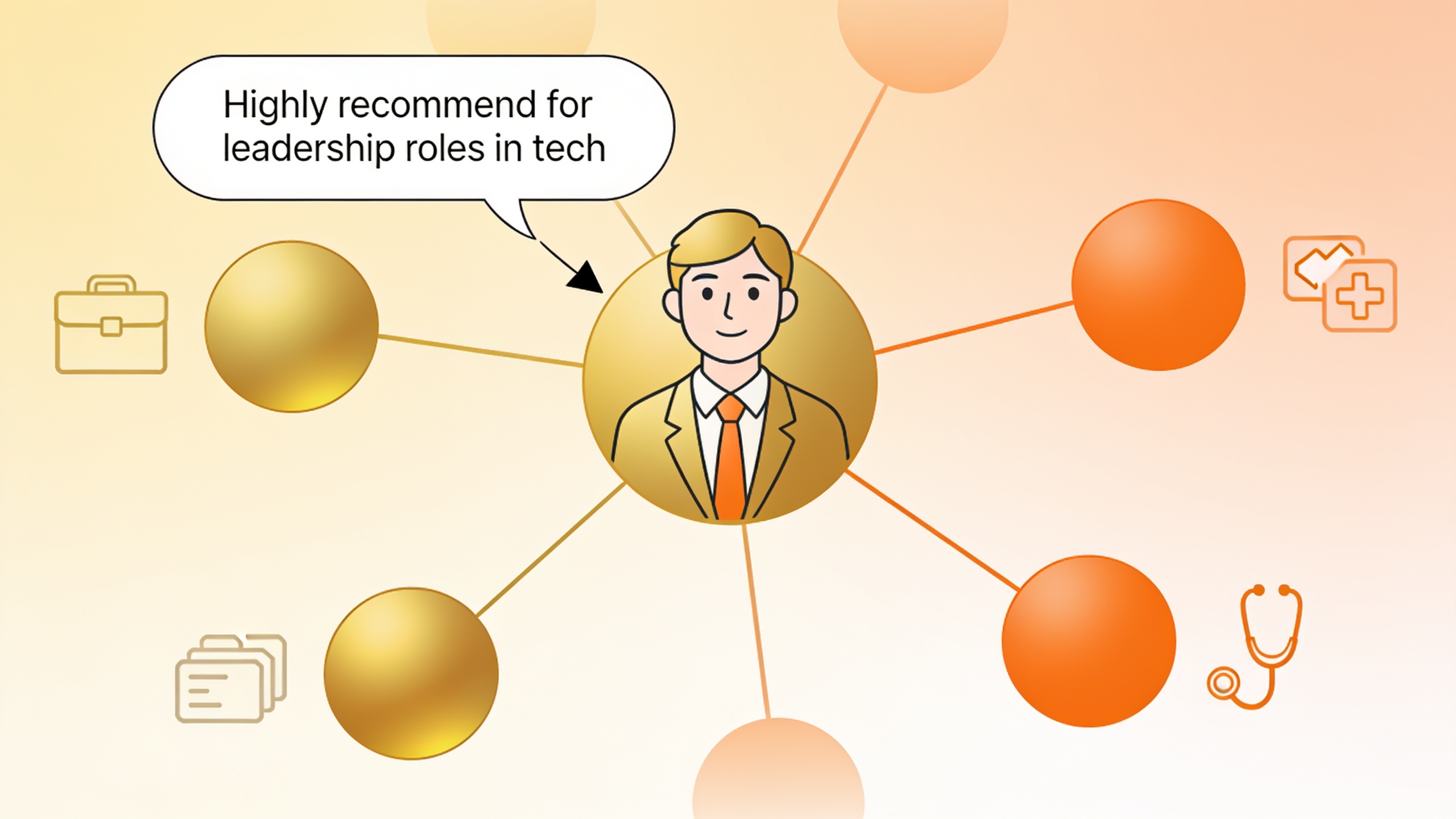
And I get the appeal. A tip from a peer who's "been there" feels way lower-risk than a cold search, and it usually comes bundled with the good stuff. How the advisor communicates. What they charge. Whether they answer their email. For a founder scaling a sales team, or a nonprofit director hunting for a grant strategist, a warm intro from someone they trust can shave weeks off the vetting slog.
But a referral is, structurally, a sample size of one.
You're using a single person's experience, sometimes an experience from years ago, as a stand-in for how that advisor will perform on your problem, in your industry, at your stage. It's a little like booking an international trip off one friend's memory of a vacation they took three years back, instead of actually checking current flights, hotel availability, and reviews. Travelers figured this out a while ago. They use dedicated tools like Global Holiday Planner to compare flights, hotels, and insurance systematically rather than trusting pure word-of-mouth, and businesses are drifting toward the same instinct with advisors, wanting a structured way to size someone up instead of leaning on one secondhand story.
There's also the geography problem. Referrals are stuck inside your social and physical circle. If nobody in your network has ever solved your exact issue, say, migrating accounting platforms, or building a go-to-market plan for some weird niche B2B product, the referral well dries up fast. And you end up with a name that's "close enough" rather than actually right.
How Does AI-Driven Advisor Matching Work?
AI-driven advisor matching works by turning a plain-language description of your problem into a structured brief, then scoring available advisors against that brief on several dimensions before handing you a ranked, explainable result. That's the part that strips out the guesswork referrals leave sitting on the table.
On Advisory Navigator, for instance, the whole thing runs through what they call the Advisory Intelligence Matching Model, or AIMM. You describe your challenge in normal human words. "Scaling my sales team." "Fundraising strategy." "Go-to-market plan." The system pulls out the context on its own, industry, urgency, scope, without making you slog through a wall of tick-box forms. That gets turned into a structured Request for Advice with your desired outcomes, timeline, budget, and an urgency classification, according to Advisory Navigator's own platform description.
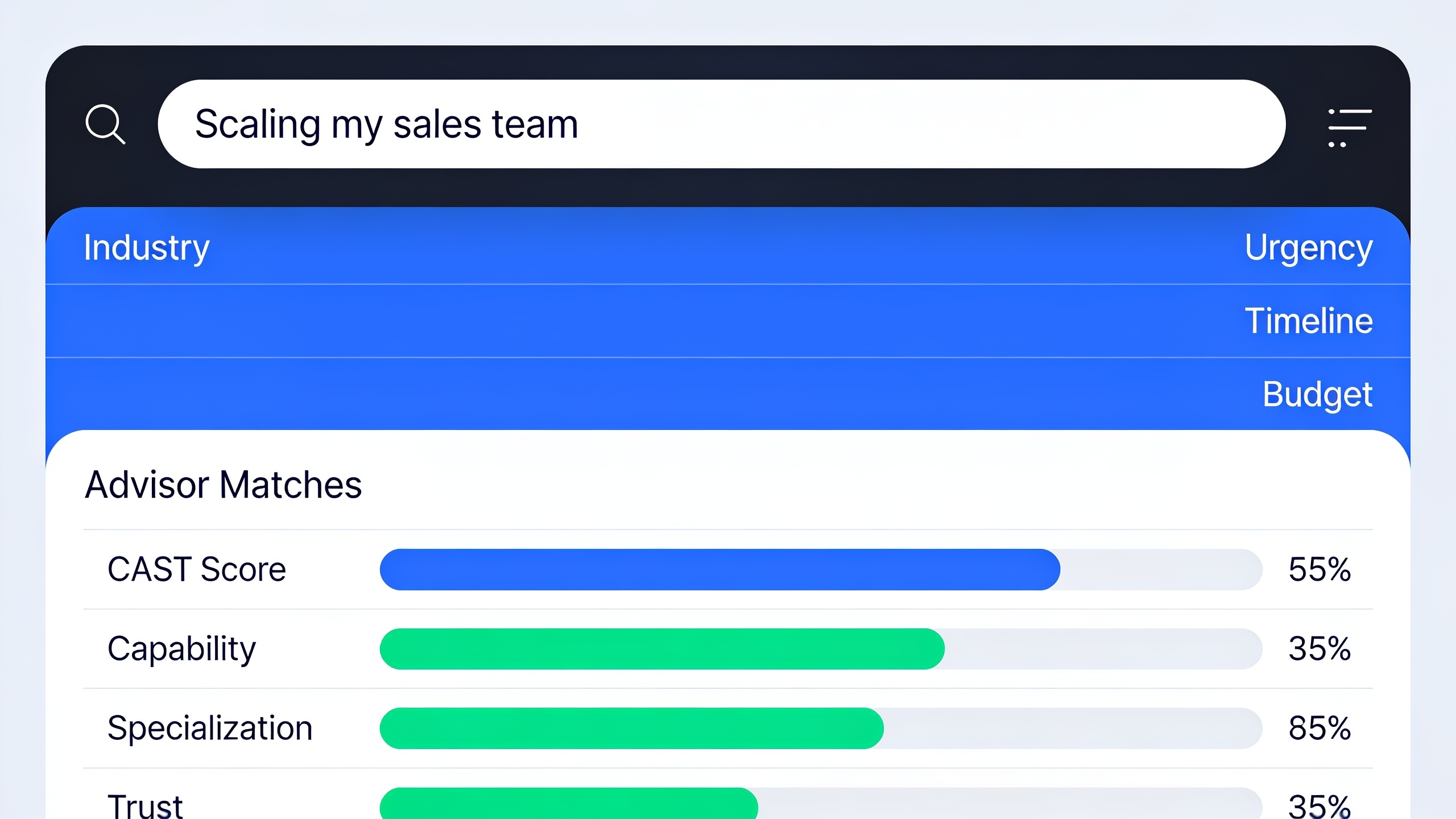
From there, advisors get scored on four things the platform calls the CAST framework. Capability, meaning skills and methods checked against real engagement outcomes rather than whatever the advisor claims about themselves. Availability, meaning do they actually have room to start soon, not three months from now. Specialisation, meaning real depth in a domain instead of generalist mush. And Trust, a composite pulled from client reviews, communication scores, and professional conduct, updated after every single engagement. The matching engine also maps your brief to standardized industry classifications (NAICS codes) so you get sector-relevant advisors instead of jacks-of-all-trades, and it lifts specialist subdomains straight out of your own wording. So a phrase like "migrating from Handisoft" becomes a precise match signal instead of getting swallowed by some generic keyword search.
If you want the real technical guts of how a system like this gets built and scored, What Is AI Advisor Matching? A Complete Guide goes deeper into the mechanics. And on the numbers, Advisory Navigator reports a 94% match satisfaction rate and an average time to first connection of 48 hours. Which, not coincidentally, are the exact two things referrals can never really promise you: fit and speed.
AI Matching vs Referrals: A Side-by-Side Comparison
Line them up next to each other and the tradeoffs get obvious: referrals win on emotional trust and near-zero setup, while AI matching wins on speed, breadth, and being upfront about why a match happened.
| Factor | Referrals | AI Matching |
|---|---|---|
| Speed to first contact | Depends on your network; can take days to weeks | Advisory Navigator reports an average of 48 hours to first connection |
| Pool of candidates considered | Limited to who your contacts happen to know | Scored across a broader advisor pool using structured criteria |
| Basis for the match | Personal experience and word-of-mouth trust | Capability, Availability, Specialisation, and Trust (CAST) scoring against your brief |
| Transparency of "why this advisor" | Often informal or anecdotal | Explainable fit scoring shown before you connect |
| Bias risk | High — limited to your existing network's blind spots | Reduced, but dependent on the quality and diversity of the advisor pool |
| Effort required to initiate | Low — a message or introduction | Low — describe the challenge; AI builds the brief automatically |
| Verification of claims | Often based on reputation, not documented outcomes | Capability is evaluated against real engagement outcomes, not self-reported claims |
| Best suited for | Founders with strong, relevant networks and time to vet manually | Businesses needing speed, precision, or access outside their existing network |
I'm not putting this table up to crown a winner. It's here to show the two methods optimize for genuinely different things. A well-connected founder with time on their hands? They'll probably do fine with a referral. But a time-crunched executive trying to crack some niche operational headache, or a founder whose network just doesn't happen to hold the right person, that's who benefits most from a system built on explainable scoring instead of anecdote.
What Are the Hidden Risks of Relying on Referrals Alone?
The biggest hidden risk of leaning only on referrals is that they inherit the blind spots of the network that produced them. If nobody in your circle has actually solved your specific problem, referrals literally cannot surface the right person, no matter how good the intentions behind them.
This plays out in a few predictable ways. For one, referrals pile up around a handful of famous names, the advisor everyone in the local business group already knows, which means that person often ends up overbooked and stretched thin even if they're genuinely great. For another, referrals almost never tell you about real-time availability. You get introduced to someone fantastic and then find out they can't touch your project for three months. That's exactly the mess Advisory Navigator's Availability dimension is designed to catch before a match ever reaches you.
And then there's the one nobody talks about: social pressure. When a peer vouches for someone, walking away feels rude, even when the fit turns out to be mediocre, because saying no to the advisor feels like second-guessing the friend who recommended them. That awkwardness basically doesn't exist with a data-driven match. The relationship starts clean, and it's the fit score doing the introducing, not a favor.
None of this makes referrals worthless, to be clear. A recommendation from someone whose judgment you actually trust, who's worked with the advisor in a genuinely comparable spot, is still gold. But if referrals are your only method, you've quietly accepted the size of your own network as the ceiling on your entire search. That's a rough ceiling.
When Does AI Matching Outperform Referrals — and When Doesn't It?
AI matching tends to beat referrals when speed, precision, and reach beyond your own network matter most; referrals hold their ground when the relationship history and the informal context around an advisor matter more than sheer breadth of options.
AI matching has a built-in edge when the problem is specific and the clock is ticking. A nonprofit that suddenly needs a grant-compliance specialist. A startup founder mid-migration between accounting platforms, that "Handisoft migration" specialist Advisory Navigator uses as its own example. In those cases a system that can extract the exact language and route it to a real specialist beats crossing your fingers that someone in your Slack knows the right person. And because Advisory Navigator scores against Capability, Availability, Specialisation, and Trust, you actually see why the match was made instead of just nodding along to secondhand reassurance.
Referrals still earn their keep when relationship continuity is the whole point. Say a corporate executive wants an advisor who already understands the company's internal politics from a past project. Or an advisor whose reputation inside a tight-knit world, like a regional nonprofit network, carries information you'd never capture in a profile. There, the referral isn't just a name. It's inherited context, and a first-time match can't fake that.
Honestly, though? The realistic answer is that these two aren't enemies. Plenty of business owners now use AI matching to pull up a fast, well-scored first option, then run it past a peer or two to sanity-check before signing anything. Using each tool for what it's genuinely good at, rather than pretending one has to lose.
How Should Advisors Position Themselves as Buyers Shift to AI Matching?
If you're an advisor who wants a steady stream of new clients, you need to stop treating referrals as your only faucet and start building a discoverable, verifiable profile that a matching system can actually read and score. This goes for independent consultants and coaches every bit as much as fractional execs.
The real shift here is going from chasing referrals to receiving matches. On Advisory Navigator, an advisor builds a CAST profile once, generated from a short onboarding conversation, and that profile then becomes visible to businesses whose briefs line up with the advisor's specialty. The platform describes it as including a live Trust Quotient that every matched requestor can see, plus inbound connections from firms aligned to the advisor's niche. No cold-pitching. No praying a peer remembers your name at exactly the right moment.
That's a big deal for advisors whose entire growth has run on word-of-mouth. Picture someone with deep, narrow expertise, like platform selection and migration for accounting practices. That person might be the perfect fit for a business, but if that business's network happens to include nobody who knows them, the referral pipe never connects. Ever. Structured matching gives that same specialist a shot at being found on the substance of what they know rather than the size of their address book. If you're an advisor weighing whether any of this is worth your time, there's a fuller breakdown of the lead-gen case in 7 Reasons Business Advisors Should List on AdvisoryNavigator for Better Advisor Lead Generation.
Frequently Asked Questions
Is AI matching actually more accurate than a personal referral?
Depends what you're measuring. A referral is only as accurate as the fact that your friend had a genuinely comparable experience, and that's rarely something you can verify. AI matching, at least on platforms like Advisory Navigator, scores advisors against a structured brief across defined dimensions (Capability, Availability, Specialisation, Trust), so the basis for the match is visible and explainable instead of just a good vibe from someone you know.
Can I use both AI matching and referrals at once when I'm hunting for an advisor?
Yep, and loads of business owners already do. The common play is to use an AI matching platform to quickly surface a scored shortlist, then run any strong referral names through the same kind of informal vetting, checking availability, recent outcomes, and specialization, before you commit to anyone.
Do these platforms mean I can skip checking an advisor's background myself?
No. AI matching narrows the field and hands you structured scoring, but you should still have real conversations with a matched advisor before you sign on. Advisory Navigator's model is built to take the guesswork out of finding the right advisor, not to yank your own judgment out of the final call.
Why do sincere referrals still lead to a bad fit sometimes?
Because a referral captures one person's experience under one set of conditions, different business stage, different industry, different urgency, and that context doesn't always carry over. An advisor who was brilliant for a friend's manufacturing company scaling to 50 people might be totally wrong for a two-person SaaS startup raising a seed round, even though the recommendation was made with the best intentions.
How much faster is AI matching than waiting on a referral?
Referral timelines are all over the map depending on how responsive your network is, anywhere from a same-day intro to weeks of asking around. Advisory Navigator states an average time to first connection of 48 hours, since the matching kicks off the moment you describe your challenge rather than waiting on someone else's calendar to make the introduction.
At the end of it, picking between AI matching and referrals for finding a business advisor was never really an either-or. Referrals carry the weight of lived experience. AI matching carries the speed and reach of structured evaluation. The businesses that come out ahead are the ones who understand what each method is genuinely good at, and then reach for the right one for whatever problem is actually staring them in the face.