
Both Boardy.ai and AdvisoryNavigator claim to fix this with AI matching. But once you actually look under the hood, they're solving pretty different problems. This is my attempt to lay out how they compare so you can figure out which one fits your situation, or whether you should just use both.
Doesn't matter if you're a small business owner trying to punch through six figures, a founder assembling your first advisory board, or an advisor yourself trying to drum up decent leads. Pick the right platform and you save yourself months of flailing. Pick the wrong one and you've torched budget on introductions that go nowhere. So let's get into it.
Table of Contents
- What Is Boardy.ai and What Is AdvisoryNavigator?
- Boardy.ai vs. AdvisoryNavigator: Core Feature Comparison
- How Does Matching Methodology Differ Between the Two Platforms?
- Which Platform Fits Different Use Cases?
- Why Look for a Boardy.ai Alternative?
- How Much Do These Platforms Cost?
- Advisor Matching Platform Comparison: Making the Final Call
- Frequently Asked Questions
What Is Boardy.ai and What Is AdvisoryNavigator?
Boardy.ai is an AI-powered networking and introduction platform that uses conversational AI (often a voice or chat intake) to learn your goals and then plug you into relevant people in its network. AdvisoryNavigator, over at advisorynavigator.com, is an AI advisor matching platform built to connect businesses, nonprofits, and executives with vetted advisors, coaches, and mentors who've actually done the thing you're struggling with.
The real difference is intent. Boardy.ai is basically a relationship accelerator. It wants to widen your circle, surfacing investors, founders, and peers based on general compatibility signals. AdvisoryNavigator is built around one blunt question: "Tell us your challenge, and we'll match you with someone who's already solved it." And that one difference ripples through everything, from how the intake feels to how you'd even measure whether it worked.
If you're a small business owner staring down a cash flow crunch, or a nonprofit director trying to move the needle on program impact, or a founder gearing up for a Series A, that distinction is the whole ballgame. Broad networking tools are great for fattening up your Rolodex. Advisor matching platforms exist to solve one defined problem, with one defined expert, on a defined timeline. Different jobs.
Boardy.ai vs. AdvisoryNavigator: Core Feature Comparison
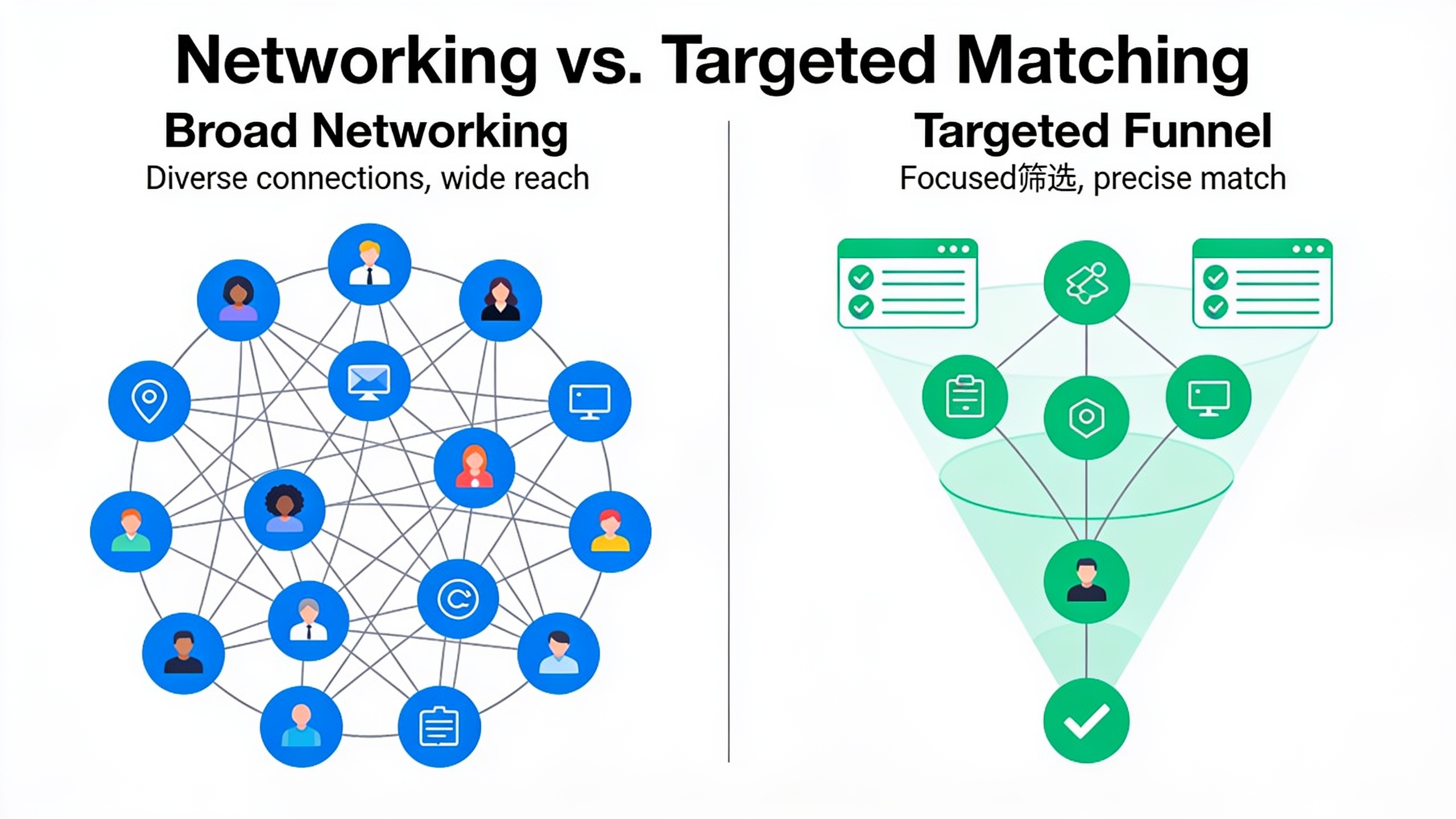
Both lean on AI to cut down the manual grind, but they part ways hard on vetting depth, matching precision, and what happens after you've been matched. Here's the quick side-by-side, based on each platform's publicly described features and how people typically use them.
| Feature | Boardy.ai | AdvisoryNavigator |
|---|---|---|
| Primary purpose | Broad professional networking and introductions | Targeted advisor, coach, and mentor matching |
| Intake method | Conversational AI (voice/chat) profile building | Guided challenge-based intake form and AI questionnaire |
| Matching basis | General compatibility and network proximity | Proven, specific experience solving the stated challenge |
| Advisor vetting | Varies by network contributor | Structured vetting for track record and outcomes |
| Best for | Expanding contacts, fundraising intros, general networking | Solving a defined business, operational, or growth challenge |
| Industry specialization | General/cross-industry | Small business, startups, nonprofits, corporate operations |
| Follow-up support | Limited; relationship-driven | Structured advisor engagement and progress tracking |
| Lead generation for advisors | Passive, network-based | Active matching based on demand signals |
| Typical time-to-match | Days to weeks | Often within 24-72 hours of intake |
This is why people treat AdvisoryNavigator as a Boardy.ai alternative rather than a straight swap. They solve neighboring problems, not the same one. If what you want is "meet more people in my industry," Boardy.ai's networking-first setup will probably do you just fine. But if what you want is "find me someone who's personally dragged a business through the exact operational bottleneck strangling me right now," then the comparison tilts pretty hard toward AdvisoryNavigator.
How Does Matching Methodology Differ Between the Two Platforms?
Matching methodology is just the logic and data a platform uses to pair you with a person. Boardy.ai leans on relationship-graph signals and conversational profiling. AdvisoryNavigator leans on challenge-specific expertise verification, meaning it prioritizes advisors who've got documented, hands-on experience with the precise problem you're facing. Same goal, very different plumbing.
How Boardy.ai Does It
Boardy.ai usually kicks off with a conversational intake, often through a phone-style AI agent, that pulls together your goals, background, and interests. Then it cross-references that against its network to surface introductions that seem broadly compatible. Think of it as an AI-souped-up version of "hey, who do you know who'd be useful to this person?" It's genuinely good for founders trying to build momentum, meet investors, or get on more people's radar. Where it gets shaky is when you need something surgical, like renegotiating a supply chain contract or plugging a churn leak in a SaaS product. Broad networks aren't built for that kind of pinpoint fix.
How AdvisoryNavigator Does It
AdvisoryNavigator's whole matching engine runs on one belief: the best advice comes from someone who's actually lived your specific problem, not someone with vaguely adjacent experience. You describe the challenge, something like "I need to cut operational costs by 15% without laying anyone off" or "our nonprofit's donor retention dropped 20% year-over-year," and the AI layer filters its advisor pool for people who've beaten that exact type of problem before, then ranks them by relevance, track record, and availability. It's closer to how specialized software matches users to solutions than how a networking app works. Kind of like how a niche tool such as Medinex matches disability support providers with the specific compliance and workforce features they actually need, instead of dumping a generic one-size-fits-all system on them.
The upshot? AdvisoryNavigator's matches come out narrower and more immediately usable. Boardy.ai's come out broader and more relationship-y. And honestly, neither is "better" in a vacuum. It hangs entirely on whether you need a solution or a network. Those aren't the same craving.
Which Platform Fits Different Use Cases?
The right pick depends on who you are and what you're actually wrestling with. Here's how it shakes out across the groups most likely to be comparing a Boardy.ai alternative.
Small Business Owners (Roughly 30-50) Chasing Growth Advice
Small business owners usually need tactical, been-there guidance. How to price a new product line. When to make the next hire. How to not get fleeced on a lease. AdvisoryNavigator's challenge-first intake tends to surface advisors who've run similarly sized businesses through the same inflection points, which shrinks the gap between "I have a problem" and "I have a plan I can actually run with." Boardy.ai can still help you widen a local or industry network, but it's not built for the urgent, this-week decisions.
Corporate Executives Obsessed With Operational Efficiency
If you're an exec sizing up supply chain redesign, workforce automation, or process reengineering, you need advisors with real enterprise-level scars, not a generalist consultant or a startup founder who's never touched a P&L that size. On this front, AdvisoryNavigator's vetting leans toward outcome verification, and that matters way more at the corporate level, where a bad match costs you real money and real time. High stakes, low tolerance for guesswork.
Startup Founders Hunting for Business Development Help
Early founders honestly benefit from both networking and targeted mentorship. Boardy.ai can shake loose investors or potential co-founders through its conversational layer, while AdvisoryNavigator can help you crack specific building blocks like go-to-market or tightening up a fundraising narrative. And founders, who spend all day context-switching between fundraising, hiring, and product, usually lean on lightweight personal systems just to stay sane. Tools like Xenith, a free productivity app built around daily intentions and deep work, pair surprisingly well with advisor matching, because great advice only compounds if you actually execute on it. Which, let's be real, is the hard part.
Nonprofits Looking for Advisory Help

Nonprofits usually need advisors fluent in donor retention, grant strategy, board governance, or measuring program impact. Those are exactly the areas that general-purpose networking tools tend to skimp on. AdvisoryNavigator's filter-for-the-exact-challenge model fits better here, mostly because nonprofit problems are so sector-specific that they just don't map cleanly onto for-profit startup experience. A brilliant SaaS founder often has no useful advice on a lapsed-donor problem.
Advisors Trying to Land More Clients
Now flip it. If you're the advisor, coach, or consultant, the question changes: which platform actually sends you relevant, qualified introductions? Boardy.ai's networking model gets you visibility, sure, but the matches don't always line up with your specialty. AdvisoryNavigator's demand-based approach only surfaces you when a business's stated challenge maps to your documented track record, which tends to mean higher-intent leads. Advisors who are serious about growth usually stack this with a broader digital presence too, maybe working with a firm like Digital Fusion Hub to build out a real website and content funnel, or running an SEO automation platform like RobinRank to keep publishing and building backlinks that establish authority in their niche. Matching platforms hand you warm leads. Solid marketing keeps the pipeline from going dry between them.
Why Look for a Boardy.ai Alternative?
People go looking for a Boardy.ai alternative mostly when they need precise, challenge-specific matching instead of general networking, or when they want a structured way to track advisor engagements over time. This isn't me trashing Boardy.ai, by the way. Its networking value is real. It's just that "who should I talk to next" and "who has actually solved my exact problem" are two completely different questions.
A few of the recurring reasons people jump ship:
- Specificity gaps. General matches sometimes serve up people who are genuinely interesting but not remotely relevant to the actual problem.
- No structured follow-up. A lot of networking-first tools make the intro and then... nothing. No progress tracking, no accountability.
- Industry mismatch. Nonprofits, regulated industries, niche B2B, they need narrow, specific experience that broad networks tend to underrepresent.
- Time pressure. If you're staring at an urgent operational or financial call, you can't afford a multi-week relationship-building slow burn. You need a fast, targeted match.
And for advisors, there's a supply-side version: they want a platform where getting matched actually signals a buyer means business, not just idle networking curiosity.
Worth mentioning here, a 2023 report from the Small Business Administration's Office of Advocacy found that small businesses that regularly seek outside advisory input report higher survival rates through their first five years than those that don't. Which drives home the point that the matching mechanism itself matters, not just whether a network technically exists. A bad match wastes the owner's time and robs the advisor of a chance to actually help. Everybody loses.
How Much Do These Platforms Cost?
Pricing across advisor and networking platforms is all over the map. Some charge subscriptions, some go per-match or per-session, some run freemium with premium tiers for deeper matching or more advisor access. Both Boardy.ai and AdvisoryNavigator keep tweaking their pricing, so always confirm current rates on the actual platform before you commit. That said, the general cost logic usually follows the patterns below.
| Cost Factor | Boardy.ai (Typical Model) | AdvisoryNavigator (Typical Model) |
|---|---|---|
| Entry cost | Often free or low-cost for basic networking access | Free or low-cost intake with matching |
| Premium tiers | May unlock expanded network access or priority intros | May unlock deeper vetting, multiple advisor matches, or ongoing engagement tracking |
| Pay-per-outcome options | Less common; relationship-based value | More common; tied to specific advisory engagements |
| Advisor-side cost | Typically free to join network | May involve a vetting or profile placement process |
| Value basis | Number and quality of introductions | Relevance and outcome-fit of the match |
Here's the takeaway I'd actually give a friend: don't just ask "what's this per month." Ask "what's this per solved problem." A cheap platform that spits out three loosely relevant intros can cost you way more in wasted hours than a slightly pricier one that nails a single high-relevance advisor on the first shot. Time is the expensive part.
Advisor Matching Platform Comparison: Making the Final Call
Picking between Boardy.ai and AdvisoryNavigator really boils down to one thing: do you need broad relationship-building or precise, challenge-specific expertise? There's no universally better platform. There's only a better fit for your situation, your timeline, and your budget.
If your goal right now is to widen your network, meet potential investors, or just get more visible in your industry, Boardy.ai's conversational, relationship-first model was literally built for that. But if your goal is to crack a specific, defined problem, reducing churn, unclogging a hiring bottleneck, rescuing nonprofit donor retention, prepping for a merger, then something like AdvisoryNavigator, with its whole "match you with someone who's already solved this" premise, tends to get you to something actionable faster.
And plenty of businesses just use both. Boardy.ai-style networking to slowly build a deep bench of relationships, plus a targeted matching platform to put out specific fires as they flare up. It's the same instinct behind running multiple specialized tools instead of praying one platform does everything. Because it won't. It never does.
Frequently Asked Questions
Is AdvisoryNavigator basically a drop-in replacement for Boardy.ai?
Not really. AdvisoryNavigator works more as a targeted Boardy.ai alternative for businesses that need challenge-specific advisor matching over broad networking. A lot of people just keep both, Boardy.ai for relationship-building, AdvisoryNavigator for solving defined operational or strategic problems.
How fast will I actually get matched on AdvisoryNavigator?
Depends on how complex your challenge is and who's available, but plenty of users say they get relevant matches within a few days of finishing intake, since the AI filters advisors by documented, specific experience rather than just who happens to be free.
Do I need to know exactly what kind of advisor I want before I start?
Nope. And this trips people up. You don't have to self-diagnose whether you need an "operations consultant" or a "growth strategist." You just describe the problem in plain English, like declining sales in one channel, or struggling to scale a remote team, and the matching engine figures out who's got the relevant, proven experience.
Are these only for startups, or can established businesses use them too?
Both handle a wide range of stages. AdvisoryNavigator especially is built for small business owners, corporate execs, nonprofit leaders, and founders alike, because its matching runs on the nature of the challenge, not how old or big your company is.
How are advisors vetted before they get matched to me?
It varies by platform, but the reputable ones verify an advisor's track record, relevant experience, and actual outcomes before surfacing them, rather than just trusting a self-reported profile. This is genuinely one of the things I'd confirm with any platform before signing up, because vetting depth is exactly what determines whether your match is worth anything.
Look, choosing between Boardy.ai and AdvisoryNavigator was never meant to be all-or-nothing. The smartest thing you can do is get crystal clear on the actual problem you're trying to solve today, match the platform to that specific need, and stay loose enough to layer in other tools as your business (and your advisory needs) keep shifting. They will. They always do.