
Table of Contents
- What Happens When You Hire the Wrong Business Advisor?
- The Financial Cost of Advisor Mismatch Risks
- The Time Cost No One Talks About
- Real-World Scenarios: How Guesswork-Based Selection Backfires
- Why Guesswork Still Drives Most Advisor Selection
- How to Avoid Choosing the Wrong Business Advisor
- How Does AI-Powered Matching Reduce Advisor Mismatch Risks?
- Frequently Asked Questions
What Happens When You Hire the Wrong Business Advisor?
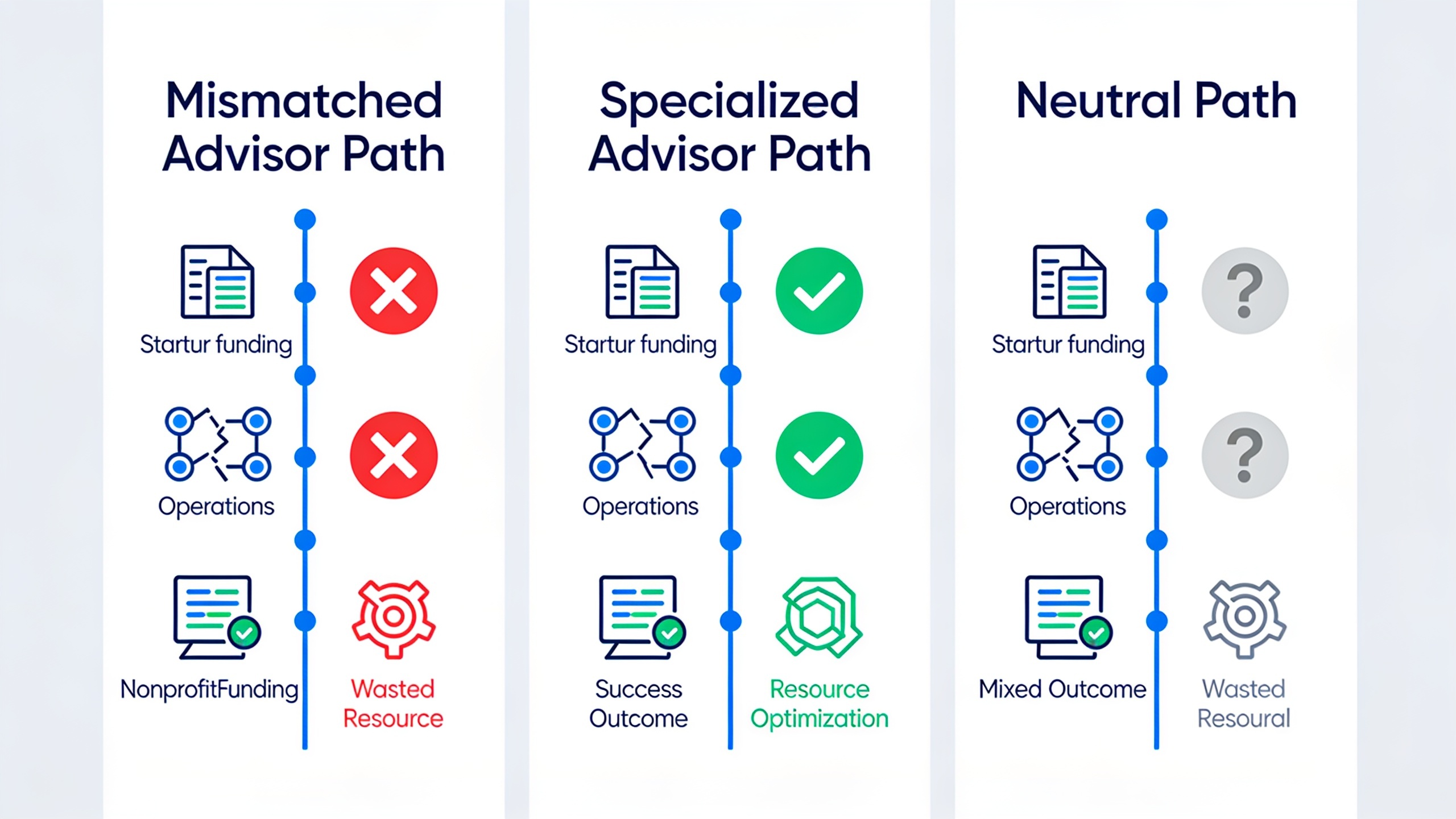
Hiring the wrong business advisor means you're paying for guidance that doesn't fit your industry, your stage, or your actual problem, and the damage usually lands as some mix of wasted budget, stalled decisions, and advice that eventually has to be torn up and redone by someone else. Notice I didn't say "incompetent." That's the thing people get wrong about this. A mismatched advisor can be genuinely talented. They just don't have direct experience with your exact situation. Think a generalist management consultant coaching a SaaS founder on go-to-market, or a retail accountant trying to steer a nonprofit through grant compliance. Smart people, wrong problem.
In my experience it goes bad in one of three ways. Sometimes the advice is technically fine but strategically useless, correct in theory and worthless in practice because it wasn't built for your market. Sometimes the engagement just... drags, because the advisor is learning your industry on your dime. You're literally paying them to catch up. And then there's the worst version, where the advice actively steers the business the wrong way and you have to hire a second person later to spot the mistake and clean it up.
Every one of those doubles the bill. You pay once for the bad call, then again for the fix.
The Financial Cost of Advisor Mismatch Risks
Advisor mismatch risks turn straight into dollars lost, through wasted fees, opportunity costs, and the price of redoing work that was built on shaky guidance. And the invoice is the smallest part of it. The real exposure lives in every decision you made downstream of that advice.
Start with the obvious. Advisory engagements, whether it's a fractional CFO, a growth consultant, or a specialized operations coach, routinely run into thousands of dollars a month. When the fit's wrong, that spend buys you basically nothing usable. Three months in before you realize it? That's three months of fees gone, plus the cost of starting the whole search over.
But honestly, the indirect costs are usually the bigger monster. A poorly matched fundraising advisor can cost a startup an entire financing round's worth of momentum if the pitch deck and investor targeting were built around the wrong strategy. A mismatched operations consultant working with a corporate exec might recommend process changes that look gorgeous on a slide and fall apart the second they hit the real workforce or supply chain. And a nonprofit that hires a generalist fundraising coach instead of someone who actually knows grant compliance and donor relations? They can lose funding outright. That's not a fee you can measure. That's mission impact.
There's also a compounding thing that hits specialized industries especially hard. Take a business in a tightly regulated niche, say something like Super Visa Insurance Calgary, which builds tailored insurance for parents and grandparents visiting Canada under the Super Visa program. That business needs an advisor fluent in the specific compliance requirements tied to Canadian immigration and insurance rules. Not a general insurance sales coach. When the advisor doesn't have that exact specialization, the business eats the cost of fixing compliance gaps a specialist would've caught on day one.
The Time Cost No One Talks About
The time cost of a mismatched advisor is usually worse than the financial one, because you can't buy back the weeks you spent walking in the wrong direction. Money you can replace. A quarter spent executing a bad plan? Gone. And for a startup sprinting toward a funding milestone, or a small business trying to catch a seasonal revenue window, that delay can decide whether you make it through the cycle at all.
It plays out in a pretty predictable order. First there's the search itself, weeks of vetting people through referrals, directories, or cold outreach, with no real way to confirm their claimed expertise matches your actual problem. Then onboarding, where the advisor has to absorb your business context before contributing anything, which is doubly wasted time if they turn out to be a bad fit and get swapped out anyway. And finally the correction phase: the hours figuring out what broke, finding someone better, and re-explaining your whole business from scratch to the new person.
What kills me is that founders and execs almost always underestimate this, because each step seems totally reasonable on its own. A two-week search. A month of onboarding. A quarter of execution. Feels fine in isolation. Stack them up, though, and you're four or five months in before anyone even names the mismatch. In a fast market that's plenty of time for a competitor to close the gap. This is exactly the kind of slow-motion disaster that 10 Questions to Ask Before Hiring a Business Advisor is built to short-circuit, by flagging fit problems before you sign anything instead of five months into the pain.
Real-World Scenarios: How Guesswork-Based Selection Backfires
Guesswork-based selection, meaning you're choosing on referrals, generic searches, or plain convenience instead of verified fit, tends to fail in the same handful of ways over and over. Here's what that actually looks like across different kinds of organizations.
The Startup That Hired a Generalist Growth Consultant
Classic early-stage mistake: you hire a broadly credentialed "growth consultant" whose real experience skews e-commerce or consumer apps, except you're building B2B SaaS with a six-month enterprise sales cycle. So the consultant runs their playbook. Rapid paid-acquisition tests, influencer partnerships, conversion optimization on a self-serve funnel. None of it maps to how enterprise deals actually close. Months go by, budget burns on tactics that generate vanity metrics instead of pipeline, and eventually the founder has to bring in someone with real enterprise SaaS chops to rebuild go-to-market from zero. That lost quarter, in a tight fundraising climate, can be the whole difference between closing a round and running out of cash.
Now flip it. A startup building something in a genuinely niche digital lane, say an affiliate marketing funnel or a content-heavy acquisition play, needs an advisor or agency who's actually lived in that lane. Businesses like that often go to specialized digital marketing and web development partners such as Digital Fusion Hub, whose focus on tailored UX/UI design, SEO, and branding is a completely different animal from general management consulting. The takeaway isn't that generalists are useless. It's that the match between what the advisor actually specializes in and what you actually need matters way more than their overall résumé.
The Niche SaaS Product That Needed a Specialist, Not a Generalist
Highly specialized products create some of the nastiest mismatch risks, simply because there aren't many advisors who grasp the full picture. Consider a digital legacy platform like Evaheld, which helps people organize estate documents, store advance care directives, and preserve family memories through an AI assistant. That thing lives at the crossroads of elder-care sensitivity, estate-law-adjacent processes, and AI product design. Hand it to an advisor with generic SaaS growth experience but zero grounding in the emotional and regulatory weight of legacy planning, and they might cheerfully recommend a marketing approach that reads as tone-deaf to the audience, or miss compliance issues around sensitive personal data entirely. The cost there isn't just wasted ad spend. It's reputational damage in a category where trust is the product.
The Nonprofit That Confused "Cheap" With "Right Fit"
Nonprofits get burned by this constantly, because tight budgets push leadership toward the cheapest option instead of the best-fit one. Say a nonprofit hires a low-cost generalist for a capital campaign rather than someone with real major-gifts and grant-compliance experience. They might even hit the fundraising number on paper, while completely missing the donor-relationship infrastructure they'll need for the next campaign. The few thousand saved on fees gets absolutely dwarfed by the cost of rebuilding a broken fundraising program two years down the road.
The Corporate Team That Chased a Big Name Over a Right Fit
Corporate execs fall for the opposite trap: hiring for brand-name prestige instead of operational fit. Picture a former Fortune 500 operations executive brought in to streamline a mid-market manufacturer's supply chain. Impressive credentials, sure. But no direct experience with the specific ERP systems, vendor relationships, or regulatory constraints this particular company runs on. The advice sounds authoritative in the boardroom and then just doesn't survive contact with the shop floor. So the company pays twice, once for the prestige hire, and again for the operations specialist who actually fixes it.
Why Guesswork Still Drives Most Advisor Selection
Most businesses still pick advisors through referrals, directory searches, or cold outreach because there's never really been a reliable, structured way to check fit before you commit. Referrals feel safe, and I get why, they come with social proof. But a referral only tells you the advisor did great work on someone else's problem. Not necessarily yours. And directory and keyword-based platforms rank people on self-reported bios, which means the best self-marketer floats to the top, not the best fit for what you actually need.
It gets worse, because most businesses can't even describe their own problem precisely enough to filter well. "I need help with growth." "I need an operations advisor." That's way too vague to separate dozens of candidates who all look roughly the same, so the decision collapses right back into gut feeling, convenience, or whoever emailed back first. And tools that help on the marketing side, even genuinely good ones like RobinRank, which automates SEO content writing, publishing, and backlink exchange, can drive visibility and demand all day long. But they don't touch the upstream problem: matching you with the right strategic advisor to read that performance data and set the right priorities in the first place.
How to Avoid Choosing the Wrong Business Advisor
The most reliable way to avoid hiring the wrong advisor is to define your challenge with enough specificity that fit can be judged on evidence, not vibes. Capability, availability, specialization, trust. That means shifting from "who do I know" to "who has actually solved this exact problem, and can they show me."
Practically, that's asking pointed questions before anyone signs anything. What specific outcomes has this person delivered in a comparable business? What industry codes or sub-specialties do they genuinely work in? And how does their availability line up with your timeline? There's a solid breakdown of exactly what to ask in 10 Questions to Ask Before Hiring a Business Advisor, and honestly it's worth a read before you sign any advisory agreement, no matter how you found the candidate.
The table below lines up the common selection methods against how fit actually gets determined and how much you can see before you commit.
| Selection Method | How Fit Is Determined | Typical Time to First Connection | Visibility Into Fit Before Engaging | Reported Match Satisfaction |
|---|---|---|---|---|
| Referral / word-of-mouth | Personal recommendation, often based on a different problem than yours | Varies widely, often several weeks | Low — based on reputation, not verified skill data | Not stated publicly |
| Directory / cold outreach search | Self-reported bios and keyword matching | Varies widely, often several weeks | Low — no independent verification of outcomes | Not stated publicly |
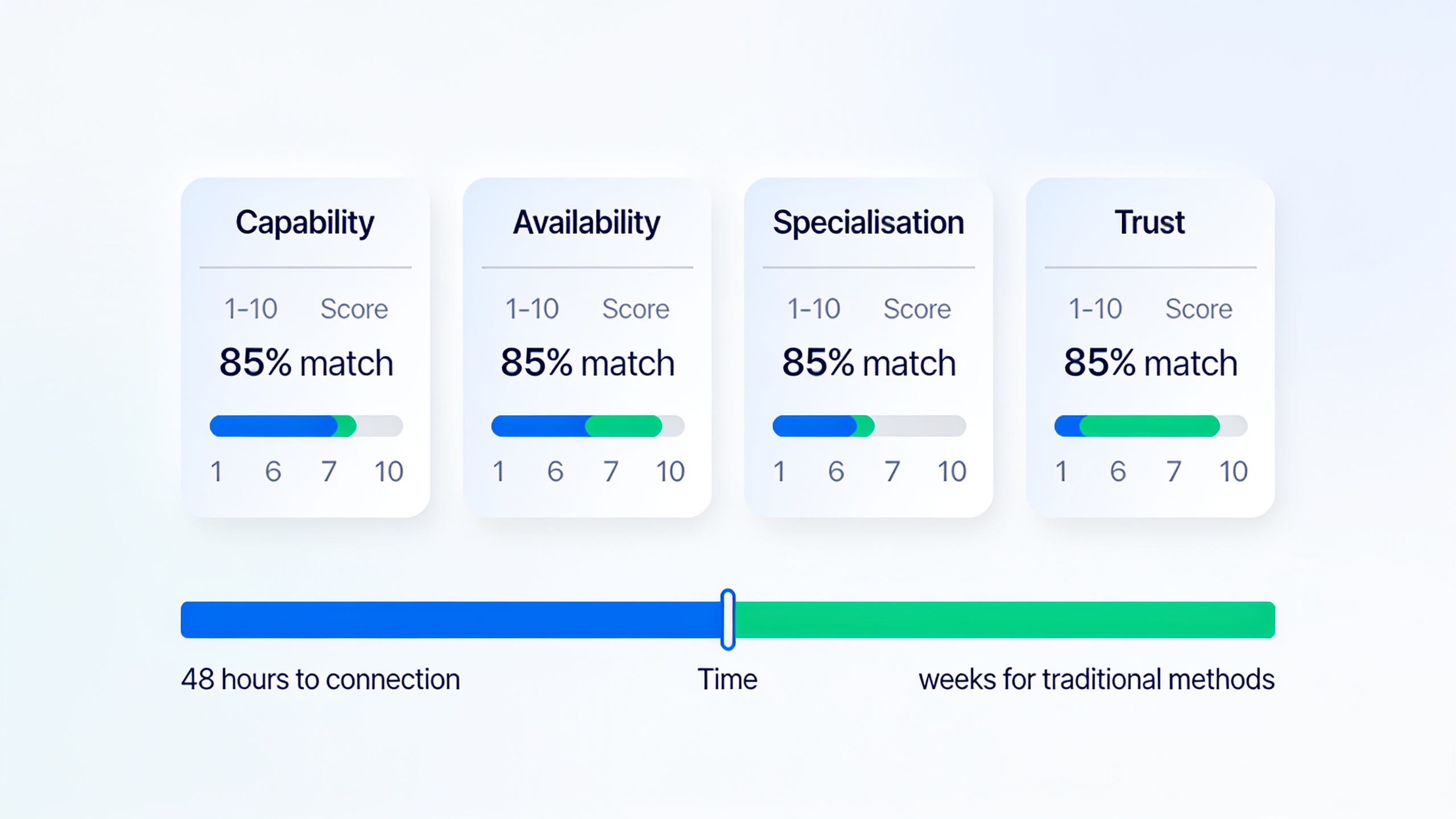
| AI-powered matching (Advisory Navigator) | CAST framework scoring across Capability, Availability, Specialisation, and Trust | Average of 48 hours to first connection | High — transparent fit score shown before you connect | 94% match satisfaction |
Quick note on those numbers. The AI-powered matching figures come from data published by Advisory Navigator. The referral and directory rows say "not stated publicly" because those methods just don't produce standardized, comparable outcome data, and that's kind of the whole point. If you're using guesswork-based methods, you have no benchmark to know whether you got a good match until you're already deep into the engagement.
How Does AI-Powered Matching Reduce Advisor Mismatch Risks?
AI-powered matching cuts mismatch risk by scoring advisors against a structured brief before you ever lay eyes on a candidate, instead of dumping a list of self-reported profiles on you and wishing you luck. Advisory Navigator's Advisory Intelligence Matching Model (AIMM), for instance, takes a plain-language description of your problem and turns it into a structured Request for Advice, with desired outcomes, timeline, budget, and urgency baked in. Then it scores advisors against that brief using the CAST framework: Capability, Availability, Specialisation, and Trust.
Capability gets checked against real engagement outcomes, not self-reported claims, which goes straight at the "everyone inflates their own bio" problem. Availability quietly filters out the people who look perfect on paper but can't actually start when you need them, and that's a sneaky common source of delay. Specialisation maps your described challenge to standardized industry codes and specific subdomains, so a request like "migrating off a legacy accounting platform" lands on someone who's done that exact migration, not a generalist accountant who'll wing it. And Trust is a composite score pulled from client reviews, communication quality, and professional conduct, refreshed after every engagement, so you get a live signal that referrals and directories simply can't fake.
Per figures published by Advisory Navigator, the model produces a 94% match satisfaction rate and averages 48 hours from describing a challenge to a first connection. That's meaningfully faster and a lot more transparent than the weeks-long grind of referral hunting or cold outreach. If you want the full mechanics of how this works start to finish, What Is AI Advisor Matching? A Complete Guide walks through AIMM and the CAST scoring model in detail.
And it's not just the business side that wins here. This kind of structure changes the incentives for advisors too. Instead of chasing referrals or cold-pitching prospects who may not even need their specialization, an advisor can build one CAST profile and get inbound matches that actually line up with their expertise. Fewer bad-fit engagements on both ends. Everybody's happier.
Frequently Asked Questions
How do I know if I've hired the wrong advisor?
Watch for advice that sounds generically right but never accounts for your specific industry or stage, an advisor who needs a suspicious amount of time to "get up to speed" on basics a specialist should already know, and recommendations that fall apart the moment you try to actually implement them. And here's the biggest tell: if you keep re-explaining fundamental context about your business instead of talking strategy, that's a specialization mismatch, not a communication hiccup.
What's the difference between a bad advisor and a mismatched one?
A bad advisor lacks competence, full stop. A mismatched advisor might be genuinely excellent, just without direct experience in your specific industry, stage, or problem type. Mismatch is actually way more common than flat-out incompetence, because most advisors really are skilled, just not in the exact domain your challenge demands. That's why you have to evaluate specialization and capability as separate things, not one blurry blob.
How much does a mismatched advisor typically cost a small business?
There's no single universal number, honestly, since it swings with engagement size, industry, and how long the mismatch goes unnoticed. But a realistic estimate should fold in three things: the fees you paid during the bad engagement, the opportunity cost of executing the wrong strategy, and the cost of the corrective engagement with someone better afterward. All three compound the longer the mismatch drags on.
Can referrals still be a decent way to find an advisor?
Sure, they can be a useful starting signal, but they work best when the person referring faced a problem that closely resembles yours in industry, stage, and scope. A referral from a buddy whose business had a completely different challenge tells you almost nothing about fit for your situation. So use referrals, just don't lean on them alone. Pair them with actual fit verification.
What should I do before signing an advisory agreement?
Ask for specific, verifiable examples of comparable engagements, confirm the advisor's real availability against your timeline, and get clear on how success will be measured. Running through a structured list like 10 Questions to Ask Before Hiring a Business Advisor before any conversation gives you a consistent yardstick, so you're comparing candidates on the same terms instead of judging each one on a hunch.
Choosing the wrong business advisor is rarely about bad intentions on anyone's part. It's usually just the predictable result of making a high-stakes call with low-quality information. And the businesses that dodge this trap aren't the ones with the fattest budgets. They're the ones who treat advisor selection as a matching problem worth solving with real evidence, rather than a networking exercise decided by whoever happened to be free that week.