
And that's the thing a lot of consultants miss. Limited budgets, volunteer-driven operations, a governance structure that answers to a board instead of shareholders. If someone doesn't understand those constraints in their bones, all the fancy frameworks in the world won't help you.
So this piece walks through what these services actually cover, the specific expertise worth hunting for in fundraising, impact measurement, and board governance, and how to vet a consultant before you sign anything. I'll also get into what this stuff realistically costs, the warning signs that should make you walk away, and how AI matching tools are quietly changing how organizations find the right person.
Table of Contents
- What Are Non-Profit Advisory Services?
- Why Non-Profits Need Advisors Who Aren't Just "Business Consultants"
- Fundraising Strategy: The Most Common Reason Non-Profits Seek Advisory Help
- Impact Measurement: Proving the Work Actually Works
- Board Governance: Where Many Non-Profits Quietly Struggle
- How Do You Evaluate a Non-Profit Consultant's Credentials?
- Non-Profit Advisory Services vs. General Business Consulting
- What Does Non-Profit Advisory Services Cost?
- Red Flags to Watch for When Hiring an Advisor
- How AI-Powered Matching Is Changing Non-Profit Advisory
- FAQ
What Are Non-Profit Advisory Services?
Non-profit advisory services are specialized consulting engagements built to help mission-driven organizations raise money better, measure and communicate their impact, tighten up board governance, and run leaner operations, all while staying inside the legal and financial rules that apply specifically to tax-exempt groups. Regular business consulting is usually about growth, margins, and returns for shareholders. Non-profit work orbits around something else entirely: mission, donor trust, and being accountable to a board and, very often, to whoever's funding you.
You can get this help from a few places. Independent consultants who work solo. Boutique firms that live and breathe the non-profit sector. Or bigger consulting shops that keep a dedicated non-profit division tucked inside them. The scope is all over the map, too. Sometimes an organization brings someone in for one strategic plan or a capital campaign feasibility study and that's it. Other times they keep an advisor on retainer for board development, sustainability planning, or a complete rebuild of how they track impact.
But the common thread is this: a non-profit's "customers," "investors," and "product" just don't translate cleanly into for-profit language. An advisor who doesn't grasp that distinction can genuinely make things worse.
Why Non-Profits Need Advisors Who Aren't Just "Business Consultants"
Non-profits need advice built around mission-driven metrics, restricted funding rules, and volunteer or donor relationships, not just revenue and efficiency, which is the default lens almost every general consultant reaches for. Look, someone who spent twenty years optimizing sales funnels might bring real operational discipline to the table. I'm not knocking that. But without sector experience, they can badly misjudge what "growth" even means for an organization that isn't trying to maximize anything except its own impact.
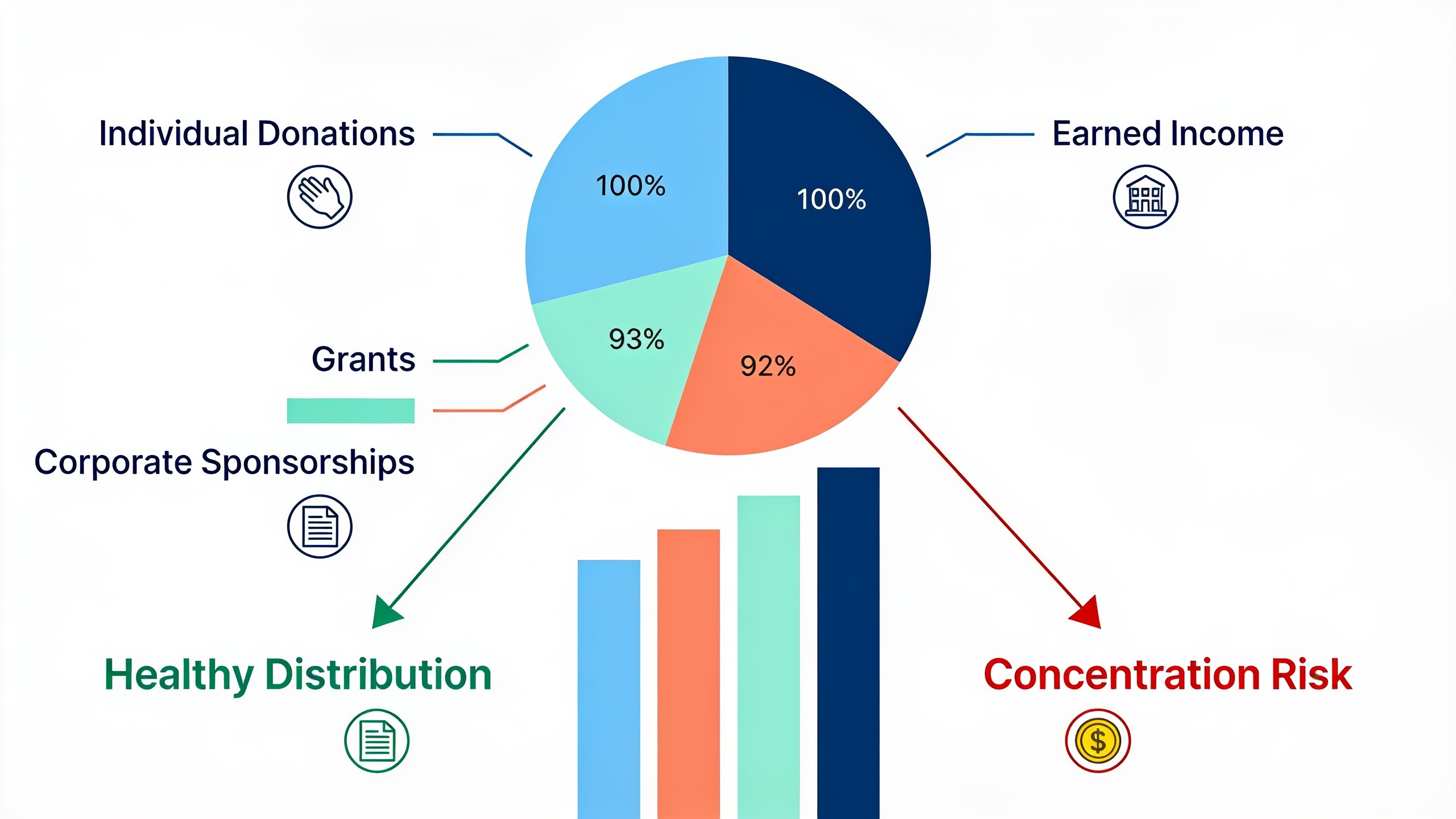
Think about how different the plumbing is. Your revenue probably comes from some mix of individual donations, grants, corporate sponsorships, and earned income, and each one carries its own reporting demands. Grants especially come with strings, rules about exactly how the money can and can't be spent. Meanwhile your decision-making authority sits with a volunteer board, not a CEO who can just make the call. That completely changes how a consultant has to frame and pitch their recommendations. And success? It's measured in people housed, students graduated, meals served. Not quarterly earnings. Which means your advisor needs to actually speak the language of impact frameworks, not just financial models.
None of this means cross-sector experience is useless. Far from it. A consultant with an operational efficiency background can add serious value on back-office processes, tech adoption, or fixing broken staff workflows, and plenty of small-business principles carry over just fine. Some of the same diagnostic questions people use to vet an operations advisor, which are laid out in this guide on how executives find the right operational efficiency consultant, work just as well when a non-profit is trying to figure out whether a candidate really understands their bottlenecks or is just reciting best practices off a slide.
Fundraising Strategy: The Most Common Reason Non-Profits Seek Advisory Help
Fundraising strategy advisory helps you spread out your revenue sources, keep more of the donors you already have, and build a real pipeline instead of praying that one big annual campaign or a couple of major gifts come through again. This is almost always the front door for outside help, and it makes sense. Money instability is the loudest, most visible problem a non-profit deals with. Boards notice a revenue cliff way before they notice a governance gap or a weak impact report.
A good fundraising advisor usually starts by auditing your current revenue mix. Individual gifts, major donors, grants, events, corporate partnerships, any earned income. What they're really hunting for is concentration risk, meaning how much of your whole budget is riding on just one or two sources. From there it typically shifts toward donor retention, because landing a brand-new donor costs a lot more than keeping one you've already got, and then into capital campaign readiness if you're eyeing a big ask.
Digital fundraising is baked into all of this now, not some optional add-on. Email campaigns, peer-to-peer pages, whether people can even find your cause when they search for it, all of that shapes how much you can pull in online. So a fundraising advisor increasingly needs at least a working grasp of digital marketing. If your team is building out online donor acquisition from scratch, resources like Sukhweb, which covers the basics of digital marketing, SEO, and web hosting, are a decent primer so your staff understand the mechanics before you hire someone to run it. Honestly, an advisor who can talk fluently about both old-school major-gift work and digital donor acquisition beats one who only knows half that equation. Every time.
What a Fundraising Consultant Should Actually Deliver
A fundraising engagement should leave you holding something concrete: a written revenue diversification plan, a donor segmentation model, or a feasibility study before a capital campaign. If it wraps up with nothing but some verbal recommendations and no document your board can actually review and approve? That tells you the work wasn't rigorous enough to be worth acting on.
Impact Measurement: Proving the Work Actually Works
Impact measurement advisory helps you define, track, and report the outcomes of your programs in a way that keeps funders, board members, and honestly your own sanity satisfied about whether the work is even working. Sometimes people call it outcomes measurement or impact evaluation. Whatever the name, it's the move from counting activity (how many people showed up to a workshop) to measuring outcomes (what actually changed for those people afterward).
This is where non-profit expertise really pulls away from generic business consulting. A business consultant knows KPIs tied to revenue and cost cold. But a non-profit impact specialist needs to understand logic models, theory of change frameworks, and how to pick outcome indicators that are both meaningful and, crucially, actually measurable given that most non-profits don't have much data infrastructure. Smaller organizations especially don't have a data team. They barely have a data person. So a big part of the job is designing measurement systems that staff can keep running long after the consultant packs up and leaves.
And funders are getting stricter about this. Grant applications and renewal reports now routinely want outcome data, not just a nice description of what your program does. That squeezes non-profits who've historically only tracked attendance or dollars spent. A good impact advisor should help you settle on a handful of high-value indicators instead of burying your staff under data collection that nobody ever looks at again. They should also be straight with you when a metric you're excited about just isn't realistically trackable with what you've got right now. That kind of honesty is worth a lot.
Board Governance: Where Many Non-Profits Quietly Struggle
Board governance advisory helps you sort out the roles, responsibilities, and accountability between your board and your staff, and it's the one thing organizations put off hiring for even though it's frequently the root cause of everything else going sideways. A board that doesn't understand its fiduciary duties, has no real committee structure, or checks out of strategic planning entirely can quietly poison your fundraising, your financial oversight, and your ability to keep a good executive director, all while the programs keep humming along and nobody notices the rot underneath.
The usual suspects that push an organization to seek help here: fuzzy lines between what the board decides and what staff decides, boards that are either so passive they provide no real oversight or so hands-on they're meddling in daily operations, trouble recruiting members who actually bring useful skills, and the succession nightmare that hits when a long-serving director is heading for the door with no plan behind them. A governance-focused consultant tends to work through board assessments, facilitated retreats, a bylaws review, and building out committee charters and clear board-member job descriptions.
Because this stuff touches legal and fiduciary responsibility, credentials matter more here than in most other advisory categories. This isn't the place to wing it. Before you commit to someone for governance work, run them through the same diagnostic rigor laid out in 10 Questions to Ask Before Hiring a Business Advisor. Ask them flat out about past governance engagements, what frameworks they lean on, and how they've handled a board that dug in its heels and refused to change.
How Do You Evaluate a Non-Profit Consultant's Credentials?
You evaluate a non-profit consultant by digging into their track record with organizations of a similar size and mission, asking for specific outcomes from past work, and confirming they actually understand the regulatory and reporting environment you live in, not just by checking that they've done "consulting." A slick proposal and a long client list prove nothing about sector fit. Specificity does.
Start by asking for examples of non-profits they've worked with that look like yours, in budget and in program area. Someone who's only advised huge, well-funded national outfits can flounder trying to give practical advice to a grassroots group running on five staff and a rotating cast of volunteers. And it cuts both ways. Then ask what actually came out of their last two or three engagements. Did donor retention climb? Did the board really adopt the governance changes, or just nod politely and ignore them? Did the impact framework end up in an actual grant report? If all you get back is vague talk about "strategic alignment" with no measurable result attached, that's a red flag waving right in your face.
It's also worth asking how they charge, because non-profit budgets are tighter and way less flexible than corporate ones. Some consultants offer sliding-scale fees or phased engagements precisely because they understand how cash flow works in this sector. Someone who won't even entertain a flexible structure probably hasn't spent much time working with non-profit clients.
Non-Profit Advisory Services vs. General Business Consulting
The table below lays out the practical differences between non-profit-focused advisory and general business consulting, which is handy context when a candidate's background is mostly corporate.
| Dimension | Non-Profit Advisory Services | General Business Consulting |
|---|---|---|
| Primary success metric | Mission outcomes and impact | Revenue growth and profit margin |
| Governance structure advised | Volunteer board with fiduciary duty | Executive leadership, sometimes shareholders |
| Revenue model considered | Donations, grants, sponsorships, restricted funds | Sales, contracts, recurring revenue |
| Reporting obligations | Funder reports, IRS Form 990, grant compliance | Investor reports, board of directors, regulatory filings vary by industry |
| Typical engagement trigger | Funding instability, board dysfunction, impact reporting demands | Growth stalls, efficiency gaps, market expansion |
| Key specialist skill required | Impact measurement, grant compliance, donor psychology | Financial modeling, operations, go-to-market strategy |
I'm not saying general consultants have nothing to offer non-profits. Plenty of operational, financial, and tech expertise crosses over just fine. The point is narrower: mission-metric fluency and governance literacy are non-negotiable for anyone advising on fundraising, impact, or board matters. A generalist can absolutely help you migrate your accounting system. Just don't hand them your capital campaign strategy.
What Does Non-Profit Advisory Services Cost?
Non-profit advisory costs are all over the place depending on the scope, the advisor's experience, and whether it's a one-off project or an ongoing retainer, and there's no tidy industry-standard rate anyone can quote you. A short strategic planning session or a board retreat facilitation is usually a fixed-fee, one-time thing. Fundraising strategy or ongoing governance coaching more often lands as a monthly retainer or a multi-month project fee.
A few things push the number around. Independent consultants generally cost less than boutique firms carrying staff and overhead, though they may not have the bandwidth for a big multi-phase project. Location matters too. Advisory rates in major metros tend to run higher than in smaller markets. And the depth of specialization plays in, so a generalist doing strategic planning will typically run cheaper than a specialist in, say, capital campaign feasibility studies or hairy grant compliance work.
Instead of fixating on a specific dollar figure that's going to swing wildly by market and scope anyway, do this: ask each prospective advisor for a detailed proposal that breaks the fee down by phase or deliverable, then hold that up against two or three other advisors with similar sector experience. And if your budget's tight, just ask directly whether they offer a sliding scale, a reduced non-profit rate, or a phased engagement that spreads the cost out. A lot of advisors who specialize in this world build that flexibility in on purpose, because they know exactly what their clients are dealing with.
Red Flags to Watch for When Hiring an Advisor
The clearest red flag is a proposal built entirely around generic, one-size-fits-all deliverables with nothing specific to your mission, your budget, or your program area. If the thing reads like it could've been emailed to any organization on earth regardless of cause or size, that's a loud signal they never actually engaged with your situation.
The other warning signs worth watching for:
- An advisor who can't name specific non-profits they've worked with, or who goes vague on outcomes the second you press.
- Someone proposing an impact framework stuffed with dozens of metrics without ever asking what data you can realistically collect and sustain.
- A governance consultant pushing sweeping bylaws changes before they've even spoken with individual board members to understand what's actually going on.
- Anyone who guarantees specific fundraising results, since donor behavior is shaped by way too many outside forces for anybody to promise you a dollar figure with a straight face.
One more thing. Be wary of consultants who push hard for a long-term retainer before they've proven anything. A short paid pilot, like a single board assessment or a fundraising audit, is a totally reasonable way to test the fit before you commit to something bigger.
How AI-Powered Matching Is Changing Non-Profit Advisory
AI-powered matching platforms are changing how non-profits find advisory help by swapping out directory searches and cold outreach for a structured process that matches your specific challenge to advisors who've actually solved that exact problem before. Instead of scrolling a list of bios and basically guessing at fit, you describe your challenge in plain language, something like "we need to diversify our donor base before a major grant expires," and the system builds a structured brief from that and scores advisors against it.
Advisory Navigator does this through what it calls the Advisory Intelligence Matching Model, which grades advisors on four things: Capability, Availability, Specialisation, and Trust, together known as the CAST framework. Rather than dumping a static list of names on you, it maps your brief to the relevant industry context and specialist subdomains, so an organization hunting for board governance help gets matched against advisors whose track record and current availability actually line up, not some generalist who just happens to have a listing. Per the platform's own reported figures, its match satisfaction rate sits at 94%, with an average time to first connection of 48 hours, numbers that hint at what's possible when the matching runs off a structured brief instead of an open-ended search.
For a non-profit with barely any staff time to vet consultants by hand, this kind of structured matching genuinely shortens the hunt. But don't let a high fit score do your homework for you. Ask for references, past outcomes, and sector-specific examples once you've been matched. A score gets you to the conversation. It doesn't replace it.
FAQ
What's the difference between a non-profit consultant and a general business consultant?
A non-profit consultant specializes in the funding structures, governance models, and outcome-based metrics unique to tax-exempt organizations, while a general business consultant is usually wired for revenue growth and profit at for-profit companies. Some skills, especially around operations and tech, cross over just fine. But fundraising strategy, impact measurement, and board governance really do need sector-specific expertise.
How do I know if my non-profit needs a fundraising advisor or an impact measurement specialist first?
If your most urgent headache is revenue instability or a campaign on the horizon, start with fundraising strategy. If funders or your own board are demanding outcome data you can't currently produce, start with impact measurement. Plenty of organizations eventually need both, but sequencing the work around your most immediate pain point tends to get you faster, more visible wins.
Can a small non-profit with a limited budget afford advisory services?
Yes, as long as you match the scope to the budget. A short, focused project like a single board assessment or a fundraising audit is far more realistic for a small shop than an open-ended retainer. And a lot of non-profit consultants offer sliding-scale fees or phased pricing specifically to make room for smaller organizations, so ask directly rather than assuming it's out of reach.
How long does a typical non-profit advisory engagement last?
Depends heavily on scope. A board retreat or strategic planning session might be a single engagement running a few weeks, while a full fundraising overhaul or ongoing governance coaching often stretches three to twelve months or longer as a retainer. Push for a phased timeline with clear milestones instead of some open-ended commitment.
Should board members be involved in choosing the advisor?
Yes, especially for governance and major fundraising work, since the board is usually the one who has to approve and act on whatever comes out of it. Getting at least a board chair or governance committee member into the vetting process also makes it far more likely the advisor's approach gets accepted rather than resisted once the recommendations land.
Choosing the right advisory support really comes down to one thing: matching the specific problem you're facing, whether that's a shaky donor base, unmeasured impact, or a board that just isn't functioning, to someone who has demonstrably fixed that exact problem for an organization like yours. Credentials and polish matter less than proof of relevant, sector-specific results. And a little extra time spent vetting fit up front saves you a whole lot more time, and money, than diving headfirst into the first engagement that comes knocking.