
So let's talk about what these consultants actually do, why the search goes wrong so predictably, and how a more evidence-based approach to executive advisory services can shrink the gap between "we've got a problem" and "the right person is fixing it."
Table of Contents
- What Does an Operational Efficiency Consultant Actually Do?
- Why Corporate Executives Struggle to Find the Right Operational Efficiency Consultant
- How Much Does an Operational Efficiency Consultant Cost?
- Key Criteria for Vetting an Operational Efficiency Consultant
- Matching Process: From Business Challenge to Right-Fit Advisor
- Traditional Search vs. AI-Powered Matching
- Where Executive Advisory Services Fit Alongside Operational Efficiency Consulting
- Real-World Signals of a Good Fit
- FAQ
What Does an Operational Efficiency Consultant Actually Do?
An operational efficiency consultant is a specialist you bring in to find the waste, redundancy, and bottlenecks buried in your processes, and then redesign those processes so they cost less, move faster, or produce fewer errors, without cheapening the actual output. The job lives at the messy intersection of process engineering, change management, and technology. Which is exactly why the good ones are almost never generalists.
In practice, though, the title means wildly different things depending on who's hiring. A manufacturing exec might want someone to map the production floor and shave time off the cycle. A professional services firm might use the same title to describe untangling a technology migration, say, moving practice management data from one platform to another without torching client history or billing continuity in the process. A nonprofit leader might need someone to rebuild grant reporting workflows so program staff aren't drowning in admin. Different worlds entirely. The one thing they share? Good operational efficiency work is diagnostic first, prescriptive second. A consultant who skips the current-state mapping and jumps straight to "here's what you should do" isn't giving you a shortcut. They're giving you a warning sign.
Honestly, "operational efficiency consultant" is less a job description and more an umbrella term you have to poke holes in. So when you're searching, expect to narrow it down by sub-specialty: supply chain, back-office automation, platform migration, staffing models, workflow redesign. Don't assume the person with the title can handle whatever operational headache you've got. They usually can't.
Why Corporate Executives Struggle to Find the Right Operational Efficiency Consultant
Most executives struggle because the whole search runs on referrals and generic directories, neither of which actually verifies whether the candidate has solved your problem. A referral tells you someone did good work for a colleague. Great. It tells you nothing about whether that work looked anything like your situation, your industry, or your "we needed this fixed last month" urgency.
And that gap shows up in a handful of very predictable ways.
Common Mismatches
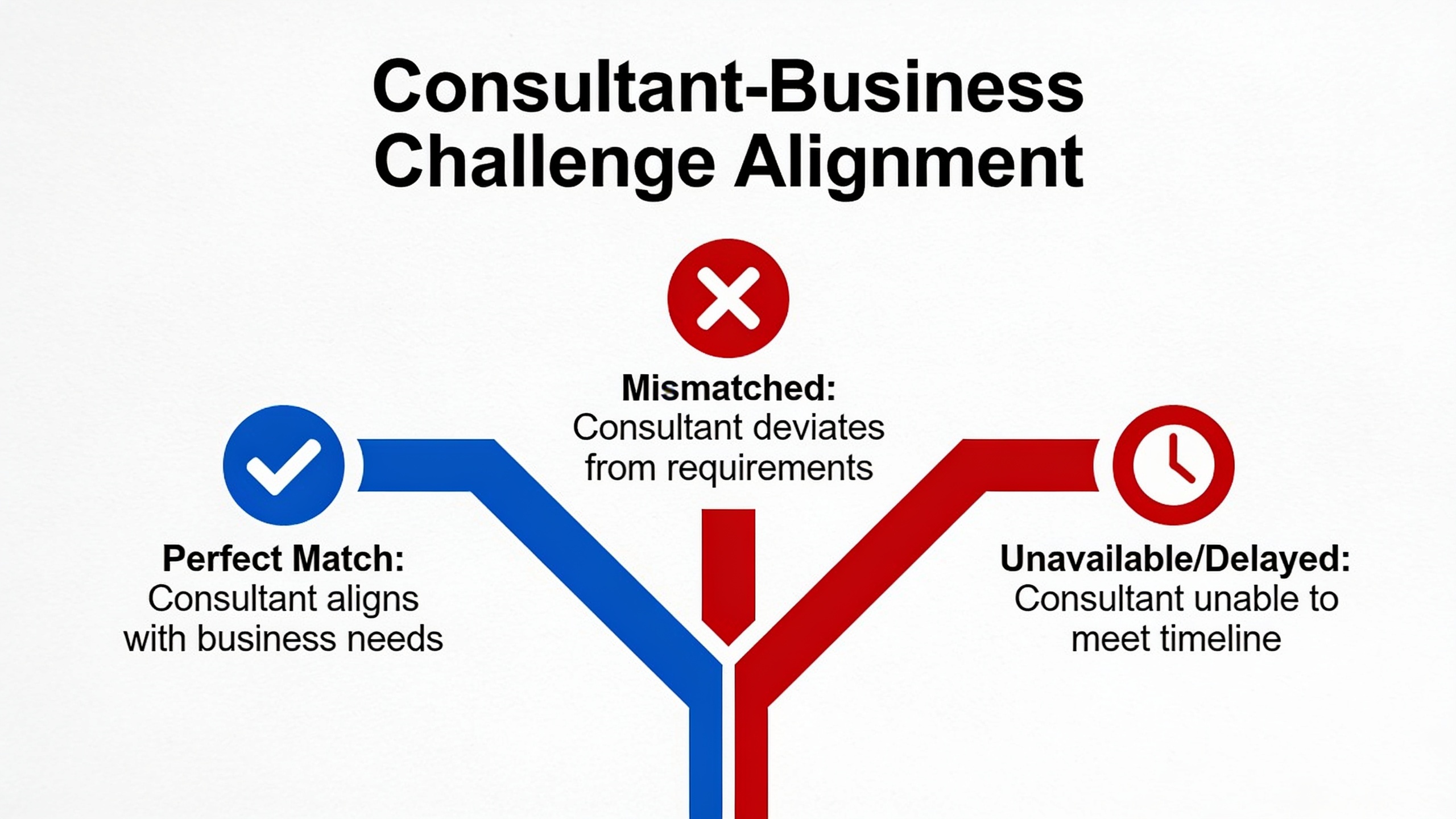
First, scope mismatch. You hire a generalist management consultant for something that needs deep technical chops, like migrating accounting practice data between platforms. The generalist will absolutely produce a beautiful slide deck about process improvement. What they won't have is hands-on experience with the specific software, the regulatory quirks, or the workflow gotchas that actually decide whether the migration goes smoothly.
Then there's timing. You finally find the right specialist and they're booked solid for four months, while your problem compounds every single week. The frustrating part is that availability almost never comes up front in referral networks. You find out about the conflict only after you've already burned time on intro calls.
The third one is trust, and it's the sneakiest. You usually can't verify a consultant's claimed results before you sign the engagement letter. The case studies on their website? Self-reported. Rarely checked by anyone independent. So you're making a six-figure call based on, essentially, marketing copy. Which is a weird thing to be comfortable with, when you think about it.
This is a big part of why more founders and executives are leaning on AI-assisted matching instead of cold outreach or endless directory scrolling. Same shift is happening earlier in the company lifecycle too, as this piece on how startups are using AI to find the right mentors lays out. Structured matching is quietly replacing the "let me ask around" approach as the main way people connect with proven expertise.
How Much Does an Operational Efficiency Consultant Cost?
There's no single market rate, and anyone who quotes you one is oversimplifying. Cost depends on scope, duration, seniority, and how specialized the work is, not some tidy hourly benchmark. So instead of anchoring on a dollar figure, look at how the engagement is structured, because structure drives the price far more than the title on the consultant's business card ever will.
You'll mostly run into three setups. Project-based fees are the norm for narrowly scoped work with a clear deliverable, like a process audit or a single-platform migration plan. You get cost certainty, but only if you nail down the scope of work upfront. Otherwise you're looking at change-order creep, and that gets expensive fast. Retainers make sense for ongoing advisory relationships where the consultant is embedded part-time over several months, which is common with change management programs that roll out in phases. And fractional or interim leadership kicks in when you basically need a temporary COO, someone actually running execution rather than just recommending it. Those tend to run longer and come with real accountability for outcomes.
One thing I'd push you to notice: the fee structure itself is a tell. If a consultant refuses to scope a fixed-fee project and insists on open-ended hourly billing, ask yourself why. Maybe they're not confident they can diagnose the problem quickly. Or maybe the engagement is built to rack up billable hours rather than actually solve the thing. Neither is a great look.
Key Criteria for Vetting an Operational Efficiency Consultant
The most reliable way to vet an operational efficiency consultant is to score them on four things: proven capability, current availability, depth of specialization, and verified trust signals. Not a resume. Not one glowing reference call that the consultant hand-picked. Those four dimensions, incidentally, mirror how the better matching platforms evaluate advisors before an executive ever lays eyes on a shortlist.
The CAST Framework Explained
Advisory Navigator turns this into something it calls the CAST framework, scoring every advisor on the platform across four dimensions before surfacing a match.
Capability is about skills, tools, and methods checked against real engagement outcomes, not the self-reported greatest-hits reel on a bio page. For an efficiency consultant, that means actual evidence of process redesigns they've pulled off, with results. Not vague talk about "driving efficiency," whatever that's supposed to mean.
Availability is exactly what it sounds like: can this person start now, or in a quarter? Advisory Navigator's whole model exists partly to stop matching executives with advisors who can't begin for months, since that's one of the most maddening parts of the old referral approach.
Specialisation captures the domains, industries, and firm types the consultant knows cold. The platform's own example is a good one: a profile might list precise sub-specialties like "Handisoft migration," "platform selection," and "go-live planning" for accounting practice tech. That's infinitely more useful than a broad label like "operations consultant."
Trust is a composite Trust Quotient built from client reviews, communication scores, and professional conduct, and it updates after every engagement rather than getting frozen at onboarding. This one goes straight at the trust problem I mentioned earlier. Instead of asking a consultant for references they've curated, the score reflects an ongoing, live record.
And look, you don't need a platform to apply this. Ask the same four questions in any interview. What have you actually built or fixed, and with what measurable result? Can you start within our timeline? Have you solved this exact type of problem, in this type of organization, before? And what do your recent clients say when someone asks them directly? If a consultant fumbles those, you've learned something.
Matching Process: From Business Challenge to Right-Fit Advisor
The fastest route from "we have an operational problem" to "we have a qualified consultant" is to describe the challenge in plain language and let a structured process, human or AI, turn that into a real brief with defined scope, timeline, and urgency. "We need help with efficiency" gets you vague matches. Specific requests get specific matches. That's basically the whole game.
Steps in AI-Powered Matching
Advisory Navigator's version runs in three steps meant to strip the guesswork out. You describe the challenge in your own words, whether that's scaling a sales team, untangling a data migration, or redesigning a go-live plan, and the platform's AI pulls out context, industry, urgency, and scope. No thirty-field intake form. Then the AI system, called AIMM (Advisory Intelligence Matching Model), turns that description into a structured Request for Advice with desired outcomes, timeline, budget, and an urgency classification. Finally, advisors get scored against that brief across the four CAST dimensions, and you see not just a shortlist but the reasoning behind each match before you reach out to anyone.
What I like about this is that it maps your request to standardized industry classifications, NAICS codes, so a manufacturing efficiency challenge doesn't accidentally get matched to someone whose real depth is healthcare administration, even though both of them list "operational efficiency" as a service line. It also pulls domain-specific language out of your own description. So "migrating from Handisoft" becomes a precise match signal instead of getting flattened into generic "software consulting."
According to platform data reported by Advisory Navigator, this model has produced a 94% match satisfaction rate and an average of 48 hours from initial challenge description to first connection. That's a genuinely different timeline than the weeks or months it usually takes to vet consultants through referrals and cold outreach.
Traditional Search vs. AI-Powered Matching
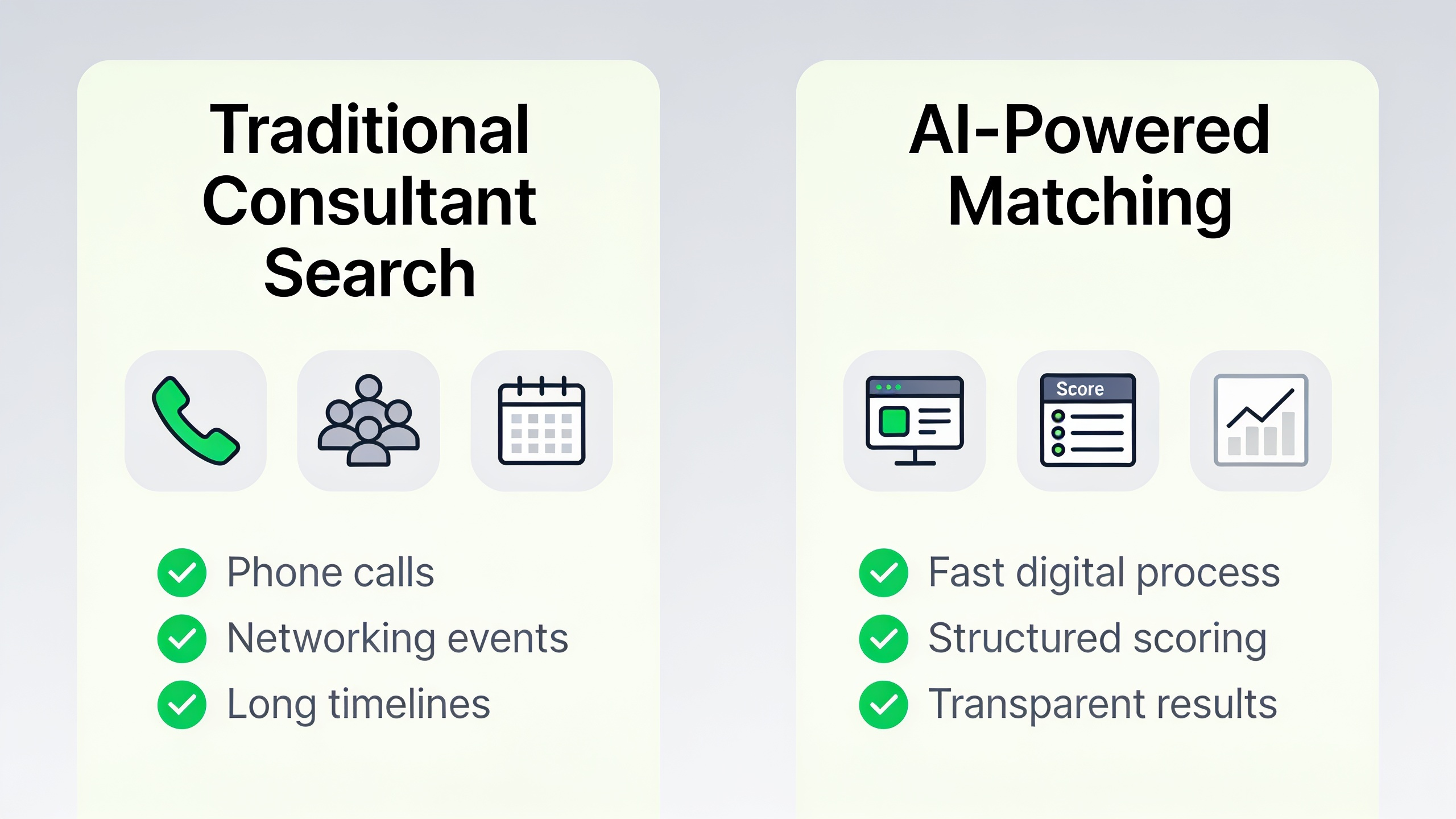
If you're stuck deciding between working your existing network and using a structured matching platform, it helps to see the trade-offs side by side. Time, transparency, verification. Here's how they stack up.
| Factor | Traditional Referral/Search | AI-Powered Matching |
|---|---|---|
| Time to first connection | Typically weeks to months of networking and vetting | Averages 48 hours to first connection, per Advisory Navigator platform data |
| Basis for matching | Word-of-mouth reputation, generalist directories | Structured brief scored against CAST dimensions (Capability, Availability, Specialisation, Trust) |
| Industry alignment | Manual research by the executive or their team | Built-in NAICS industry alignment mapped from the brief |
| Availability confirmation | Often discovered only after outreach begins | Assessed before a match is surfaced |
| Transparency of fit | Largely reputational; reasoning is implicit | Transparent fit scoring visible before you connect |
| Reported outcome tracking | Rarely tracked systematically across engagements | 94% match satisfaction reported by the platform |
Neither one is magic. No matching system gets you out of doing your own final diligence, and don't let anyone tell you otherwise. But the structured approach cuts way down on the number of pointless conversations you have to sit through before you find someone who actually fits the problem. And that alone is worth something.
Where Executive Advisory Services Fit Alongside Operational Efficiency Consulting
Executive advisory services are the bigger bucket. They cover strategic guidance on growth, fundraising, leadership, organizational design, all of it, and operational efficiency consulting is just one specialized lane inside that. The thing is, executives often need both at once: a strategic advisor to set the direction, and an operational specialist to make sure the org can actually execute on it without process failures quietly sabotaging the strategy.
That's why platforms built for expertise matching are getting away from treating "advisor" as one flat category. Advisory Navigator frames its own goal as connecting a business with "the right advisor, coach, mentor, or expert, whoever has actually solved this before," which nails the reality that a scaling-stage exec might need a fundraising strategist one quarter and an operational efficiency consultant to fix fulfillment bottlenecks the next. Assuming those are interchangeable, or that one advisor can competently wear both hats, is one of the more expensive mistakes I see people make when building out an advisory bench.
For nonprofit leaders especially, this distinction really matters. A strategic advisor might help you refine a theory of change or rework a board governance model. An operational efficiency consultant focuses narrowly on cutting the administrative drag of grant reporting or donor management workflows so more of every dollar reaches the mission. Both live under executive advisory services. But they need different vetting criteria, and usually different timelines too.
Real-World Signals of a Good Fit
The clearest sign a consultant is right for your challenge is that they can point to a repeatable process they've already refined in a comparable context. Not a one-off war story that might not generalize to anything. Be a little skeptical of anyone who describes every past engagement as totally unique and unrepeatable. Real specialization produces patterns, frameworks, checklists, stuff that gets reused and sharpened across clients.
And this holds true way outside corporate consulting, by the way. Take a business like Minneapolis House Painting, which does residential and commercial painting across the Twin Cities metro, including exterior and interior work, cabinet painting, and specialized work on historic homes. A company that's painted enough historic homes to build a reliable process for lead-paint protocols, scaffolding logistics, and multi-week scheduling across a fleet of crews has basically become an operational efficiency specialist inside its own niche. Transparent pricing and consistent communication end up being byproducts of that repeatable process, not separate selling points. Same logic runs straight through corporate work. You want a consultant whose specialization has produced a repeatable method, not just a scrapbook of anecdotes.
You can test for this pretty easily in a first conversation. Ask them to walk you through their standard diagnostic process, step by step, before any customization for your specific situation. Someone with genuine depth will have a clear, consistent answer ready to go. A generalist stretching into unfamiliar territory tends to flounder here, falling back on reassurances about "experience" and "adaptability" instead of describing an actual process. It's a surprisingly reliable tell.
FAQ
Which industries hire operational efficiency consultants the most?
Manufacturing, professional services (accounting and legal practices going through tech migrations are big here), healthcare administration, logistics, and nonprofits juggling complex grant and program reporting. Basically, any field where process bottlenecks carry a direct, measurable price tag.
How long does one of these engagements usually run?
Depends entirely on scope. A focused process audit might wrap in a few weeks. A full platform migration or org-wide workflow redesign can stretch over several months, especially once you're doing phased change management across multiple departments.
Solo consultant or a firm, which should I go with?
It comes down to complexity and how much bench depth you need. A solo consultant with deep, narrow expertise, like a specific software migration, can often move faster and cost less than a firm. A firm makes more sense for org-wide transformations that need several workstreams running at once. Neither is inherently better. Match the structure to the scope and you'll be fine.
Can an operational efficiency consultant also handle strategic growth planning?
Some can. But verify it explicitly instead of assuming, because operational efficiency and strategic growth advisory are genuinely distinct disciplines. Someone brilliant at workflow redesign is not automatically qualified to advise on fundraising or market expansion, and the reverse is just as true.
How do I know if I even need an outside consultant versus an internal fix?
If the problem sits inside one team and a manager can diagnose and solve it with the resources you already have, you probably don't need to hire anyone. External expertise earns its keep when the inefficiency crosses departmental lines, requires specialized technical knowledge you don't have in-house, or has stubbornly survived repeated internal attempts to fix it.
At the end of it all, finding the right operational efficiency consultant comes down to matching how specific your problem is with how specific their expertise is. A generalist referral almost never beats a specialist who's solved your exact challenge before. Executives who treat this search with the same rigor they'd bring to any other high-stakes hire, rather than just grabbing the first name a colleague tosses out, tend to get faster and more durable results. Boring advice, maybe. But it works.