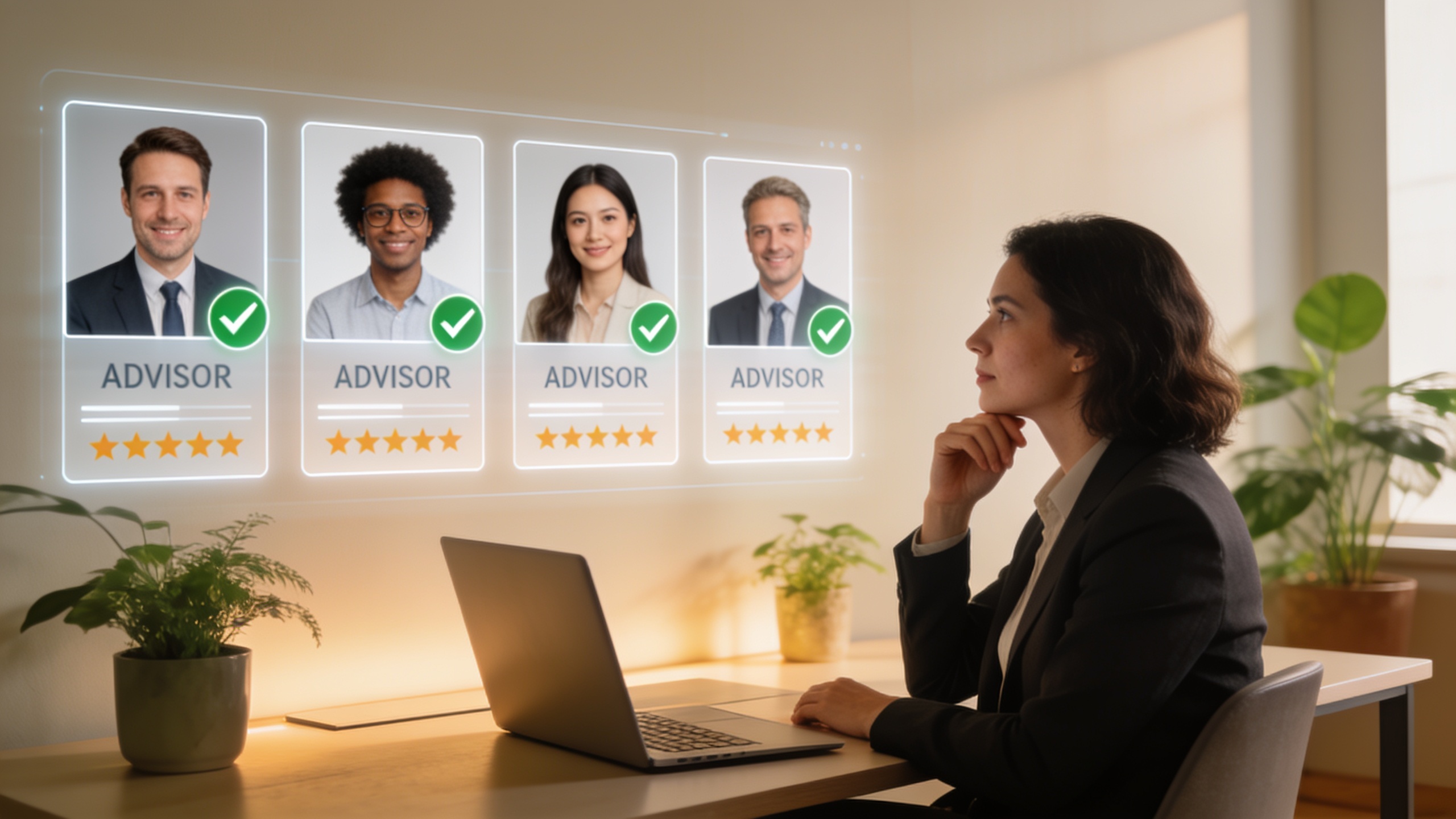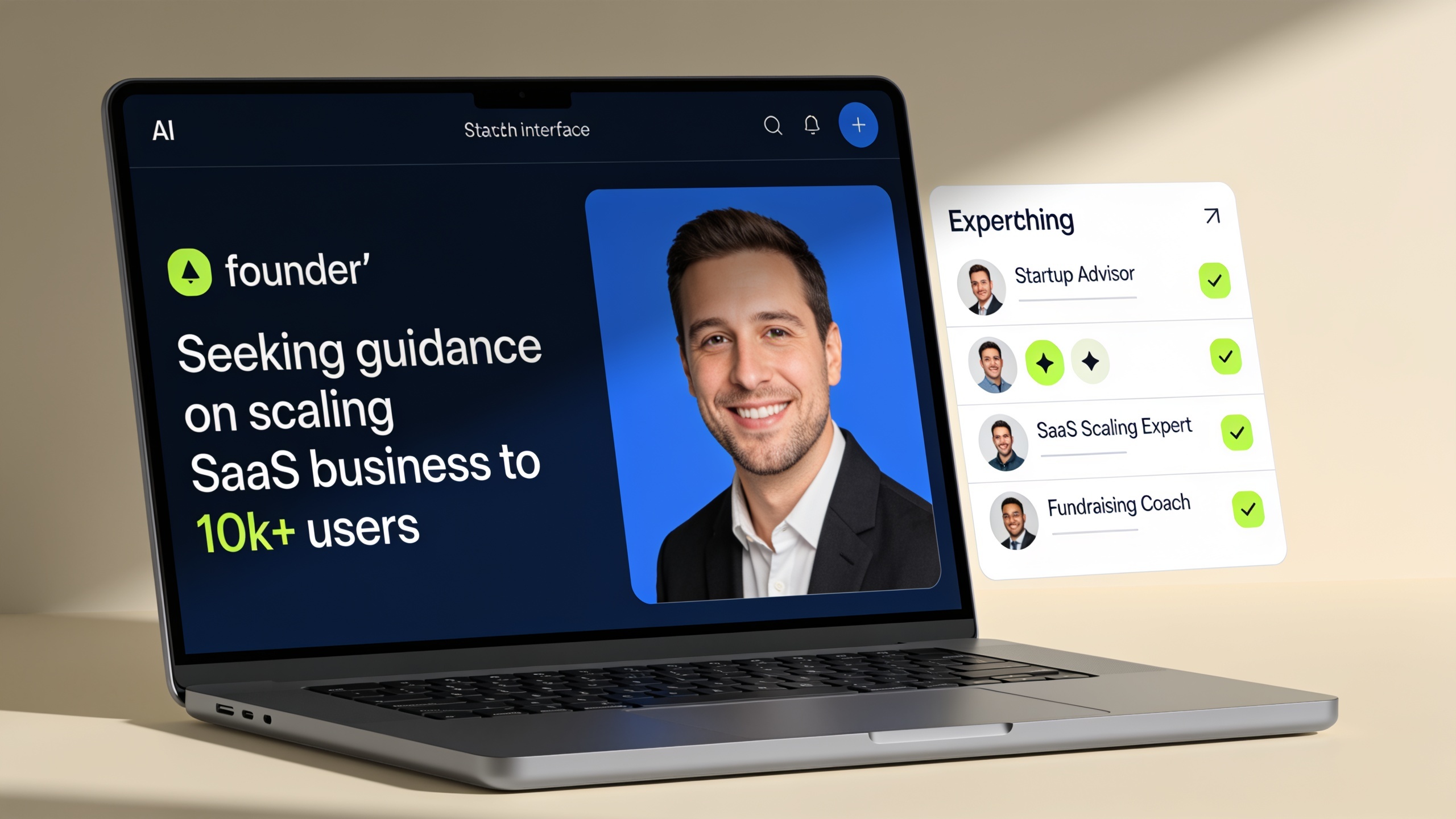
The old way was broken almost by design. Say you're wrestling with brutal enterprise sales cycles and the only mentor available happens to be a consumer-app person. You're going to have a nice chat and learn basically nothing that applies to you. AI for startups is closing that gap by treating mentor matching less like networking and more like a search-and-recommendation problem. Think Netflix picking your next show, or a job board matching a candidate to a role. Same underlying idea.
Table of Contents
- Why Traditional Mentor Matching Falls Short
- How Does AI-Powered Startup Mentor Matching Actually Work?
- What Makes AI Matching More Accurate Than Human Networking?
- Real-World Applications Across Industries
- Comparing Mentor Discovery Methods
- How Much Does AI Mentor Matching Cost?
- Challenges and Limitations of AI Mentor Matching
- Building a Mentor Relationship That Actually Works
- Frequently Asked Questions
Why Traditional Mentor Matching Falls Short
Traditional mentor matching leans on limited networks, generic accelerator rosters, and casual introductions, which means founders too often get paired based on who's available rather than who actually knows anything relevant. You end up with a B2B SaaS veteran advising a marketplace founder, not because their experience transfers, but because they happened to sit in the same accelerator cohort. That's it. That's the whole reason.
And it costs founders real money and real time. Studies of startup ecosystems keep landing on the same conclusion: founders who get relevant, experience-based guidance make fewer expensive strategic blunders than those flying blind or nodding along to generic advice. The frustrating part is that there's no shortage of mentors. Plenty of seasoned operators genuinely want to give back. It's a discovery problem. There's just no clean way for a founder in Denver sweating over fintech compliance to know that some former compliance officer three states away has already untangled that exact mess. Twice.
Accelerators have tried to patch this with structured mentor pools, and to their credit, the good ones try hard. But even a strong program usually caps out at a few hundred mentors spread across dozens of industries. That's a shallow pond when your problem is narrow and weirdly specific, like negotiating a Series A term sheet or fixing a subscription pricing model that's bleeding churn. This is exactly the gap AI platforms are wandering into, and it's part of a bigger shift where AI for startups is rewriting how early-stage companies get to expertise that used to live behind someone's personal Rolodex.
How Does AI-Powered Startup Mentor Matching Actually Work?
AI-powered startup mentor matching works by taking a founder's specific challenge, described in plain English or through an intake form, and comparing it against a database of mentors' documented experience, outcomes, and specialties to surface the closest fits. The key word is specific. Instead of matching on lazy buckets like "tech startup" or "marketing," the system looks at the granular stuff: what problem got solved, in what industry, at what stage, and what actually happened as a result.
Roughly speaking, it moves through a few stages.
First, intake and profiling. A founder types something like, "We're a 12-person logistics startup and we can't close our first enterprise contract because procurement keeps stalling." Natural language processing pulls out the variables that matter: industry (logistics), stage (early, 12 people), problem type (enterprise sales, procurement friction).
Then it looks at the mentor side, where profiles are hopefully more than a job title. The better platforms capture actual outcomes. Stuff like "helped three logistics startups land their first enterprise deal" or "spent eight years negotiating procurement contracts inside a Fortune 500." That level of detail is the whole difference between modern matching and a glorified phone book.
After that comes scoring and ranking. The algorithms weigh similarity across a bunch of dimensions, industry overlap, company stage, problem type, sometimes even communication style and availability, and rank people by relevance instead of dumping an alphabetical list on you. And finally there are feedback loops. Rate a session highly and the system doubles down on what made that match work. Rate it poorly and it recalibrates.
This is basically the model AdvisoryNavigator is built on: founders describe a specific problem, and the system finds an advisor, coach, or mentor who's genuinely solved that thing before, not just someone who checks a broad category box. If you're weighing your options here, the piece on the Boardy.ai alternative and how AdvisoryNavigator stacks up walks through how different AI matching approaches handle scoring and ranking, which honestly matters a ton depending on how niche your problem is.
The Role of Natural Language Processing
Natural language processing (NLP) is the branch of AI that lets software actually read what you wrote instead of forcing you into rigid dropdown menus. This is huge for mentor matching, because nobody describes their problems in neat little categories. A founder might say, "I think my co-founder and I are misaligned on equity and it's slowing down our fundraise." That one sentence touches co-founder dynamics, equity structuring, and fundraising all at once. NLP can catch all three tags at once instead of making you pick your one favorite crisis.
What Makes AI Matching More Accurate Than Human Networking?
AI matching usually beats informal networking because it can chew through thousands of mentor profiles and outcome histories at the same time, which no human connector, accelerator director, or investor can do from memory. A really well-connected advisor might personally know 50 to 100 mentors well enough to vouch for them. An algorithm can compare every mentor in a database of thousands against your exact problem in seconds.
Now, I'm not saying human intuition is worthless. It isn't. A sharp connector picks up on things a form never will, like whether two personalities are going to click or quietly hate each other. But the accuracy edge from AI mostly comes down to scale and specificity. Here's the contrast laid out:
| Matching Approach | Typical Pool Size | Matching Criteria | Time to Match | Specificity of Fit |
|---|---|---|---|---|
| Informal networking | 10-100 contacts | Personal familiarity, availability | Days to weeks | Low to moderate |
| Accelerator mentor pool | 100-500 mentors | Program enrollment, general industry | Days | Moderate |
| Generic directory search | Thousands (unfiltered) | Keyword search, self-reported bios | Hours to days | Low |
| AI-powered matching platform | Thousands (filtered) | Problem type, outcome history, stage, industry | Minutes to hours | High |
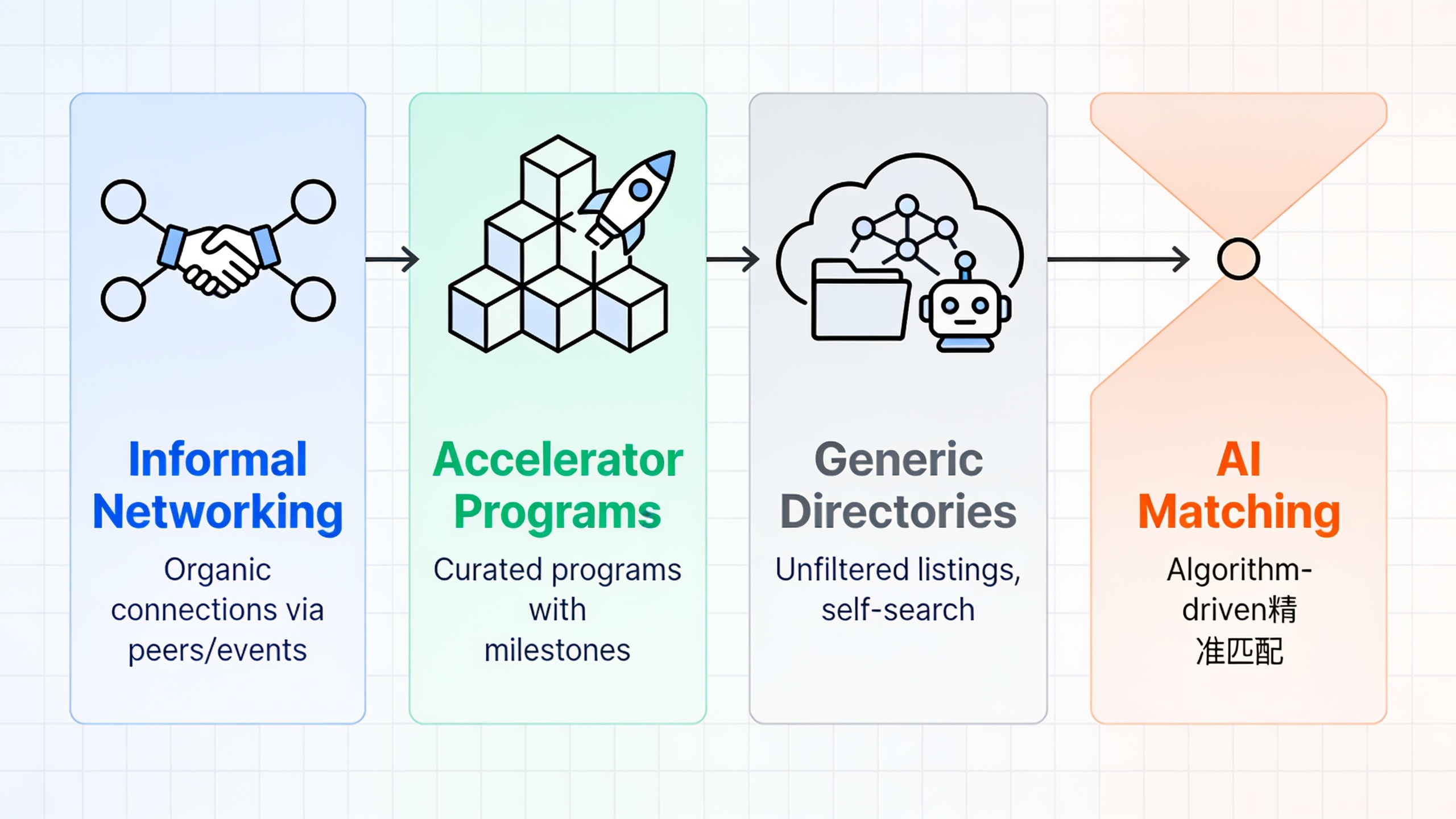
The specificity thing matters most when your problem is strange or narrow. Search a generic directory for "startup mentor" and you get thousands of results with no way to filter for "has personally survived a down-round" or "has scaled a two-sided marketplace past 10,000 active users." AI platforms are built to slice on those granular criteria, and that's where the accuracy advantage really stacks up.
There's a speed angle too, and it's underrated. The traditional route, hitting events, begging for intros, waiting around for accelerator office hours, can eat weeks. AI matching usually squeezes that down to hours or days. Which matters a lot when you're staring at a term sheet that expires Friday or a key hire deciding between you and a competitor.
Real-World Applications Across Industries
AI mentor matching isn't just a Silicon Valley toy anymore. It's creeping into very specific professional corners where the "right" advisor needs particular, verifiable experience. That verification requirement is exactly why these tools are catching on outside the traditional startup bubble.
Take State6, which uses AI-powered coaching to help UK police officers prep for promotion boards. Not a startup, obviously. But the logic is identical to founder matching: a generic career coach is nowhere near as useful as someone who's actually navigated that specific promotion process, board format, and competency framework. Same deal as a founder prepping for a Series B who gets stuck with an advisor who's only ever done seed rounds. The specificity of the prior experience is what makes advice actionable instead of just theoretical.
Fintech and crypto founders have it especially rough here, because the regulatory and market ground shifts so fast that a mentor's playbook from three years ago might already be a museum piece. Founders in this space usually need to pair mentor guidance with fresh market intelligence, which is why resources like Cryptocoinsjournal, which tracks cryptocurrency market trends and blockchain developments, tend to sit alongside mentor conversations rather than replacing them. A mentor gives you judgment and pattern recognition. But you still need current data to apply that judgment without embarrassing yourself.
Proptech is another interesting one. Founders building property products often need a mentor who gets both software and the messy realities of property deals, like inspection delays, financing contingencies, weird local regulations. Something like Vivienda Lista, which helps people navigate home buying and rental listings more smoothly, captures exactly the kind of domain friction a generalist mentor would sail right past but that anyone who's worked inside proptech would clock in a second.
Even inside AI and SaaS tooling, the matching needs get oddly specific. A founder building an AI content or SEO tool doesn't want a vague "tech mentor," they want someone who's scaled a similar product. Take RobinRank, which automates SEO content writing, publishing, and backlink exchange. That's a niche enough category that the founder would get way more out of talking to someone who's actually built and scaled an AI content automation business than a generalist SaaS advisor who's never touched that particular market weirdness.
Nonprofit and Mission-Driven Organizations
Nonprofits are quietly becoming a real chunk of AI mentor matching adoption, even though they're not "startups" in the venture-backed sense. Nonprofit leaders need help with fundraising strategy, board governance, program measurement, and a bad mentor match hurts them just as much. A nonprofit executive director trying to wean the org off a single major donor needs someone who's actually pulled off that transition, not generic management platitudes. So platforms that serve both founders and nonprofit leaders are increasingly tagging mentor profiles with mission-sector experience, because the fundraising mechanics of a 501(c)(3) are a completely different animal from a startup's cap table conversations.
Comparing Mentor Discovery Methods
Founders today mostly pick from four paths to mentorship, and each one comes with its own tradeoffs in cost, speed, and fit. Worth thinking these through before you sink time into any single one.
Accelerators are still popular because they bundle mentorship with funding, curriculum, and a peer network, which is a lot of value in one package. But acceptance rates at the name-brand programs are painfully low, and even founders who get in will tell you mentor quality can swing wildly inside a single cohort. Paid coaching marketplaces fix the access problem but often flip into the opposite headache: too many options, too little to tell them apart, so you're stuck manually vetting dozens of profiles built on self-reported bios you can't really verify.
Personal referrals, on the other hand, still produce some of the highest-trust relationships out there. A recommendation from someone you respect comes with built-in credibility, which is genuinely valuable. The catch is obvious though. Your network is finite, and it reflects who you already know rather than the full universe of people who might actually be perfect for your problem. That's the exact constraint AI matching is trying to blow open, shifting the search from "who do I know" to "who's actually done this."
AI matching platforms, meanwhile, optimize for problem-to-experience fit over relationship warmth or program prestige. The tradeoff? You have to be precise and honest describing your challenge, or the matching falls apart. Vague inputs give you vague matches, no matter how clever the algorithm is under the hood.
How Much Does AI Mentor Matching Cost?
AI mentor matching platforms run the gamut, from free basic matching all the way to paid tiers with recurring sessions, so you're looking at anything from no cost for a single introduction up to several hundred dollars a month for structured, ongoing advisory relationships. What you pay mostly depends on whether the platform is connecting you with volunteer mentors, vetted professional advisors, or some blend of the two.
Free or cheap tiers usually cover the matching itself, describing your problem and getting a short list back, but they might charge separately for actual advisory time, or just pass through the mentor's hourly rate. Paid tiers tend to wrap the matching algorithm together with extras like scheduling tools, progress tracking, and access to a bigger or more thoroughly vetted mentor pool. Some go with a subscription model on purpose, because ongoing relationships just produce better results than one-off calls, and a subscription nudges you to come back for follow-ups instead of treating mentorship like a single transaction.
One thing worth saying plainly: cost isn't the only number that matters. A $0 intro to the wrong mentor is arguably more expensive than a $200 session with someone who's solved your exact problem, once you factor in opportunity cost. Bad advice and wasted hours compound at precisely the moment a startup can least afford it. So when you're comparing platforms, weigh the specificity and verification of the matching at least as heavily as the sticker price.
Challenges and Limitations of AI Mentor Matching
AI mentor matching is not magic, and its biggest weak spots come down to data quality, the temptation to over-trust the algorithm, and the fact that some of the best parts of a mentor relationship, like trust and communication chemistry, are just hard to put a number on. A matching algorithm is only as good as the data describing your problem and the mentor's real experience, and self-reported bios get inflated or go stale if a platform isn't actively verifying outcomes.
Then there's the "cold start" problem that haunts basically every recommendation system. A brand-new platform with few mentors and no feedback history has thin data to work with, so its early matches tend to be rougher than they'll be once it's chewed through thousands of hits and misses. If you're on a newer platform, treat those early matches as a starting point, not gospel, and actually give feedback so the thing gets smarter.
There's also a real risk of leaning too hard on past experience. A mentor who cracked a similar problem back in 2015 might be running on assumptions about markets, tools, or customer behavior that have since gone out the window. This gets especially dicey in fast-moving spaces like consumer AI, where the competitive landscape can shift meaningfully inside a single year. Good systems try to weigh recency alongside relevance, but you still have to apply your own brain instead of treating a match as infallible just because an algorithm coughed it up.
And finally, algorithms can't fully judge chemistry. Two people can have perfectly aligned experience and still just not gel, because their communication styles clash or their personalities grate. The better platforms handle this by letting you have a low-stakes intro chat before committing to anything ongoing, rather than locking you into a match based purely on a score.
Building a Mentor Relationship That Actually Works
A good mentor relationship depends way less on how you found the match and way more on what you do after the intro, specifically whether you show up with a clear, specific question and an actual willingness to act on the answer. Even a flawless match can't do much if you roll into every session with nothing concrete to discuss.
The founders who squeeze the most out of mentorship tend to do a few things consistently. They arrive with one or two specific decisions they're trying to make, not a fuzzy "let's talk strategy." They treat the mentor's experience as informed judgment rather than scripture, asking "why did that work for you" instead of blindly copying a move that worked in a totally different market or stage. And they follow up. Sharing what happened after they acted on the advice closes the loop, helps the mentor calibrate, and, conveniently, is exactly the kind of feedback signal that sharpens AI matching over time.

Oh, and set expectations about cadence early. Some founders need intense weekly support through a specific crunch, a fundraising sprint, a product pivot, while others get more out of a monthly check-in over a longer stretch. Being honest about which one you are, right at the start, saves you from the classic slow death where sessions get sparse and eventually just... stop, because nobody ever said out loud what the rhythm should be.
Frequently Asked Questions
Is AI mentor matching only for tech startups?
Nope. Tech and SaaS got there first, sure, but the same logic now applies to nonprofits, professional development (like police promotion coaching), real estate, fintech, and plain old small businesses. Any situation where "who's actually solved this specific problem" beats general advice is fair game for AI-driven matching.
How is startup mentor matching different from just hiring a business coach?
A general business coach usually works across a wide range of challenges using established frameworks. Startup mentor matching is built to connect you with someone who's got specific, relevant experience with your exact problem, like a particular fundraising stage, an industry regulation, or a growth bottleneck. The value is in the lived experience with that precise situation, not the coaching methodology.
Do AI matching platforms verify a mentor's claimed experience?
Depends on the platform. The more credible ones verify outcomes through references, professional history checks, or documented case studies instead of just trusting self-reported bios. Ask directly how a platform verifies mentor claims before you commit serious time or money.
Can AI matching replace an accelerator program entirely?
Not really. Accelerators bundle mentorship with funding, structured curriculum, and a peer cohort, and AI matching platforms don't recreate all that on their own. Plenty of founders use AI-driven matching alongside an accelerator, or as a standalone option when they didn't get in or don't need the full program.
What information should a founder provide to get a good mentor match?
The more specific your input, the better your match. Don't say "I need a marketing mentor." Say something like "our customer acquisition cost has doubled since we started running paid ads and I can't tell if it's a targeting problem or a messaging problem." Honest, detailed descriptions of the actual bottleneck pull far better matches than broad category requests.
Startup mentor matching is drifting away from who-you-know networking and toward a model where the specificity of your problem, not the size of your Rolodex, decides the quality of advice you can reach. As AI for startups keeps maturing, the gap between founders with killer networks and those without one is shrinking. Not because mentorship got less valuable, but because finding the right mentor finally got a whole lot more precise, faster, and a lot less dependent on luck.