
That's what this whole piece is about: how to find someone with real, verifiable experience instead of credentials that just sound good.
Doesn't matter if you're a small business owner, a startup founder, a corporate exec, or running a non-profit. You're all fighting the same battle. There are thousands of advisors out there. But the ones who've actually solved your specific problem? Way rarer than you'd think. My goal here is to help you spot the difference before you sign anything, not after you've burned three months and a chunk of budget finding out the hard way.
Table of Contents
- Why Generic Credentials Don't Solve Specific Problems
- How to Find an Experienced Advisor Who's Actually Solved Your Problem
- What Questions Should You Ask to Vet an Advisor's Track Record?
- Credentials vs. Proven Track Record: A Side-by-Side Comparison
- Where to Look for an Advisor With Relevant Experience
- Red Flags That Signal a Mismatch
- How Can AI Matching Help You Find an Experienced Advisor Faster?
- FAQ
Why Generic Credentials Don't Solve Specific Problems
A credential tells you what someone studied. It does not tell you whether they've ever solved the specific problem sitting on your desk. An MBA, a CPA license, a bio that brags about "20 years of experience," sure, those signal general competence. But none of them prove the person has actually migrated an accounting practice off a legacy platform, or scaled a SaaS sales team from five reps to fifty.
The reason this trips people up so often is that credentials are broad by design, while business problems are narrow and weirdly specific. Take a management consultant who spent ten years at a big firm advising Fortune 500 companies on "operational efficiency." Impressive, right? But that person may have never once set foot inside a 12-person startup where the burn rate is measured in weeks, not quarters. Totally different universe. Same goes for the business coach with the popular podcast, who might be genuinely brilliant at mindset and motivation but has never gotten anywhere near the mechanics of a Series A term sheet.
So here's how I'd reframe it. Stop treating experience like a vibe you catch off someone's bio. Treat it like a claim that needs evidence. The question isn't "Is this person qualified?" It's "Has this person actually done the thing I need done?" Small shift, huge difference. That's the whole ballgame when it comes to finding an experienced advisor instead of just an impressive one.
How to Find an Experienced Advisor Who's Actually Solved Your Problem
The fastest way to find the right advisor is to work backward from your actual problem. Define it precisely, then go hunting for people who've solved that, not some broader category it happens to fall under. Which means naming your industry, your stage, your timeline, and the outcome you need before you even start looking at candidates.
Start With a Precise Problem Statement
Vague requests get you vague matches. Say "I need help with growth" and you'll drown in advisors who all swear they're growth experts. But say "I need someone who's taken a B2B SaaS company from $1M to $5M ARR by rebuilding the outbound sales motion," and suddenly the field shrinks to people who can actually point to that result. Write your challenge down. One or two sentences, with your industry, your stage, and the specific outcome you're chasing. And yeah, the whole point of being that specific is to make it easy to disqualify people who don't fit. Disqualifying is good. Disqualifying is the job.
Look for Outcome Evidence, Not Just Experience Claims
A genuinely experienced advisor can point to a measurable before-and-after, not just a rolodex of past clients. So dig in. What did the situation look like before they showed up? What actually changed? How long did it take? If they can't give you numbers, timelines, or concrete deliverables, their "experience" is probably more theoretical than practical. Which is a nice way of saying they read about it more than they did it.
Match on Stage and Scale, Not Just Industry
Two companies in the same industry can need wildly different things depending on their size. A non-profit running on a $200,000 annual budget needs completely different operational advice than one managing $20 million in grants. A founder raising a seed round is in a different world than one prepping for a Series B. So when you're sizing up an advisor, make sure they've operated at your scale, not just in your sector. Someone with great experience at the wrong scale can steer you straight off a cliff with the best intentions.
What Questions Should You Ask to Vet an Advisor's Track Record?
The questions that actually reveal a track record are specific, outcome-focused, and hard to bluff your way through. Ask "Tell me about your experience" and you'll get a rehearsed monologue. Ask something specific and you force something specific back.
A few worth asking straight up:
- "Walk me through a client situation that looked like mine. What was broken, what did you do, what changed?"
- "What would you do differently if you could run that engagement again?"
- "Can I actually talk to a past client who had a similar problem?"
- "Based on similar work you've done, what timeline should I expect here?"
- "What didn't work when you tried this before, and how'd you adjust?"
That last one matters way more than people give it credit for. An advisor who only tells you about wins, no stumbles, no course corrections, no "oh man, that one nearly went sideways," is either green or not being straight with you. Either way, not great. Real experience is messy. It always includes at least one story about the thing that didn't go to plan.
Oh, and pay attention to how they talk about the edges of what they know. Someone who says "honestly, that part's outside what I've done, you'd want someone with direct experience in X" is showing you exactly the kind of honesty that makes everything else they claim more believable.
Credentials vs. Proven Track Record: A Side-by-Side Comparison
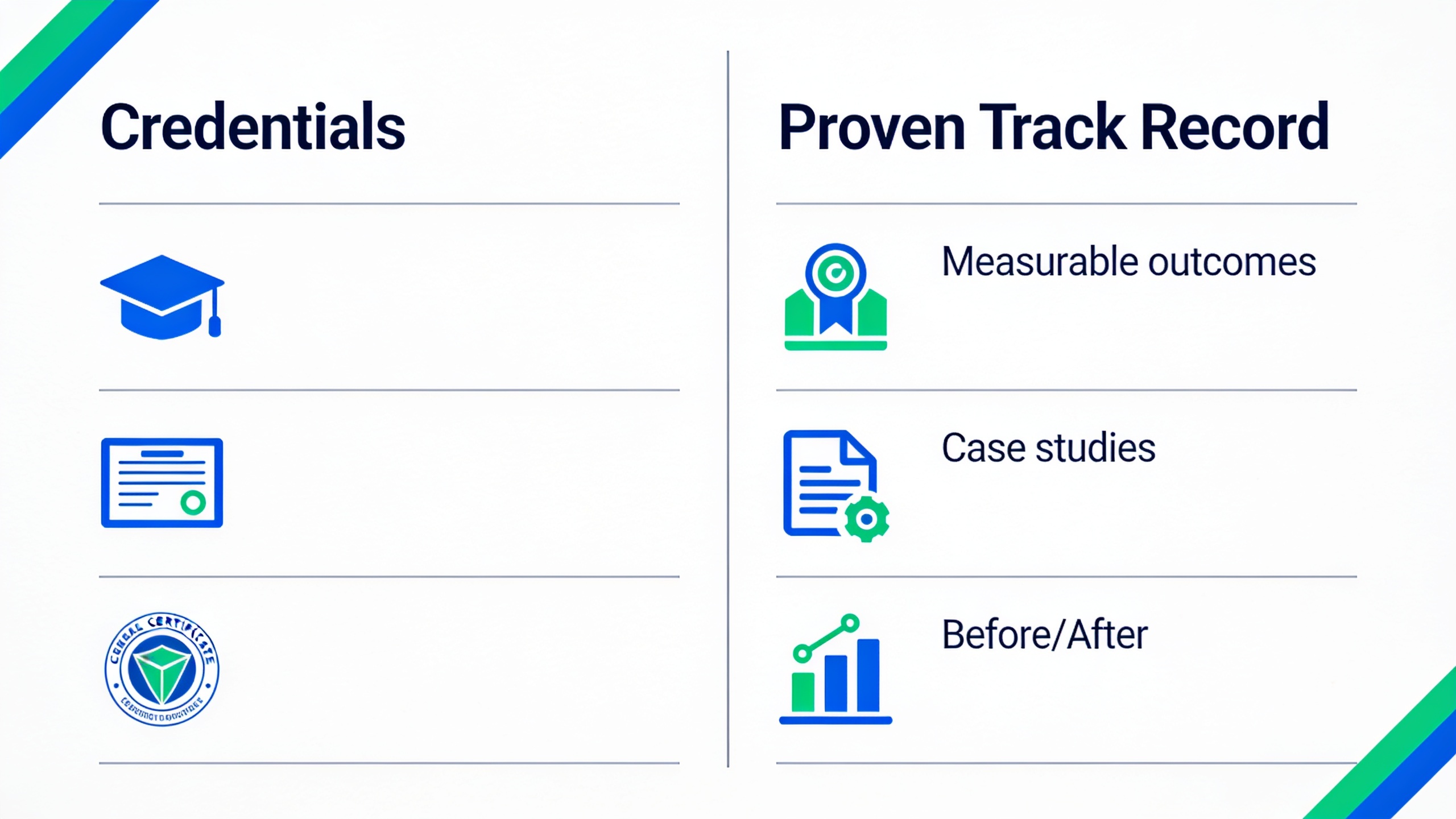
Credentials and a proven track record are not the same thing, and mixing them up is one of the top reasons advisory engagements flop. Here's what each one actually tells you, and what it doesn't.
| Signal | What It Tells You | What It Doesn't Tell You | How to Verify |
|---|---|---|---|
| Degree or certification | Baseline formal training in a discipline | Whether they've applied it to your specific problem | Ask for direct case examples, not credentials |
| Years in the industry | General familiarity with the field | Depth of hands-on experience with your exact challenge | Ask what percentage of that time was spent on this specific problem type |
| Client logos or brand names | They've worked with recognizable companies | What role they played, or whether the engagement succeeded | Ask for outcomes, not just names |
| Client testimonials | Some clients were satisfied | Whether the situation matched yours | Ask if you can speak to a client with a similar problem |
| Specific outcome data (e.g., "reduced churn from 8% to 3% in six months") | Direct evidence of relevant, applied experience | Whether the result will repeat in your context | Ask what conditions made that result possible and whether they exist for you |
| Live availability and current workload | Whether they can actually start soon | Nothing about skill — availability is separate from competence | Ask directly about their current capacity before engaging |
If you take one thing away from that table, make it this: outcome data and direct case examples are the only two signals that reliably tell you someone has relevant experience. Everything else is a proxy. It might correlate with skill. It doesn't prove it.
Where to Look for an Advisor With Relevant Experience
The best places to find someone with relevant experience are the ones that surface specific, verified outcomes, not broad directories sorted by job title. Referral networks, professional associations, general freelance marketplaces, they all have a role. But each one comes with baggage you should know about going in.
Referrals from other founders or execs are great because they come pre-loaded with a reference check. The catch? You're limited to the size of your network. You'll only ever hear about the advisors that someone you happen to know happened to use. Professional associations and industry groups widen the pool, but membership mostly just proves someone paid their dues and holds general credentials. It doesn't verify a single outcome. And the big freelance marketplaces list thousands of consultants and coaches, but they're built around self-reported skills and keywords, which means all the vetting work lands right back in your lap.
Which is a big part of why the market has drifted toward AI-assisted matching platforms that score advisors on more than keyword overlap. Now, if you're an advisor yourself rather than someone shopping for one, it's worth understanding how these platforms shape lead generation and who actually gets seen. The piece on 7 Reasons Business Advisors Should List on AdvisoryNavigator for Better Advisor Lead Generation gets into why a verified profile has become a real lead source, not just a nice-to-have on top of referrals.
And one more thing worth saying, because people forget it constantly. "Relevant experience" isn't just a big-company thing. Even a tiny product-based business has needs every bit as specific as a venture-backed startup. Think of a founder running a hand-poured candle brand like Noir Glow Candles, with seasonal collections and made-in-USA production. That person doesn't need some generalist retail consultant. They need someone who's actually helped a small-batch, direct-to-consumer product business wrestle with seasonal demand swings, packaging costs, and channel strategy. Same principle no matter the company size: match the advisor to the exact shape of the problem, not the general category of business. That's the whole thing, really.
Red Flags That Signal a Mismatch
A mismatch usually reveals itself early, in the language an advisor uses and the questions they ask (or, more tellingly, don't ask). Catch these before you sign and you'll save yourself months.
Vague Language Around Outcomes
Watch for advisors who talk in permanent generalities. "I help businesses grow." "I focus on operational excellence." Great, but grow how, excellent at what? People with real hands-on experience can't help but get specific, sometimes almost too specific. They'll name the exact tools, drop numbers, mention the obstacle nobody warned them about. Vague is what you get when the experience is broad but shallow.
No Curiosity About Your Specific Context
Someone with real experience in your kind of problem starts asking sharp questions almost immediately. They can't help it. They've seen the variations before and they know which details actually move the needle. So if a prospective advisor skips all that and jumps straight into pitching their process without asking about your stage, budget, or timeline? That's usually a one-size-fits-all framework wearing a costume.
Over-Reliance on Brand Names Instead of Roles
Be a little skeptical of advisors who wave around famous company names they've "worked with" but stay fuzzy on what they actually did. Leading a project and being body number 42 in the room are not the same. Just ask: "What was your specific responsibility, and what would've been different without you?" You'll learn a lot from how fast they answer.
Unwillingness to Discuss Past Failures
Like I said earlier, a flawless track record with zero lessons learned is a red flag, not a green one. It means they're either editing the truth or they haven't done enough real work to hit friction yet. Real experience has scar tissue.
No Clear Answer on Timeline
Someone who's genuinely solved your kind of problem can give you a realistic range for how long it takes, because they've sweated through that timeline at least once. People without that direct experience tend to either dodge the question or hand you a timeline so optimistic it should come with a disclaimer.
How Can AI Matching Help You Find an Experienced Advisor Faster?
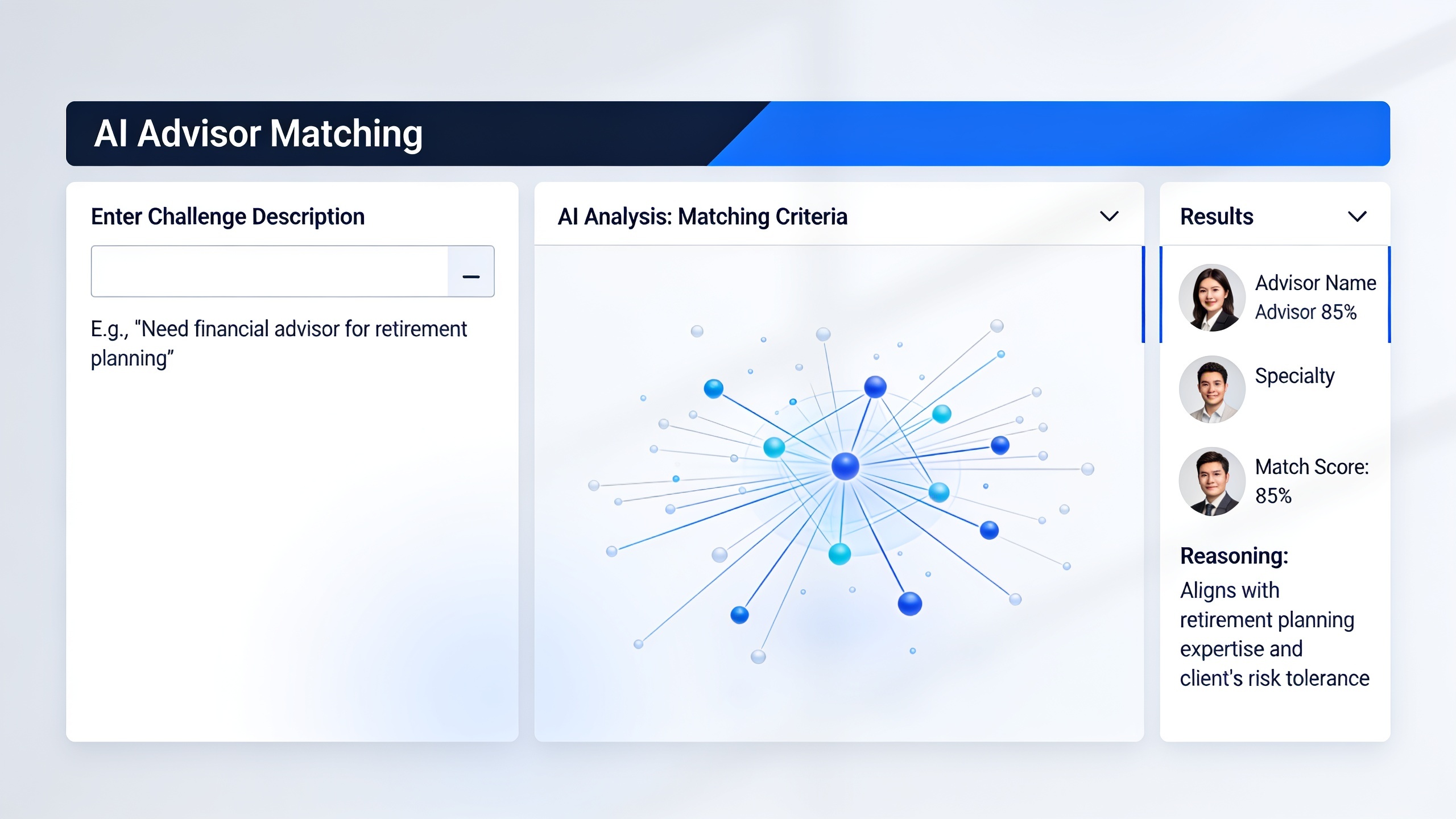
AI matching speeds things up by evaluating candidates against your specific brief across several dimensions at once, instead of leaving you to manually claw through directories, chase referrals, and send cold emails into the void. Rather than searching by job title or a single industry keyword, a well-built matching system takes your actual challenge and turns it into a structured profile, then scores advisors against that.
Advisory Navigator does this with a framework it calls AIMM, the Advisory Intelligence Matching Model. You describe your challenge in plain language, and it converts that into a structured brief covering desired outcomes, timeline, budget, and urgency. From there it maps your brief to standardized industry classifications (NAICS codes) so you get sector-relevant advisors instead of generalists, and it pulls out subdomain-specific language too. So a phrase like "migrating from Handisoft" becomes a precise matching signal rather than a generic keyword floating in the ether.
Then every advisor profile gets scored through what they call the CAST framework, across four dimensions:
- Capability — skills, tools, and methods checked against real engagement outcomes, not just what someone claims about themselves.
- Availability — whether they can actually start, so you're not matched with someone booked solid for the next four months.
- Specialisation — the specific domains, industries, and firm types they genuinely know, depth over broad generalist claims.
- Trust — a composite Trust Quotient built from client reviews, communication scores, and professional conduct, and it updates after every engagement.
According to Advisory Navigator's own platform data, this shakes out to a 94% match satisfaction rate, with an average time to first connection of 48 hours. Compare that to the weeks or months of referral-chasing most people do, and it's a real difference. The process itself boils down to three steps: describe your challenge in plain language, let AIMM build the structured brief automatically, then review your matches along with a transparent breakdown of why each one fits. That last part is the bit I actually care about, the "why."
If you're an advisor or a firm sizing up different matching platforms, it's worth seeing how the various tools compare. The write-up in Boardy.ai Alternative: How AdvisoryNavigator Stacks Up (And Which One You Actually Need) walks through the practical differences between approaches, useful whether you're the business hunting for help or the advisor trying to get found by the right clients.
But honestly, the real advantage here isn't just speed. It's that this kind of system forces specificity from the very start. Because it demands a structured brief with actual detail about your industry, stage, and outcome, it quietly filters out advisors whose experience doesn't line up, instead of dumping all that filtering work on you after you've already gotten your hopes up.
FAQ
How do I know if an advisor's experience actually applies to my situation?
Ask for a specific, comparable case. The situation before they got involved, what they did, what measurably changed. If they can describe a similar stage, industry, and scale to yours, with numbers and a timeline, that's a strong signal it transfers. If all you get is generalities, treat that as a warning, not reassurance. Big difference.
Is it better to hire an advisor with broad experience or narrow, specific experience?
For a well-defined, urgent problem, a platform migration, a fundraising round, a sales team restructuring, narrow beats broad almost every time. The specialist has already tripped over the specific obstacles waiting for you. Broad generalists earn their keep on open-ended strategic stuff, but when the problem is specific, specialization wins.
What's the difference between a coach, a consultant, and an advisor?
Honestly? These terms overlap so much and are so loosely defined across the industry that the label barely matters. Don't filter by title. Filter by whether the person, whatever they call themselves, has direct, demonstrable experience solving your specific type of problem. That's the only thing that counts.
How much should I expect to pay for an advisor with relevant, proven experience?
Pricing is all over the map depending on specialization, scope, and industry, and there's no universal benchmark that applies to everyone. So don't anchor to some number you saw on a forum. Ask prospective advisors directly how they structure fees for engagements similar in scope to yours, and get it in writing before anything starts.
Can AI matching tools replace personal referrals when looking for an advisor?
Not replace, complement. They do different jobs. Referrals come with built-in trust from someone you know, while AI matching can surface a much wider pool scored against your specific brief, including people well outside your existing network. Plenty of business owners just use both. Gather referrals where you can, then lean on a matching platform to widen and verify the search.
At the end of the day it comes down to discipline in how you evaluate people, not luck in who you happen to bump into. Write your problem down precisely. Ask for evidence, not impressions. And don't settle for an advisor whose experience is merely adjacent to your situation when someone with directly relevant, proven experience is almost certainly out there. Go find that person.