
The tricky part is figuring out what kind of help. Because the advisory world isn't one thing, it's several, and the coach-versus-consultant question is usually where people get stuck first. Throw mentors into the mix and a lot of otherwise sharp owners and executives just... freeze. They know they need someone. They have no idea who.
So let me clear this up, because it actually matters. A coach, a consultant, and a mentor are not three words for the same job. They're completely different relationships with different methods and different outcomes, and picking the wrong one will quietly burn your time, your money, and your momentum. This is a breakdown of how each one really works, what they cost, and how to match the right person to the problem you're actually dealing with.
Table of Contents
- Business Coach vs. Consultant: What's the Core Difference?
- What Does a Business Coach Do?
- What Does a Consultant Do?
- What Does a Mentor Do?
- Business Coach vs. Consultant vs. Mentor: Side-by-Side Comparison
- Types of Business Advisors: Which One Fits Your Challenge?
- How Much Does a Business Coach, Consultant, or Mentor Cost?
- How to Choose the Right Advisor for Your Business
- Frequently Asked Questions
Business Coach vs. Consultant: What's the Core Difference?
The short version: a consultant tells you what to do based on their expertise, and a coach helps you figure out what to do based on your own thinking. That's the whole thing in one sentence. A consultant is a subject-matter expert you hire to diagnose a problem and hand you a solution. A coach is a process expert who asks the questions, keeps you honest, and builds up your ability to solve problems yourself, this time and the next time.
Here's a concrete example. Say your checkout page has a 68% cart abandonment rate. A consultant will dig into the funnel, find the friction, and give you a ranked list of fixes (and might even implement them for you). A coach won't touch the funnel. Instead they'll work on your decision-making, your leadership habits, your ability to lead a team through the fix without falling apart. Same problem, wildly different angle.
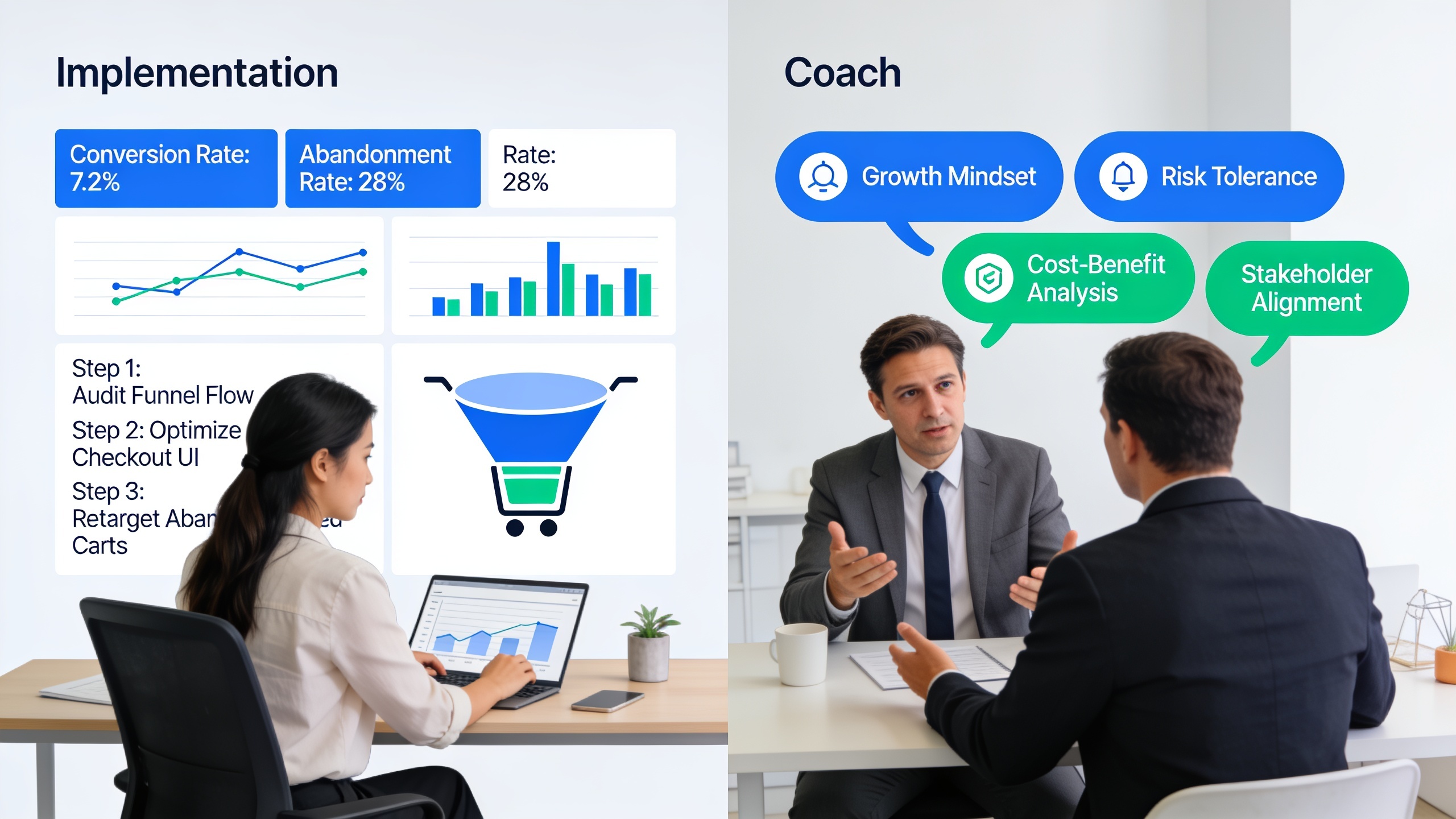
And this difference isn't academic. It changes how they bill you, how the work gets scoped, how you measure whether it worked. Consultants get hired for a defined project with a beginning and an end. Coaches get hired for an ongoing relationship, usually three to twelve months, sometimes way longer, built around recurring sessions instead of deliverables.
Coaching, by the way, is no longer some fringe self-help thing. The International Coaching Federation's 2023 Global Coaching Study pegged the professional coaching industry at an estimated $4.564 billion in annual revenue worldwide. That's a lot of money flowing toward something a lot of people used to dismiss, and it's increasingly tied to hard outcomes like revenue and leadership retention, not just feeling good about yourself on a Tuesday.
What Does a Business Coach Do?
A business coach is a trained pro who works alongside an owner or executive through structured conversations to clarify goals, poke at blind spots, and build accountability, without necessarily knowing anything about your specific industry. The point isn't the coach's answers. It's yours.
What Coaching Actually Looks Like
Most coaching runs on a rhythm. Weekly or biweekly one-on-ones, some goal-setting framework (OKRs, SMART goals, whatever), and homework in between. A coach isn't going to write your business plan or haggle with your vendors. They're going to ask you things like "What's actually stopping you from raising your prices?" or "What would you do here if you weren't scared of losing that client?"
This works best for the stuff that lives in your head. Leadership development, work-life balance, the delegation problem you keep saying you'll fix, the confidence gap nobody talks about. Behavioral and psychological, not technical. And it's why coaching has spread way beyond the classic small-business owner. There are now specialized coaching niches for basically every profession, including public-sector career stuff. State6, for instance, offers AI-powered promotion coaching built specifically for UK police officers prepping for rank assessments. Which tells you something. The coaching method bends to fit almost any career context, not just "business owner."
When a Coach Is Actually the Right Call
Go with a coach when you already know how to run the business but you keep tripping over execution, mindset, communication, or consistency. If you know exactly what needs to happen and you just... keep not doing it, keep dodging the hard conversation, keep burning out, a coach handles the "why can't I make myself do this" problem. Not the "what should I even do" problem. Those are two different problems, and people mix them up constantly.
What Does a Consultant Do?
A consultant is a hired expert brought in to analyze a specific problem and hand you recommendations (or actually do the work), usually within a defined scope and timeline. You're paying for specialized knowledge in finance, operations, marketing, IT, HR, or a particular industry, and they get judged on their deliverables. Full stop.
What Consulting Engagements Usually Look Like
Consulting work is almost always project-shaped. A market entry strategy. A supply chain redesign. A compliance audit. A tech migration. A turnaround plan. IBISWorld's reports on management consulting show the U.S. management consulting industry has ranked among the fastest-growing professional services sectors for the past decade, mostly pushed by companies chasing digital transformation and operational efficiency and needing outside brains to get there.
The real value of a good consultant is that they've solved your exact problem across dozens of other companies, so they show up with frameworks and benchmarks you don't have. And this is where industry specificity gets huge. A generic operations consultant will miss things a niche specialist catches in about four seconds.
Think about a trades business, like a plumbing and heating company. An operator such as Dmplumbingheating, which handles installation, maintenance, and repair across residential and commercial properties in the UK, is going to get far more out of a consultant who actually understands seasonal demand swings, technician scheduling software, and trade licensing than from some generalist strategy consultant who's never set foot on a job site. Same logic for wholesale and distribution. A business like t7b, a general wholesale trading operation, needs someone fluent in inventory turnover ratios, supplier negotiation, and bulk logistics, not a coach who wants to talk about leadership mindset all day.
When a Consultant Is the Right Call
Hire a consultant when you genuinely don't know what the right answer is, when the problem needs technical or regulatory expertise you don't have in-house, or when you need somebody to come in and implement a fix on a deadline. They shine on the one-off, infrequent stuff. An acquisition. A rebrand. A system overhaul. Cracking into a new market. Things you'll do once, maybe twice, and want done right the first time.
What Does a Mentor Do?
A mentor is an experienced person, often a veteran founder or retired exec, who voluntarily shares what they've learned to guide someone earlier in the game, usually without a paycheck or a formal curriculum. It's relational, not transactional. The whole thing runs on trust built over time, not a signed statement of work.
How Mentorship Feels Different
Mentorship doesn't run on a fixed schedule or fee. A mentor might grab coffee with you once a month, might introduce you to an investor, might just be the person you call when a nasty decision lands on your desk. It's loose. Sometimes it comes through an accelerator or an industry group, sometimes it's just someone you know, and it can quietly go on for years.
There's data behind this too. A widely cited analysis from the SBA's SCORE mentoring program found that small businesses getting at least three hours of mentoring reported significantly higher revenue growth than those that got less. Even light-touch, informal guidance moves the needle over time. And honestly, the magic of mentorship is pattern recognition. Someone who's already built and sold a company, survived a recession, or scaled past $10 million in revenue can see the mistake you're about to make before you make it. That's worth a lot.
When a Mentor Is the Right Call
Mentors are perfect for early-stage founders who need perspective and encouragement and a network way more than they need a formal deliverable. They're also great when you're deep in the fog, situations with no clear playbook, where lived experience beats any framework. First-time founders, nonprofit leaders assembling their first board, execs jumping into an unfamiliar industry. All prime mentorship territory.
Business Coach vs. Consultant vs. Mentor: Side-by-Side Comparison
Sometimes it just clicks better when you see it all lined up. Here's how the three stack up on structure, cost, and outcomes.
| Attribute | Business Coach | Consultant | Mentor |
|---|---|---|---|
| Primary focus | Mindset, behavior, accountability | Technical expertise, deliverables | Wisdom, network, lived experience |
| Relationship style | Structured, recurring sessions | Project-based, defined scope | Informal, relationship-driven |
| Typical duration | 3–12 months | Weeks to a few months per project | Months to years, often ongoing |
| Who leads decisions | The client | The consultant, with client sign-off | The mentee, guided by advice |
| Typical cost model | Hourly or monthly retainer | Project fee or day rate | Often free or low-cost/volunteer |
| Best for | Leadership growth, execution gaps | Specific technical problems | Early-stage guidance, perspective |
| Credentialing | ICF or similar certification common | Industry credentials/experience | Rarely formal; based on track record |
Types of Business Advisors: Which One Fits Your Challenge?
Coach, consultant, mentor. Those three cover most of the advisory world, though not all of it. Fractional executives, industry specialists, and peer advisory groups fill out the rest. But matching the type of advisor to the type of problem is genuinely the most important call you'll make in any advisory relationship. Get that wrong and nothing else matters.
Matching the Advisor to the Actual Problem
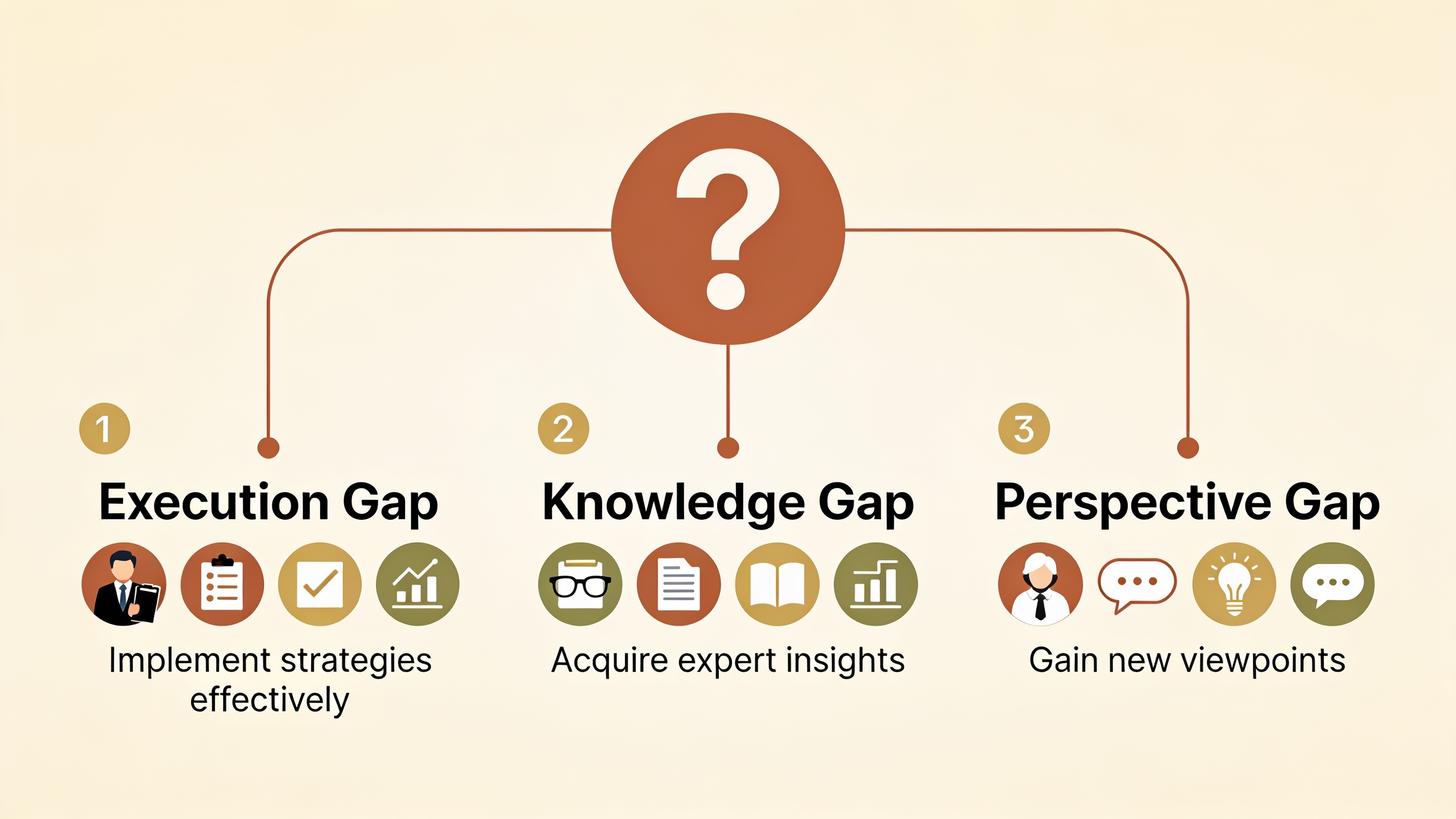
If it's a knowledge gap, you flat out don't know how to do something, like filing a patent, structuring a cap table, or setting up a CRM, a consultant or specialist is your fastest path. If it's behavioral, you know what to do but you're not doing it, or your team's in conflict, or you're fried and can't make decisions, a coach will get you better long-term results. And if it's about perspective and nerve in territory you've never crossed, your first fundraise, your first hire, your first expansion into a new region, a mentor's scar tissue usually beats both of the others.
Nonprofit leaders often end up using all three at once, which is fine. A consultant for grant compliance and financial audits, a coach for board leadership, and a mentor who's already scaled a nonprofit's impact regionally or nationally. Corporate execs chasing operational efficiency do something similar. A consultant to redesign the process, plus a coach to handle the change-leadership and the messy human side of actually rolling it out. In theory you could do it all with one person. In practice, you usually can't.
The Rise of Hybrid and Tech-Enabled Advisory
Technology's quietly reshaping this whole space, changing how all three advisor types find clients and run their engagements. Advisor-matching platforms use algorithms to connect businesses with the right expert faster. And on the flip side, marketing tools are helping independent coaches, consultants, and mentors actually get found in the first place. Platforms like RobinRank, which automate SEO content writing, publishing, and verified backlink exchange, are increasingly picked up by solo consultants and coaching practices trying to build organic visibility without hiring a marketing team. Even the most relationship-driven advisory work is leaning on AI growth tools now. Which, a few years ago, would've sounded weird.
How Much Does a Business Coach, Consultant, or Mentor Cost?
Ballpark: business coaches usually run $150 to $500 an hour, or $1,000 to $5,000 a month for ongoing work. Consultants charge $100 to $500+ an hour, or flat project fees anywhere from $5,000 to well over $100,000 depending on scope. Mentors are mostly free or cheap, usually arranged through networks, accelerators, or nonprofit programs. These are rough ranges, obviously. Real pricing swings a lot with region, specialization, and how strong the advisor's track record is.
Why the Prices Are So Different
Consultants tend to command higher project fees because their work ties straight to measurable outcomes, a finished audit, a new go-to-market strategy, a system that actually got implemented, and their rates reflect expertise that's sometimes genuinely rare. Coaches price around recurring value, the ongoing relationship and the behavioral change, not one big deliverable. Mentors usually don't charge at all, since the whole thing runs on reciprocity, legacy, community, that kind of thing. Though there are now "paid mentorship" programs that honestly blur the line with coaching so much I'm not sure the label means anything anymore.
The Costs Nobody Puts on the Invoice
Look past the sticker price for a second. The sneaky cost is engagement length. A three-month consulting project that ends with a finished operations manual might cost more upfront than six months of coaching. But if the coaching never produces a single implemented change? Then the coaching was actually the more expensive path, because you just burned six months. This is exactly how so many owners end up hiring the wrong person. They pick based on budget or a referral instead of a clear read on what the underlying problem even is.
How to Choose the Right Advisor for Your Business
Name the problem before you name the solution. Ask yourself: do I lack knowledge, lack execution, or lack perspective? Those three answers point you at a consultant, a coach, or a mentor respectively. Skip this step and I promise you the relationship underdelivers. It's the number one reason these things flop.
A Framework You Can Actually Use
Write down the specific outcome you want six months from now. Then ask yourself three questions. One: do I know exactly what needs doing but keep failing to do it consistently? Two: do I not actually know what needs doing, and need someone with real expertise to design the fix? Three: am I facing a decision with no precedent in my own experience, where I'd kill for someone who's already been through it? Answer those honestly and you've got your category.
Then interview two or three people inside that category before you commit. Don't just hire the first name someone gave you. Ask for references tied to a problem like yours, ask them to walk you through their process, and pin down how success gets measured. A consultant should be able to describe past deliverables in hard numbers, percentage lifts, dollar figures, deadlines they hit. A coach should be able to lay out their framework and how they track behavioral change over a set period. If they can't do either, keep looking.
This, by the way, is the exact matching problem advisory platforms are built to solve. Instead of guessing which category, or which specific human, fits your mess, you describe the actual challenge upfront and let a matching service surface advisors who've already cracked that exact problem. It strips out a lot of the trial-and-error that makes hiring an advisor feel like a gamble.
Frequently Asked Questions
Can the same person be both a coach and a consultant?
Yeah, plenty of independent advisors do both, sometimes calling it "consulting coaching" or "advisory coaching," where they give you expert recommendations in some sessions and coaching-style accountability in others. Just get them to tell you upfront which mode you're in for a given session. Mix the two without clear boundaries and accountability gets muddy fast.
Do I need a certified coach, or is that just a nice-to-have?
Certification from a recognized body like the International Coaching Federation is a solid signal of training and ethics, but it's not legally required to practice as a business coach in the U.S. Some of the best coaches out there are uncertified and just spent years running real businesses. So weigh track record and client references at least as heavily as the credential on their website.
Is a consultant more expensive than a coach over the long haul?
Depends on scope, not category. A tight, well-defined consulting project can cost less overall than six or twelve months of coaching retainers. But a big consulting engagement, like an enterprise software rollout, can blow past a full year of coaching. Compare the total projected cost against the actual deliverable or outcome. Not the hourly rate. The hourly rate lies.
Can a mentor eventually turn into a paid advisor or board member?
Absolutely, and it happens a lot. When a mentorship proves its worth over time and the business grows enough to formalize things, it often shifts into equity, an advisory fee, or a board seat. Long-term mentor relationships tend to drift this way naturally as the trust and mutual investment build up.
How do I know if I actually need outside help versus just fixing it internally?
If the problem's stuck around for more than a full planning cycle (a quarter or two, usually) despite your team really trying, or if solving it needs expertise that doesn't exist anywhere in your org, it's time to bring someone in. Persistent problems don't sit still. They compound, whether that's as lost revenue, employee turnover, or a market window closing while you weren't looking.
At the end of it, no advisor type is universally "better." It genuinely comes down to whether your problem is one of knowledge, behavior, or perspective. Figure out which of those three you're actually facing before you start hunting for names and referrals. That single bit of clarity is what separates the advisory relationships that change your business from the ones that just quietly drain your time and your bank account.